|
|
|
|
|
|
|
|
 |
 |
 |
 |
 |
 |
 |
 |
 |
 |
 |
 |
 |
 |
|
Aircraft Index |
Squadron Index |
Aviation Art by Country |
Aviation Signatures Index |
Aviation Artists Index |
Aviation Art Offers |
|
|
Stirling
Manufacturer : Short
The Royal Air Force's first four engined monoplane Bomber, the Short Stirling first flew in May 1939 and entered front line service in August 1940 with no. 7 squadron. Due to its poor operational ceiling the aircraft sustained heavy losses and by mid 1942 the Stirling was beginning to be replaced by the Lancaster. Improved versions of the Short Stirling were built for Glider towing, paratroopers and heavy transport. also from 1943 many of the Stirling's were used for mine laying. A total of 2381 Stirling's were built for the Royal air Force and from this total 641 Stirling bombers were lost to enemy action. Crew 7 or 8: Speed: 260 mph (MK1) 275mph (MKIII) and 280mph (MKV)Service ceiling 17,000 feet Range: 2330 miles. (MK1) 2010 miles (MKIII) and 3,000 miles (MKV) Armament: two .303 Vickers machine guns. in nose turret, two .303 in browning machine guns in dorsal turret , Four .303 Browning machine guns in tail turret. Bomb Load 14,000 Lbs Engines: four 1150 Hp Bristol Hercules II (MK1) four 1650 hp Bristol Hercules XVI (MK111 and MKV) |
Stirling
  Guardian Moon by Ivan Berryman. (PC) |   Tribute to the Crews of the Stirling by Graeme Lothian. (PC) |   Tugs of War (Stirling & Gliders) by Ivan Berryman. (PC) |   MacRobert's Reply by Ivan Berryman. (PC) |
Stirling Artwork Collection |
  Short Stirling MkI R9257 MG - C. by M A Kinnear. |   Tugs of War (Stirling & Gliders) by Ivan Berryman. |   Preparing To Go - Crew of a Short Stirling by Ivan Berryman. |
  Stirlings of No.90 Squadron by Ivan Berryman. |   Stirling Work by Ivan Berryman. |   MacRobert's Reply by Ivan Berryman. |
  Clipped Signature - George Chalmers. |   Clipped Signature - Graham Blacklock. |   Clipped Signature - Peter Boggis. |
  Clipped Signature - Geoffrey Tyson. |   McRobert's Reply by Geoff Lea. |   Tribute to the Crews of the Stirling by Graeme Lothian. |
  The Night Shift by Philip West. |   Teamwork by Philip West. |   Sterling Service by Philip West. |
  Stirling - The Heavy Brigade by Keith Woodcock. |   Stirlings Outward Bound by Robert Taylor. |   Stirlings Outward Bound by Robert Taylor. |
  Guardian Moon by Ivan Berryman. |   Outbound from Mildenhall by Ivan Berryman. |   The Long Way Home by Ivan Berryman. (PC) |
  Close Encounter by Iain Wyllie. |   Stirling Mine Laying by Keith Aspinall. |  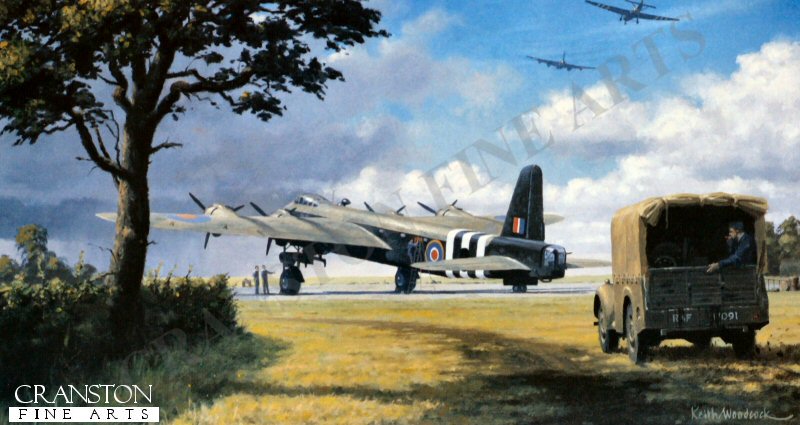 Stirlings by Keith Woodcock. |
  Stirlings Ready by Keith Woodcock. |   Stirling - 1940s by Barry Price. |
| Squadrons for : Stirling | ||
| A list of all squadrons from known to have used this aircraft. A profile page is available by clicking the squadron name. | ||
| Squadron | Info | |
Country : UK Founded : 12th July 1917 Mens agitat molem - Mind over matter | No.101 Sqn RAF No 101 Squadron was formed on 12th July 1917 and based at South Farnborough. The squadron was commanded by Major The Hon L J E Twisleton-Wykeham-Fiennes, and by the end of July the squadron was sent to France where 101 Squadron was to become the second specialist night-bomber unit in the Royal Flying Corps. 101 Squadron was equipped with the FE2b two-seat pusher bi-plane and on the 20th September 1917 began flying night bombing missions during the Battle of Menin Ridge. 101 1quadron continued night bombing missions during the 3rd Battle of Ypres and the Battle of Cambrai. 101 squadron attacked several German long-range night bomber airfields during February 1918 and these missions were among the first offensive counter air operations and up until the end of the war continued bombing missions. After the First World War 101 squadron were based in Belgium until March 1919 when returning to Britian and disbanded on the 31st December. No.101 squadron reformed on the 21st March 1928 at RAF Bircham Newton and in March 1929 the squadron was issued with the new bomber the Boulton and Paul Sidestrand. The squadron moved to RAF Andover iIn October 1929 where it remained until December 1934 when 101 squadron moved to RAF Bicester and issued with the the improved Boulton Paul Overstrand, which featured the first powered gun turret in RAF aircraft as well as othe rmodifications including more powerful engines. The Boulton Paul Overstrand is displayed on 101 Squadron's official badge. In June 1938 No 101 Squadron re-equipped with Bristol Blenheim and was stationed now at RAF West Raynham in May 1939, as part of No 2 Group, Bomber Command. When World War Two broke out 101 Squadron were stationed at RAF Brize Norton, but returned to West Raynham. It was not until the fall of France when the squadron became operational but suffered a set back when its officer commanding, Wg Cdr J H Hargroves, and his crew were lost on its first bombing mission on 5th July 1940. During the Battle of Britain 101 Squadron Blenhiems carried out bombing missions against the German barges in French ports as well as German airfields in France. Another OC 101 Squadron, Wg Cdr D Addenbrooke, was lost on the 3rd April while taking part in a raid on French ports just 3 days after taking command. 101 Squadron were re-equipped with the Vickers Wellington in April 1940 and were based at RAF Oakington and became part of No 3 Group bomber command. On the 24th July 101 Squadron lost its first Wellington on a raid against Brest. Ten Wellingtons of 101 Squadron took part in the first 1,000 bomber raid on Cologne, but losses began to mount and between July and September the Squadron lost 20 Wellingtons with 86 aircrew killed. In September 101 Squadron moved to RAF Holme-on-Spalding-Moor in Septmber 1942 and became the first operational Avro Lancaster squadron in No 1 Group.Bomber Command. 101 squadron moved to its final wartime base, RAF Ludford Magna on 15th June 1943. 101 Squadrons Lancasters took part in the raids on Hamburg and the raid on the secret German rocket site at Peenemunde. Over the winter of 1943-1944 No.101 squadron took part in the raid on Berlin but suffered high casualties. On the 31st March 1944, during the Nuremberg Raid, 101 Squadron lost 7 Lancasters and crews out of 26 dispatched. In the spring and summer of 1944 101 squadron attacked targets in France in preparation for and support of the allied invasion of Normandy. On D-Day, the squadron used ABC to jam nightfighter controllers to protect the British airborne landings. After D-Day 101 squadron continued raids on German cities with their last bombing mission on Berchtesgarden on 25th April 1945. 101 bomber squadron suffered the highest casualties of any Royal Air Force Squadron during the Second World War, losing 1176 aircrew killed in action. In October 1945, the Squadron moved to RAF Binbrook and later equipped with Avro Lincolns. In May 1952 101 squadorn became the first bomber squadron to receive the first Jet Bomber the English Electric Canberra B2 and in 1954 were stationed in Malaya carrying out bombing misisons against terrorist targets. In October 1956 during the Suez crisis to Malta for Operation MUSKETEER bombing raids against Egypt befroe being disbanded in February 1957 but in 1959 101 squadron was reformed and re equipped with the new Avro Vulcan B1 and the first squadorn to be armed with the British H Bomb, In 1961 101 squadron moved to RAF Waddington. In 1968 the squadron was equipped with the new Vulcan B2 . In 1982,101 Squadron Vulcans took part in Operation CORPORATE, during the Falklands War. A 101 Squadron crew carried out the first and last Operation BLACKBUCK Vulcan conventional bombing raids on Argentinean forces occupying Port Stanley in the Falkland Islands. These 8,000 mile round trip missions required extensive use of Air to Air refuelling. After the Falklands war 101 squadron was equipped with VC10s and supplied fighter aircraft with air to air refuelling during all major conflicts form Bosnia, to Operation Desert Storm and continues today in this role. | |
Country : UK Founded : 20th September 1918 Fate : Disbanded 1st April 1962. For Freedom | No.138 Sqn RAF Full profile not yet available. | |
Country : UK Founded : 1st March 1918 Fate : Disbanded 31st August 1956 East India Fortis nocte - Strong by night | No.149 Sqn RAF Full profile not yet available. | |
Country : UK Founded : 1st March 1915 Aim sure | No.15 Sqn RAF On 1st March 1915, the officers and men who made up No.1 Reserve Squadron and the Recruits Depot, all of whom were based at South Farnborough, Hampshire, were brought together to form No.15 Squadron, Royal Flying Corps. Initially, the new squadron was equipped with a diverse range of flying machines, including Henri and Maurice Farmans, Avros, Bleriots, Moranes and BE2c aircraft. Having relocated to an airfield at Hounslow, west of London, where the squadron was allowed time to work up to operational status, it was, on 11th May, relocated to another airfield at Swingate Down, to the east of Dover, on the Kent coast. On 23rd December 1915, No.15 Squadron, RFC, deployed to France for operational duties. Throughout its time on the Western Front, during the First World War, the squadron was engaged in observation and reconnaissance duties, initially using BE2c aircraft but later, during June 1916, upgrading to R.E.8s. The work undertaken by the squadron, in its reconnaissance role, was recognised by higher authority, on a number of occasions, in the form of telegrams or communiqués. On 1st April 1918, No.15 Squadron became part of the newly formed Royal Air Force, which came into being with the amalgamation of the Royal Flying Corps and Royal Naval Air Service. With the end of hostilities in November 1918, came a reduction in the fighting strength of the RAF and, although not disbanded as a number of squadrons were, No.15 was reduced to a cadre. The axe finally fell on the final day of December 1919, when No.15 Squadron was disbanded. It was to be approximately five years before No.15s number plate was to be resurrected when, on 20th March 1924, No.15 Squadron was reformed as part of the Aeroplane and Armament Experimental Establishment (A&AEE), at Martlesham Heath, Suffolk. Over a period of ten years, No.15 Squadron completed 12,100 flying hours on over seventy-five different types of airframe. Over that same period, it also saw five changes of commanding officer. On 1st June 1934, No.15 was re-designated as a new unit, equipped with Hawker Hart Mk.I aircraft, undertaking daylight operations flying as part of Bomber Command. The new C.O. was Squadron Leader Thomas Elmhirst, who secured permission for his squadron to change the number plate to Roman numerals and have the XV applied to the fuselage on all the squadrons aircraft. This decision was to have a lasting effect and was only interrupted by the Second World War. Thomas Elmhirst also gave thought to the fact the squadron should have its own badge and motto, both of which were approved, during 1935. In early 1936, the squadron re-equipped with Hawker Hind bomber aircraft. These machines remained in service with No.XV until 13th July 1938, when the unit converted to Fairey Battle bomber aircraft. It was with the latter aircraft that the squadron prepared for war when, on 27th August 1939, a state of emergency was declared. History repeated itself when the Squadron returned to France on a war footing, but it was forced to return to England in order to re-equip with the Bristol Blenheim bomber. The new aircraft was initially seen as a wonder aircraft, but No.XV Squadron was virtually decimated in strength following the German invasion of the Netherlands in May 1940. With the Blenheim being designated unsuitable for the task, the squadron began converting to the Vickers Wellington bomber, designed by Barnes Wallace, on 7th November 1940. This was really a stop-gap measure as on 30th April 1941 No.XV began converting to the Short Stirling, four-engine, heavy bomber. During the next couple of years, night after night, the squadron carried the fight back to the enemy, enduring many losses and exploits of valour in the process. It participated in all the 1,000 bomber raids against Germany. As 1943 drew to a close, No.XV prepared to continue the fight with new equipment. Having converted to the Avro Lancaster bomber in late December 1943, the squadron went operational in mid-January 1944 with its new aircraft. By the time the war came to an end, No.XV was flying Lancaster B.1 Specials, which were specially adapted to carry 22,000lb Grand Slam bombs. February 1947 saw another change of equipment when the squadron converted to the Avro Lincoln bomber, whilst based at RAF Wyton in Huntingdonshire. However, by the end of that same year, No.XV found itself deploying aircraft to Shallufa, Egypt, as part of Operation Sunrise. Another change of occurred at the end of November 1950, when No.XV Squadron was disbanded but immediately reformed with Boeing B29 Washington bomber aircraft. It was during the Washington period, in March 1951, that the squadrons code letters ‘LS’, which it had been adopted during late 1939, were removed from the aircraft fuselages. The new scheme called for a natural metal finish, adorned with only the RAF roundel, fin flash and aircraft serial. With technology advancing all the time, No.XV entered a new phase in its history in June 1953, when it was declared fully operational flying English Electric Canberra bombers. During the next couple of years, the squadron continued to train and undertook many navigational and bombing exercises, which proved fruitful in 1956 when the Suez crises erupted. No.XV was deployed to Nicosia, as part of Operation Accumulate, on 23rd October. During the short period of fighting that followed, No.XV dropped a higher concentration of bombs than any other squadron. Following a cease-fire, the squadron returned to England where, on 15th April 1957, it was disbanded. The 1st of September 1958 saw the re-formation of No.XV as a V-Bomber squadron, equipped with Handley Page Victor B.I bombers. These aircraft were not only adorned with the official RAF insignia described above, but were also permitted to carry the squadron badge, together with the Roman XV numerals. The squadron retained these aircraft until 1964 when it was again disbanded. For a period of five years No.XV Squadron ceased to exist. However, this changed on 1st October 1970, when the squadron number plate and badge were resurrected and No.XV was reformed at RAF Honnington, in Suffolk. Equipped with Blackburn S.2B Buccaneer aircraft, the squadron departed for RAF Laarbruch, where, during January 1971, it officially became part of Royal Air Force Germany. After thirteen years service with the squadron, the Buccaneers were replaced with Panavia Tornado, swing-wing, bombers. On 1st September 1983, No.XV became the first RAF Squadron in Germany to be equipped with this type of aircraft. During the latter quarter of 1990, No.XV had deployed two flights, totalling twelve crews, to Muharraq Air Base, on Bahrain Island, in readiness for operations against the Iraqi dictator Saddam Hussein. During the following conflict, two aircraft crewed by XV Squadron personnel were shot down, resulting in the loss of Flt Lt Stephen Hicks and the capture of Flt Lts John Peters, John Nichol and Rupert Clark. The squadron returned to RAF Laarbruch at the end of March 1991, where a number of awards, for service in the Gulf War were announced. Wing Commander John Broardbent was awarded a Distinguished Service Order, whilst Sqn Ldr Gordon Buckley and Sqn Ldr Nigel Risdale were both awarded Distinguished Flying Crosses. Senior Engineering Officer S/L Rob Torrence was awarded the Member of the British Empire. Following disbandment in January 1992, No.XV was reformed a few months later on 1st April, at RAF Honnington, where it took on the role of the Tornado Weapons Conversion Unit. It was also granted the status of a Reserve Squadron. No.XV (R) Squadron remained at Honnington until 1st November 1993, when it re-located to RAF Lossiemouth, Moray, Scotland. During January 1998, it was re-designated as the Tornado GR1 Operational Conversion Unit and equipped with the up-graded Tornado GR4 variant. In 2011, just four years away from its 100th anniversary, No.XV (R) Squadron still operates from RAF Lossiemouth, providing refresher crews and new crews to the front line squadrons. Text by kind permission of Martyn Ford Jones | |
Country : UK Founded : 4th September 1918 Fate : Disbanded 31st December 1945 Strength in unity | No.158 Sqn RAF Full profile not yet available. | |
Country : UK Founded : 15th June 1942 Fate : Disbanded 27th July 1945 Per dolum defendimus - Confound the enemy | No.171 Sqn RAF Full profile not yet available. | |
Country : UK Founded : 24th October 1917 Fate : Disbanded 21st January 1946 Ex tenebris - Through darkness | No.190 Sqn RAF Full profile not yet available. | |
Country : UK Founded : 7th November 1942 Fate : Disbanded 16th March 1946 Sie fidem servamus - Thus we keep the faith | No.196 Sqn RAF Full profile not yet available. | |
Country : UK Founded : 1st June 1917 Fate : Disbanded 15th December 1958 Let tyrants tremble | No.199 Sqn RAF Based at Lakenheath, August 1943. | |
Country : UK Founded : 1st April 1918 Fate : Disbanded 28th January 1977 Federated Malay States Ulter in umbris - Avenging in the shadows | No.214 Sqn RAF Full profile not yet available. | |
Country : UK Founded : 24th April 1918 Fate : Disbanded 23rd August 1963 Gold Coast In time | No.218 Sqn RAF Full profile not yet available. | |
Country : UK Founded : 3rd August 1942 Fate : Disbanded 31st October 1948 In caelo auxilium - Aid from the skies,/i> | No.295 Sqn RAF Full profile not yet available. | |
Country : UK Founded : 4th November 1943 Fate : Disbanded 15th February 1946 Click the name above to see prints featuring aircraft of No.299 Sqn RAF | No.299 Sqn RAF Full profile not yet available. | |
Country : UK Founded : 19th April 1916 Fate : Disbanded 31st August 1975. Uganda We rise to conquer | No.46 Sqn RAF No. 46 Squadron was formed on the 19th April 1916 and based at RAF Wyton base. In October 1916, 46 Squadron moved to France and was equipped with the two seater Nieuport. 46 Squadrons role was artillery spotting and reconnaissance until May 1917 when 46 squadron were re equipped with the fighter the Sopwith Pup. 46 Squadron operated as part of the 11th Army Wing, and saw many engagements with the enemy. Returning to England and based at Sutton's Farm, Essex, the squadron took part in the defence of London, in July 1917. London had been bombed several times by German Gotha Bombers but after 46 Squadrons patrols no enemy aircraft managed to bomb London in their area. Later 46 squadorn returned to France at the end of August 1917 and in November the squadorn was re equipped with the Sopwith Camel and participated in the Battle of Cambrai protecting the ground troops. In November 1917, Lieutenant (later Major) Donald Maclaren joined 46 Squadron. His first dogfight was not until February 1918, but in the last 9 months of the war Donald Maclaren was credited with shooting down 48 aeroplanes and six balloons, making him one of the top aces of World War I. By November 1918, 46 Squadron had claimed 184 air victories, creating 16 aces. After the First World War had ended the squadorn returned to England and was disbanded on the 31st of December 1919. The outbreak of war found 46 Squadron at RAF Digby, equipped with Hawker Hurricanes. Action with the enemy came quickly when, at the end of October 1939, Squadron Leader Barwell and Pilot Officer Plummer attacked a formation of 12 Heinkel 115s, destroying one each, and scattering the remainder. The next six months were uneventful, consisting in the main of providing air cover for the shipping convoys steaming along the East Coast - a few enemy aircraft were sighted but no contacts were made. In May 1940, the squadron was selected to form part of the Expeditionary Force in Norway, which had been invaded by the Germans on 9th April. The Hurricanes were embarked on HMS Glorious and, despite doubts that a Hurricane could take off from a carrier flight deck in a flat calm, they all took to the air without difficulty, thanks to the efforts of the ship's engineers, who managed to get the Glorious up to a speed of 30 knots. No.46 Squadron assembled at Bardufoss and began operation on 26 May. Patrols were maintained over the land and naval forces at Narvik without respite, some of the pilots going without sleep for more than 48 hours. Conditions on the ground were very basic with poor runways and primitive servicing and repair facilities. Many air combats took place, and in its brief campaign in Norway the squadron accounted for at least 14 enemy aircraft, besides probably destroying many others. On 7th June the squadron was ordered to evacuate Norway immediately and, on the night of 7th through 8th June, the Hurricanes were successfully flown back to Glorious — a dangerous procedure as none of the aircraft were fitted with deck arrester hooks. The ground parties embarked on HMS Vindictive and SS Monarch of Bermuda and reached the UK safely, but the squadron's aircraft and eight of its pilots were lost when Glorious was sunk by German warships on 9th June 1940. The two pilots who survived were the Squadron Commander, Squadron Leader (later Air Chief Marshal) Bing Cross, and the Flight Commander, Flight Lieutenant (later Air Commodore) Jamie Jameson. | |
Country : UK Founded : 15th May 1916 Swift and sure | No.51 Sqn RAF Full profile not yet available. | |
Country : UK Founded : 15th September 1943 Fate : Disbanded 21st November 1943 Click the name above to see prints featuring aircraft of No.513 Sqn RAF | No.513 Sqn RAF Full profile not yet available. | |
Country : UK Founded : 15th November 1943 Fate : Disbanded 28th December 1945 Impetum deducimus - We launch the spearhead | No.570 Sqn RAF Full profile not yet available. | |
Country : UK Founded : 17th June 1943 Fate : Disbanded 1st September 1946 Transport Command Dona ferentes adsumas - We are bringing gifts | No.620 Sqn RAF Full profile not yet available. | |
Country : UK Founded : 10th August 1943 Fate : Disbanded 30th September 1953 Bellamus nocta - We make war by night | No.622 Sqn RAF Full profile not yet available. | |
Country : UK Founded : 10th August 1943 Fate : Disbanded 6th December 1943 Click the name above to see prints featuring aircraft of No.623 Sqn RAF | No.623 Sqn RAF Full profile not yet available. | |
Country : UK Founded : 1st May 1914 Per diem per noctem - By day and by night | No.7 Sqn RAF No.7 Squadron was formed 1st May 1914 at Farnborough as a Scout squadron, and went to France April 1915, equipped with the Vickers Gunbus. No.7 squadron saw service through the war with BE2c, RE5 and RE8 aircraft. The squadron pioneered the use of R/T (instead of normal W/T), using it operationally for the first time in October 1918. Disbanded at Farnborough on 31st December 1919 it reformed at Bircham Newton on 1st June 1923 equipped with Vickers Vimy bombers. These were replaced by the Vickers Virginia after moving to Worthy Down in April 1927. Between the wars No.7 squadron was equipped with various aircraft including the Handley Page Heyfords, Vickers Wellesleys and Armstrong Whitworth Whitleys and became the leading bomber squadron, winning the Laurence Minot Memorial Bombing Trophy more than any other squadron. At the outbreak of World War II, the squadron was equipped with Handley Page Hampdens, until August 1940, when it equipped with the RAF's first four engined bomber, the Short Stirling Mk I - becoming the first RAF squadron to be equipped with four engined bombers. The first raid by No.7 was 10th February 1941 on Rotterdam. The squadron settled down to a night bombing role, adding mine laying to its duties in 1942. Later with four other squadrons, it formed the nucleus of the new Pathfinder Force, its task to find and accurately mark targets with flares. In May 1943, the Stirling (which was handicapped by a low operational ceiling - it had to fly through flak rather than over it) was gradually replaced by the Avro Lancaster, which No.7 used in Peenemunde in August. From June1944 and until the end of the war, the squadron also undertook a daylight operational role in support of land forces in France and the low countries, and against V-1 and V-2 sites. No.7 squadron flew to Singapore in January 1947, and converted to Avro Lincolns, seeing action against Communist terrorists in Malay, during 'Operation Firedog'. Returning to UK, having won the Laurence Minot Memorial Bombing Trophy outright for the eighth time it was disbanded 1st January 1956. Reforming in November of the same year with the Vickers Valiant 'V' bomber. Disbanded on 30th September 1962, it was reformed in May 1970 at RAF St. Mawgan on target provision duties. Equipped with the English Electric Canberra, the squadron provided targets for the Army and Navy anti aircraft guns. They also provided silent targets for radar station practice. On 12th December 1981 the squadron was again disbanded, reforming soon after as the second operational Boeing Vertol Chinook helicopter Squadron on 2nd September 1982. | |
Country : UK Founded : 1st October 1916 Fate : Disbanded 15th October 1945 New Zealand Ake ake kia kaha - For ever and ever be strong | No.75 Sqn RAF Full profile not yet available. | |
Country : UK Founded : 8th October 1917 Fate : Disbanded 1st March 1965 Celer - Swift | No.90 Sqn RAF Full profile not yet available. | |
| |||||||||||||||||||||||||||||||||||||||||||||||||||||||||||||||||||||||||
About our Signatures on Artwork
|
Contact Details |
|
Sign Up To Our Newsletter!
This website is owned by Cranston Fine Arts. Torwood House, Torwoodhill Road, Rhu, Helensburgh, Scotland, G848LE Contact: Tel: (+44) (0) 1436 820269. Email: cranstonorders -at- outlook.com |
 |


