|
|
|
|
|
|
|
|
 |
 |
 |
 |
 |
 |
 |
 |
 |
 |
 |
 |
 |
 |
|
|
Jason Askew
Jason Askew was born in south africa, went to the Johannesburg school of art ballet,and music, and attended the City and Guilds of London Art College, Kennington. His interest in military history started as a teenager in the history of South Africa, The Zulu and South African wars, where he got his inspiration for his first major epic series of the Zulu war. Everyone doing national service had a choice of going to the army or the police. He was in the police - the police and army training being very similar. In South Africa, the police service was, and is still bearing the brunt of the civil unrest, and the crime wave (average of 19000 murders per year for the last ten years) It is through the experience of the police, and what he had to confront, that motivated him to paint these experiences, and it was very good for somoene with an interest in military history to see the effects of fighting first hand, particularly in the brutal, sometimes hand to hand killing that is the norm in South African situations. He was based at Hillbrow (the bronx of Joburg) and also served with the SAPS flyng squad. All the experiences that he had in the SAPS directly inform the paintings that Jason Askew does. : I never lose sight of the fact that real people are often caught in the middle of conflicts that are created by politicians/governments/reasons beyond the control of individuals, yet it is always individuals that suffer. Jason Askew is often commisisoned by many British and overseas regiments. 2RGR the gurkhas,The Queens Lancashire Regiment, the Coldstream Guards,the Staffordshire Regiment to name a few. He was also an official war artist for the Staffordshire Regiment in Iraq. Cranston Fine Arts are proud to be publishing a majority of art prints by Jason Askew since 2005 and are planning a major series of releases which they have commissioned over the next few months, including an outstanding series of eight First World war battlescenes of many of the major western front battles. This series started in 2007 and will be completed by the end of 2008. Also included is a series of four Battle of Waterloo and four Zulu War limited editions, all specially priced for collectors. |
| Navigation | |
| Page 1 of 6 | Page 1 .. Next |
| Jason Askew Art Prints, Paintings and Drawings |
|
|
|
|
|
|
|
|
|
|
|
|
|
|
|
|
|
|
|
| Navigation | |
| Page 1 of 6 | Page 1 .. Next |
| Text for the above items : |
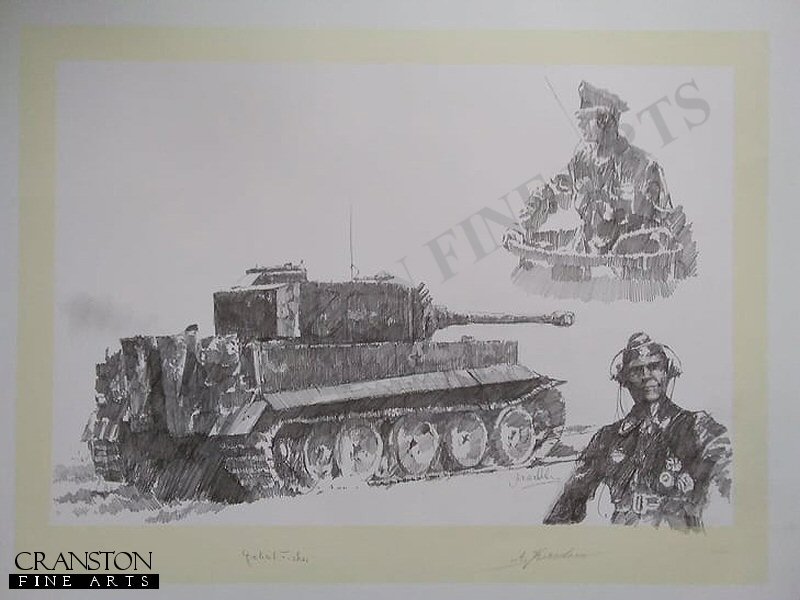
Eastern Front Tiger by Jason Askew. (P) The Tiger tank was one of the most fearsome tanks in the German WW2 armoury. With firepower that could destroy most enemies at long range and armour that could withstand all but the closest of attacks, the Tiger is rightfully regarded as one of the most effective fighting machines of the war. Please note this drawing has a small crease in the lower left border which goes into the image about 2cm. See the photo provided. |
The Defence of Rorke's Drift by Jason Askew. The Battle at Rorke's Drift, also known as the Defence of Rorke's Drift, was an action in the Anglo-Zulu War. The defence of the mission station of Rorke's Drift, under the command of Lieutenant John Chard of the Royal Engineers, immediately followed the British Army's defeat at the Battle of Isandlwana on 22nd January 1879, and continued into the following day, 23rd January. 150 British and colonial troops successfully defended the garrison against an intense assault by approximately 2000 Zulu warriors. The intense and noisy Zulu attacks on Rorke's Drift came very close to defeating the tiny garrison, but were ultimately repelled by blasts of Martini-Henry rifle fire-and some smart bayonet work-with some guts behind the bayonet thrusts! Eleven Victoria Crosses were awarded to the defenders, along with a number of other decorations and honours. Of particular note in the painting is the dog 'Pip' - he survived Isandlwhana by retreating along the fugitive's trail to Rorke's Drift. During the Zulu attacks on Rorke's drift, Pip did his part in the defence - by jumping on the mealie bag parapets and barking at Zulus- who were hiding in the long grass and sneaking up to the defences, then biting any Zulu who came within range. Unfortunately Pip was not officially recognised for his part in the action. He was not awarded a VC, on the basis that he was a volunteer canine that accompanied an officer, rather than a War Office issued canine. Conversely, if Pip had been killed, then he would not have been officially listed as a casualty, as he accompanied the army in a strictly private capacity. British army horses were in a different category as they were War Office issue, therefore the loss of a horse in action, or to disease, carried a financial liability for the War Office. |
Stug and Half-Track by Jason Askew. (P) Stug Mk.III |
Ju87 Stukas by Jason Askew. (P) A formation of Stukas featured alongside a portrait of this aircraft's most prolific pilot, Hans-Ulrich Rudel. |
Tiger on the Russian Front by Jason Askew. (P) No text for this item |
Desert Defence by Jason Askew. (P) Infantry of the British 8th Army fend off marauding Me109s with a Bren gun in the Western Desert in 1942. |
Swordfish Strike on U-451 by Jason Askew. (P) U-451 was sunk on 21st December 1941 near Tangiers, in position 35.55N, 06.08W, by depth charges from a British Swordfish aircraft (Sqdn. 812/A). There was just one survivor from the crew of 45. |
The Battle of the Somme - At the German Trenches by Jason Askew. Very few of the British soldiers made it through the barbed wire defences, and even fewer to the German trenches. By the end of the first day the British losses were 60,000 men. |
Fw190 by Jason Askew. (P) No text for this item |
German Assault on the Nimy Bridge, Mons, 23rd August 1914 by Jason Askew. German forces begin their assault on the Nimy Bridge, 23rd August 1914. The bridge was defended by the 4th Battalion The Royal Fusiliers. |
Bismarck by Jason Askew. (P) No text for this item |
Tank vs Tank Combat on the Russian Front by Jason Askew. (P) A German Panther tank in combat with a Russian T-34 tank. |
The Battle of Aliwal by Jason Askew. The Battle of Aliwal was fought on 28th January 1846 between the British and the Sikhs. The British were led by Sir Harry Smith, while the Sikhs were led by Ranjodh Singh Majithia. The British won a victory which is sometimes regarded as the turning point of the First Anglo-Sikh War. The Sikhs had occupied a position 4 miles (6.4 km) long, which ran along a ridge between the villages of Aliwal, on the Sutlej, and Bhundri. The Sutlej ran close to their rear for the entire length of their line, making it difficult for them to manoeuvre and also potentially disastrous if they were forced to retreat. After the initial artillery salvoes, Smith determined that Aliwal was the Sikh weak point. He sent two of his four infantry brigades to capture the village, from where they could enfilade the Sikh centre. They seized the village, and began pressing forwards to threaten the fords across the Sutlej. As the Sikhs tried to swing back their left, pivoting on Bhundri, some of their cavalry tried to threaten the open British left flank. A British and Indian cavalry brigade, led by the 16th Lancers, charged and dispersed them. The 16th Lancers then attacked a large body of Sikh infantry. These were battalions organised and trained in contemporary European fashion by Neapolitan mercenary, Paolo Di Avitabile. They formed square to receive cavalry, as most European armies did. Nevertheless, the 16th Lancers broke them, with heavy casualties. The infantry in the Sikh centre tried to defend a nullah (dry stream bed), but were enfiladed and forced into the open by a Bengal infantry regiment, and then cut down by fire from Smith's batteries of Bengal Horse Artillery. Unlike most of the battles of both Anglo-Sikh Wars, when the Sikhs at Aliwal began to retreat, the retreat quickly turned into a disorderly rout across the fords. Most of the Sikh guns were abandoned, either on the river bank or in the fords, along with all baggage, tents and supplies. They lost 2,000 men and 67 guns. Comment from the artist, Jason Askew. This painting shows the extremely violent and brutal clash between British cavalry (16th Lancers) and Sikh infantry at the battle of Aliwal. The Sikh infantry formed 2 triangles, a version of the famous Allied/British squares used at Waterloo, but the Sikhs, after firing a ragged volley at the attacking horsemen, dropped their muskets and assaulted the cavalry with their traditional Tulwars (sabres) and dhal shields. These shields are also used offensively, to punch, and to slice with the edge. Although the British horsemen claimed a victory as they felt they successfully dispersed the Sikh triangles, and forced the Sikh infantry to retreat to the nullah (dry stream bed) in the Sikh rear, this opinion is open to debate. The Sikhs traditionally fought in loose formations, with tulwar and shield-taking full advantage of their abilities as swordsmen, blades being weapons with which the Sikhs are particularly skilled in the use of. The Sikhs actually inflicted more casualties on the 16th Lancers than the lancers inflicted on the Sikh infantry. British eye witnesses spoke of the sight of the grotesquely swollen and distorted dead bodies of men and horses of the Her Majesty's 16th Lancers, stinking in the sun and littering the ground at Aliwal - testimony to the progress of their charge. The regiment lost 27% of effectives out of a total strength of over 400 effectives. The lancers were dreadfully hacked about, many being cruelly maimed for life, losing hands and limbs to the slashing strokes of the Sikh blades. The Sikhs had no compassion for the cavalry horses either - many of the poor animals (over 100 by some accounts) had to be shot, due to having their legs hacked clean off, or being literally disemboweled by Sikh Tulwars. In the painting, the central figure with the wizard-shaped Turban, is in fact an Akali - a sect of extremely religious Sikhs, who disdained the use of armour, and often fought to the death with a fanatical and suicidal devotion. |
Isandlwana 22nd January 1879 - The Death of Private W Griffiths VC by Jason Askew SOLD OUT. |
Well Earned Rest by Jason Askew. After taking the town of Sainte-Marie-du-Mont, US infantry take time out for coffee and cigarettes while keeping a look out from the rooftop of the building they have captured. |
The Battle of Isandlwana by Jason Askew. The Battle of Isandlwana on 22 January 1879 was the first major encounter in the Anglo-Zulu War between the British Empire and the Zulu Kingdom. Eleven days after the British commenced their invasion of Zululand in South Africa, a Zulu force of some 10,000-12,000 warriors attacked a portion of the British main column consisting of about 1,800 British, colonial and native troops and perhaps 400 civilians. The Zulus were equipped mainly with the traditional Assegai iron spears and cow-hide shields, but also had a number of muskets and old rifles though they were not formally trained in their use. The British and colonial troops were armed with the state-of-the-art Martini-Henry breech-loading rifle and two 7 pounder artillery pieces as well as a rocket battery. Despite a vast disadvantage in weapons technology, the numerically superior Zulus ultimately overwhelmed the poorly led and badly deployed British, killing over 1,300 troops, including all those out on the forward firing line. The Zulu army suffered around 350 killed, and up to several hundred wounded. The battle was a crushing victory for the Zulus and caused the abandonment of the first British invasion of Zululand. |
The Fight for Sainte-Marie-du-Mont by Jason Askew. No text for this item |
Private Samuel Wassall of the 80th Regiment of Foot (Staffordshire Volunteers) at Fugitives Drift by Jason Askew. Private Wassall, whilst escaping the debacle of Isandhlwana, was being pursued by Zulu warriors as he made his way down the Buffalo River, the border between Zululand and Natal. Wassall rode his Basuto pony into the river, but upon hearing a cry for help and seeing a man from his own regiment drowning, he turned and made his way back to the Zulu side of the river, Quickly dismounting he tied his horse to a tress, swam into the river and rescued a private called Westwood as the Zulus were sweeping along the riverbank just at the moment the Zulus rushed forward. For his act of valour in the face of the enemy Private Samuel Wassall was awarded the first of the Zulu War Victoria Crosses. |
| Navigation | |
| Page 1 of 6 | Page 1 .. Next |
|
Contact Details |
|
Sign Up To Our Newsletter!
This website is owned by Cranston Fine Arts. Torwood House, Torwoodhill Road, Rhu, Helensburgh, Scotland, G848LE Contact: Tel: (+44) (0) 1436 820269. Email: cranstonorders -at- outlook.com |
 |