Military-Art.com Home Page
Order Enquiries (UK) : 01436 820269

You currently have no items in your basket


Buy with confidence and security!
Publishing military art since 1985

Don't Miss Any Special Deals - Sign Up To Our Newsletter!
MILITARY
ART
AVIATION
ART
NAVAL
ART

Product Search         

FEATURED CURRENT OFFER - £16 LARGE SIZE CLASSIC MILITARY ART PRINTS.

ALWAYS GREAT OFFERS :
20% FURTHER PRICE REDUCTIONS ON HUNDREDS OF LIMITED EDITION ART PRINTS
BUY ONE GET ONE HALF PRICE ON THOUSANDS OF PAINTINGS AND PRINTS
FOR MORE OFFERS SIGN UP TO OUR FREE NEWSLETTER

Raising Havoc by Stan Stokes. - Military Art
THIS ITEM IS INCLUDED IN OUR BUY ONE GET ONE HALF PRICE OFFER !
Choose any two prints in this special offer and the lower priced item is half price. (Any free bonus prints already supplied with an item are separate and will also be included !)
Hundreds of items across our websites are included in this offer!

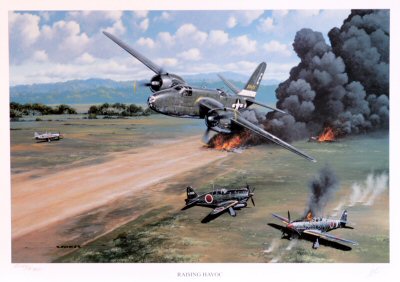
Raising Havoc by Stan Stokes.


Please note that our logo is used on our website images only and does not appear on our products.


Raising Havoc by Stan Stokes.

In 1936, under the supervision of Jack Northrop and Ed Heinemann, Douglas Aircraft began work on a new twin-engine light attack/observation aircraft designated the Model 7A. Powered by two R985 Wasp radials mounted in wing nacelles, the A-20 also utilized a tricycle landing gear configuration. The aircrafts fuselage was quite narrow and there was room for only 1 pilot and 1 crewmember. As the project proceeded it became clear that the 7A was not going to meet the Armys objectives. In early 1938, Northrop left Douglas to form his own company, and Heinemann began work on upgrading their design. One interesting feature was the use of interchangeable nose sections. A clear nose could be fitted with a bombardiers compartment, or alternatively a solid nose section could be fitted with an impressive total of 8 machine guns. More powerful Pratt and Whitney radials were incorporated into the design. Now designated the DB-7 by Douglas, a prototype aircraft was completed by October 1938. The new aircraft proved very fast, highly maneuverable, and capable of carrying a 2000 pound bomb load. While impressed with the aircrafts specs, the Army placed no immediate orders. The French, however, were impressed with this aircraft, and anxious to match the build-up of the Luftwaffe, they ordered more than 270 aircraft. The Havoc first saw combat in 1939 flying with the French Air Forces during the Battle of France. The French had received about 64 aircraft, and following the fall of France a decision was made to divert the balance of the French order to the RAF. By mid-1939 the Army placed an initial order for 63 A-20s. The A-20B variant was built in significant numbers with most being sent to Russia. (Almost 50% of the A-20s produced during the War were sent to Russia where they were utilized in many combat roles, including torpedo bombing.) The most significant variant was the G model with nearly 3000 produced. The G variant was produced with a solid nose section with lots of firepower. Many of the G models were fitted with an electrically driven Martin gun turret. More fuel tank capacity was added and with twin 1600-HP radials the A-20Gs were capable of a range in excess of 1000 miles, and could attain top speeds in excess of 340-MPH. The maximum bomb load was increased to 4000 pounds. The A-20 was the ideal low-level attack bomber. With its high speed, excellent maneuverability, and heavy firepower, Havocs were well suited for pinpoint bombing attacks on airfields, ammo dumps, etc. With their incredible forward firing power a flight of A-20s could easily overwhelm shipboard anti-aircraft guns. A-20s saw a lot of service in the Pacific. The Allied campaign of slowly retaking key islands was aided by the capabilities of the Havoc. Attacks on Japanese airfields with the A-20 were made with disastrous consequences to the Japanese, and there are several instances where flights of A-20s virtually wiped out Japanese ship convoys. Some A-20s were modified into night fighters (designated P-70) prior to the use of P-61 Black Widows. In Stan Stokes painting an A-20 in service with the 386th Bomb Squadron of the 312th Bomb Group rips up a Japanese airfield in Dutch New Guinea.
Item Code : STK0094Raising Havoc by Stan Stokes. - This EditionAdd any two items on this offer to your basket, and the lower priced item will be half price in the checkout! Buy 1 Get 1 Half Price!
TYPEEDITION DETAILSSIZESIGNATURESOFFERSYOUR PRICEPURCHASING
PRINT Signed limited edition of 4750 prints.

Supplied with signed and numbered certificate of authenticity.
Print size 16 inches x 11.5 inches (41cm x 30cm)Artist : Stan Stokes£15 Off!Now : £35.00

Quantity:
SPECIAL OFFER : ADD A CLIPPED SIGNATURE TO THE ABOVE PRINT AT A VERY SPECIAL RATE!

Add Signature :
Ralph F Conte.
for £100.00
Buy One Get One Half Price
Add this signature to the print for £117.50


Add Signature :
Dick Wheeler.
for £60.00
Buy One Get One Half Price
Add this signature to the print for £77.50


Add Signature :
Daniel F Shea.
for £60.00
Buy One Get One Half Price
Add this signature to the print for £77.50


Add Signature :
Arthur R Milow.
for £100.00
Buy One Get One Half Price
Add this signature to the print for £117.50

All prices on our website are displayed in British Pounds Sterling


Extra Details : Raising Havoc by Stan Stokes.
About all editions :


A photo of an edition of the print.

The Aircraft :
NameInfo
HavocA-20
Artist Details : Stan Stokes
Click here for a full list of all artwork by Stan Stokes


Stan Stokes

Stan Stokes is a California native with more than 37 years as a full time professional artist, who developed a passion for vintage cars, trains and airplanes at an early age. Model building and RC planes filled the many hours of the young enthusiasts free time. However, unlike most other young aviation enthusiasts Stokes also displayed a great gift for artistic talent. After studying art in College, Stan decided to pursue a career as a professional artist. Stokes initially focused his great talents on depicting uniquely realistic landscapes of the western desert and mountain scenes. More than thirty years ago a good friend suggested that Stan combine his passion for aviation history and flying with his artistic talents, and render an aircraft or two. The rest is history. Stan has won many prestigious awards including the Benedictine Art Award in 1975 and the Smithsonian National Air and Space Museums Golden Age of Flight award in 1985. In May of 2000, Stan was honored with the National Museum of Naval Aviations R. G. Smith Award for Excellence in Naval Aviation Art. Commissioned by the Ronald Reagan Presidential Library in Simi Valley, California, Stans 12 x 120 foot mural of the History of the Flying White House is on permanent display in the Air Force One Pavilion. In addition Stans painting of the USS Ronald Reagan is hanging in the Legacy Room of the library. In 2005 Stan also completed a painting of our nations next aircraft carrier, the USS George H. W. Bush, which is on permanent display at the George H. W. Bush Presidential Library in College Station, Texas. Stan has also completed several impressive murals for the Palm Springs Air Museum including: The Tuskegee Airmen at 12 x 60 feet and contains 51 portraits of the original Tuskegee Airmen. Dauntless at Midway at 12 x 34 feet and Corsair on Approach at 19 x 55 feet. Stans work also hangs in the Air Force art collection, the Pentagon, San Diego Aerospace Museum, and the Smithsonian National Air and Space Museum in Washington DC. Stan has had the pleasure of meeting and working with many of his boyhood aviation heroes, including the late General Jimmy Doolittle, the late Pappy Boyington, Chuck Yeager, and many many others. A true aviation history buff, Stan often spends more time pouring over research materials for his paintings to assure their accuracy to the smallest detail than he does behind the canvas. Noted for his incredible detail and strikingly realistic illustration, Stans canvases have a life-like three-dimensional effect that often leaves viewers spellbound. Today his work encompasses not only aviation and space but also portraits, landscapes, ships, classic cars and his new collection of cat-related fine art paintings. Stan particularly enjoys the tough assignment. During his 37 years as a professional artist, he has been asked to produce literally hundreds of paintings documenting historical events, people and places. Although Stan has logged many hours flying his own airplanes, in recent years pleasure flying has had to take a backseat to the artistic demands of his backlog. Stan was commissioned to paint more than twenty original paintings for an aviation museum being in the Philippines. Since the mid-1980s NASA has also tapped Stans talents from time to time and he has completed more than fifteen paintings ranging from the space shuttles to the SR 71 Blackbird. Stan has also painted numerous works for the cutting edge genius in aviation and space design, Burt Rutan.

More about Stan Stokes

Contact Details
Shipping Info
Terms and Conditions
Cookie Policy
Privacy Policy

Join us on Facebook!

Sign Up To Our Newsletter!

Stay up to date with all our latest offers, deals and events as well as new releases and exclusive subscriber content!

This website is owned by Cranston Fine Arts.  Torwood House, Torwoodhill Road, Rhu, Helensburgh, Scotland, G848LE

Contact: Tel: (+44) (0) 1436 820269.  Email: cranstonorders -at- outlook.com

Follow us on Twitter!

Return to Home Page