|
|
|
|
|
|
|
|
 |
 |
 |
 |
 |
 |
 |
 |
 |
 |
 |
 |
 |
 |
|
| |||||||||||||||||||||||||||||||||||||
| ||||||||||||||||||||||||||||||||||||||||||||||||
| The Aircraft : | |
| Name | Info |
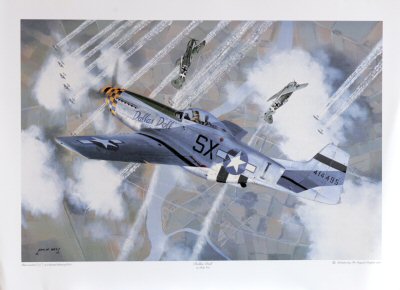
| Mustang | The ubiquitous North American P-51 Mustang, which many consider to be the best all-around fighter of WW II, owes its origins to the British Air Ministry. Following Britains entry into WW II in 1939, the RAF was interested in purchasing additional fighter aircraft from American sources, particularly the Curtiss P-40. Curtiss, which was busy, was unable to guarantee timely delivery so the British approached North American Aviation as a possible second source for the P-40. North American chose to propose its own fighter design which would use the same Allison engine as the P-40. Utilizing new laminar flow wings, the North American fighter was expected to have performance better than the P-40. Developed in record time the new aircraft was designated as a Mustang I by the Brits, whereas the USAAF ordered two for evaluation which were designated XP-51 Apaches. Intrigued with the possibility of using this aircraft also as a dive bomber, North American proposed this to the USAAF which decided to order 500 of the P-51 aircraft to be modified for dive bombing use. Designated as the A-36 Invader, this version of the Mustang utilized dive flaps, and bomb racks under each wing. Some reinforcing of the structural members was also required because of the G-forces to be encountered in dive bombing. A-36s entered combat service with the USAAF prior to any P-51s. In early 1943 the 86th and 27th Fighter Bomber Groups of the 12th Air Force began flying A-36s out of Northern Africa. Despite some early problems with instability caused by the dive flaps, the A-36 was effective in light bombing and strafing roles. It was not, however, capable of dog fighting with German fighters, especially at higher altitudes. Despite these drawbacks one USAAF pilot, Captain Michael T. Russo, who served with the 16th Bomb Squadron of the 27th Fighter Bomber Group, was credited with five confirmed aerial victories in the A-36, thereby becoming the first mustang ace. |
| Artist Details : Philip West |
| Click here for a full list of all artwork by Philip West |
 Philip West Philip West is recognised as one of the worlds finest aviation artists. Collectors of his original oil paintings span the globe, many waiting patiently for his next breathtaking canvas to appear. With some one hundred and eight limited editions behind him, a waiting list of commissioned paintings for clients both existing and new, and a head full of ideas for new limited edition prints, life is never dull for this Wiltshire based artist! Self-taught, after years of painting pictures for friends and relatives, Philip took the plunge and became a full-time professional artist. Since then he has developed a very loyal and expanding for both his original paintings and prints. Whilst jets, and Phantoms in particular, light Philips fire, he is also a master painter of piston-engined classics; being renowned for his rendition of Avro Lancasters and Supermarine Spitfires. Philip is also one of the few artists to also enthusiastically paint pictures of Fleet Air Arm aircraft. Philips knowledge of aircraft and the accuracy of his work combine to record a moment in history so perfectly, that both collectors and admirers of his work are able to feel a real sense of the excitement and drama that his work portrays. More about Philip West |
|
Contact Details |
|
Sign Up To Our Newsletter!
This website is owned by Cranston Fine Arts. Torwood House, Torwoodhill Road, Rhu, Helensburgh, Scotland, G848LE Contact: Tel: (+44) (0) 1436 820269. Email: cranstonorders -at- outlook.com |
 |


 Rudorffer, Erich
  (signed in person)
 Anderson, C E Bud
  (signed in person)