|
|
|
|
|
|
|
|
 |
 |
 |
 |
 |
 |
 |
 |
 |
 |
 |
 |
 |
 |
|
| THIS ITEM IS INCLUDED IN OUR BUY ONE GET ONE HALF PRICE OFFER ! Choose any two prints in this special offer and the lower priced item is half price. (Any free bonus prints already supplied with an item are separate and will also be included !) Hundreds of items across our websites are included in this offer! |
| |||||||||||||||||||||||||||||||||||||||
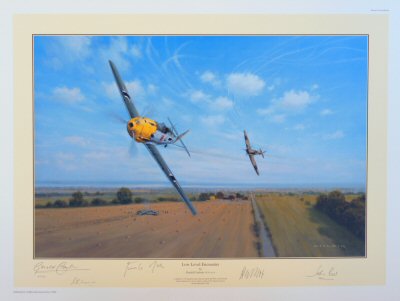
| Extra Details : Low Level Encounter by Gerald Coulson. | ||
|
| Signatures on this item | |
| *The value given for each signature has been calculated by us based on the historical significance and rarity of the signature. Values of many pilot signatures have risen in recent years and will likely continue to rise as they become more and more rare. | |
| Name | Info |
  General Gunther Rall (deceased) *Signature Value : £75 | A young pilot with III/JG52 at the outbreak of war. He quickly demonstrated his natural ability and leadership qualities, scoring his first air victory early in the Battle of Britain, and by July 1940 was leading 8/JG52. After transfer to the Eastern Front his air victories mounted at an astonishing rate. A crash hospitalised him but within nine months he was back in the cockpit, and, when commanding III/JG52, gained the Wings 500th victory. Gunther fought throughout the war to become the 3rd highest Ace in history with 275 victories. He was awarded the Knights Cross with Oak Leaves and Swords. Gunther Rall was born on March 10, 1918 in the small Bavarian town of Gaggenau, Baden. Immersing himself in Boy Scout activities during the difficult economic times in Germany following WW 1, Rall finished school in 1936 and joined the German Army. Influenced by a friend, who was a young officer in the Luftwaffe, Rall entered pilots school in 1938. His initial posting was with JG52. He attained his first aerial victory during the Battle of France in May of 1940. During the Battle of Britain JG52 absorbed many casualties, and Rall was promoted to Squadron Commander at the young age of 22. With his fair-hair and smooth complexion the young officer looked even younger than his years. But behind this pleasant exterior was a fierce competitor with the heart of a tiger. Later, Ralls squadron would support the attack on Crete, followed by deployment to the Southern Sector on the Eastern Front. Ralls victory totals began to mount. Following his 37 th victory, GiInther was himself shot down. He was lucky to survive the crash, but with a badly broken back he would spend most of the next year in various hospitals. In Vienna at the University Hospital he would meet his future wife, Hertha. Miraculously, Rall recovered and returned to the Luftwaffe in August of 1942. By November his score exceeded 100 and he was awarded the Oak Leaves to accompany the Knights Cross he was awarded only weeks earlier. As the War progressed against Russia, Rall began to encounter ever more experienced Soviet pilots flying better performing aircraft. Despite this fact, and being shot down several more times himself, Ralls victory tally kept rising. By March of 1944 the ace had attained 273 aerial victories. With the War now going badly for Germany, Rall was transferred to the Western Front. He was able to attain only two more victories against the swarms of Allied bombers and fighter escorts which now pounded Germany every day and night. In May of 1944 Rall was shot down by a P-47. Losing his thumb in the battle he remained out of combat until later in 1944. Ralls final assignments included flying 190Ds as Kornmodore of JG300, and flying the Me-262 jet. Ralls 275 aerial victories (attained on less than 700 combat sorties) make him the third highest scoring ace of all time. If not for the down time suffered as a result of his broken back, Rall might have actually equaled or exceeded Erich Hartmanns alltime record of 352 aerial victories. Rall was not much for socializing during the War. He was a fierce competitor with a businessmans attitude about flying. He was an excellent marksman, and possibly the best deflection shot expert of the War. He continued to fly with the Bundeslufwaffe following the War, serving as its Commander-In Chief in 1970-74. Sadly Gunther Rall died on 4th October 2009. |
  Group Captain John Peel DFC DSO (deceased) *Signature Value : £65 | Born 17th October 1911. John Peel is credited with having fired the first shots of the Battle of Britain. In July 1940, he commanded No.145 Sqn destroying one and sharing in the destruction of three German bombers. During the battle of Britain, he damaged or destroyed three enemy aircraft, and was himself shot down, crash landing on the Isle of Wight. After the Battle of Britain he served as a Wing Leader, once more being shot down - this time over the Channel, until in January 1943 he took a job in the Air Ministry, where he served until the end of the war. He died 7th January 2004. |
  Major Hans-Ekkehard Bob (deceased) *Signature Value : £50 | After success in the Battle of Britain, Hans-Ekkehard Bob took over leadership of 9./JG54 in 1940. The following year he was awarded the Knights Cross. Transferring to the Eastern Front his victories rose steadily to 50 by September 1942. His Group later transferred back to the West for a short period, where in April 1943, he rammed a B-17 Fortress. Returning to the Eastern Front as Kommander of IV./JG3, he ended the war as Adjutant of Gallands JV44 in the West. In his 700 missions he scored 60 victories. |
  Wing Commander George Grumpy Unwin, DSO, DFM* (deceased) *Signature Value : £75 | George Unwin joined the RAF in 1929, and in 1936 was posted to Duxford with 19 Squadron as a Sergeant Pilot. He was one of the first pilots in the RAF to fly the Spitfire. With the outbreak of war 19 Squadron moved to Hornchurch and George, now one of the Squadrons most experienced pilots, took part in the great air battles over France and Dunkirk, scoring 3 and a half victories. He flew with 19 Squadron continuously during the whole of the Battle of Britain. He was commissioned in 1941. After a period instructing, he resumed operations, flying Mosquitoes with 16 Squadron. George finished the war with 13 victories, 2 shared, 2 unconfirmed, and 2 probables. He died 28th June 2006. |
| The Aircraft : | |
| Name | Info |
| Spitfire | Royal Air Force fighter aircraft, maximum speed for mark I Supermarine Spitfire, 362mph up to The Seafire 47 with a top speed of 452mph. maximum ceiling for Mk I 34,000feet up to 44,500 for the mark XIV. Maximum range for MK I 575 miles . up to 1475 miles for the Seafire 47. Armament for the various Marks of Spitfire. for MK I, and II . eight fixed .303 browning Machine guns, for MKs V-IX and XVI two 20mm Hispano cannons and four .303 browning machine guns. and on later Marks, six to eight Rockets under the wings or a maximum bomb load of 1,000 lbs. Designed by R J Mitchell, The proto type Spitfire first flew on the 5th March 1936. and entered service with the Royal Air Force in August 1938, with 19 squadron based and RAF Duxford. by the outbreak of World war two, there were twelve squadrons with a total of 187 spitfires, with another 83 in store. Between 1939 and 1945, a large variety of modifications and developments produced a variety of MK,s from I to XVI. The mark II came into service in late 1940, and in March 1941, the Mk,V came into service. To counter the Improvements in fighters of the Luftwaffe especially the FW190, the MK,XII was introduced with its Griffin engine. The Fleet Air Arm used the Mk,I and II and were named Seafires. By the end of production in 1948 a total of 20,351 spitfires had been made and 2408 Seafires. The most produced variant was the Spitfire Mark V, with a total of 6479 spitfires produced. The Royal Air Force kept Spitfires in front line use until April 1954. |
| Me109 | Willy Messerschmitt designed the BF109 during the early 1930s. The Bf109 was one of the first all metal monocoque construction fighters with a closed canopy and retractable undercarriage. The engine of the Me109 was a V12 aero engine which was liquid-cooled. The Bf109 first saw operational service during the Spanish Civil War and flew to the end of World War II, during which time it was the backbone of the Luftwaffe fighter squadrons. During the Battle of Britian the Bf109 was used in the role of an escort fighter, a role for which it was not designed for, and it was also used as a fighter bomber. During the last days of May 1940 Robert Stanford-Tuck, the RAF ace, got the chance to fly an Me109 which they had rebuilt after it had crash landed. Stanford-Tuck found out that the Me109 was a wonderful little plane, it was slightly faster than the Spitfire, but lacked the Spitfire manoeuvrability. By testing the Me109, Tuck could put himself inside the Me109 when fighting them, knowing its weak and strong points. With the introduction of the improved Bf109F in the spring of 1941, the type again proved to be an effective fighter during the invasion of Yugoslavia and during the Battle of Crete and the invasion of Russia and it was used during the Siege of the Mediteranean island of Malta. The Bf109 was the main fighter for the Luftwaffe until 1942 when the Fw190 entered service and shared this position, and was partially replaced in Western Europe, but the Me109 continued to serve on the Eastern Front and during the defence of the Reich against the allied bombers. It was also used to good effect in the Mediterranean and North Africa in support of The Africa Korps. The Me109 was also supplied to several German allies, including Finland, Hungary, Romania, Bulgaria, Croatia, and Slovakia. The Bf109 scored more kills than any other fighter of any country during the war and was built in greater numbers with a total of over 31,000 aircraft being built. The Bf109 was flown by the three top German aces of the war war. Erich Hartmann with 352 victories, Gerhard Barkhorn with 301 victories and Gunther Rall with 275 kills. Bf109 pilots were credited with the destruction of 100 or more enemy aircraft. Thirteen Luftwaffe Aces scored more than 200 kills. Altogether this group of pilots were credited with a total of nearly 15,000 kills, of which the Messerschmitt Bf109 was credited with over 10,000 of these victories. The Bf109 was the most produced warplane during World War II, with 30,573 examples built during the war, and the most produced fighter aircraft in history, with a total of 33,984 units produced up to April 1945. Bf109s remained in foreign service for many years after World War II. The Swiss used their Bf109Gs well into the 1950s. The Finnish Air Force did not retire their Bf109Gs until March 1954. Romania used its Bf109s until 1955. The Spanish Hispanos flew even longer. Some were still in service in the late 1960s. |
| Artist Details : Gerald Coulson |
| Click here for a full list of all artwork by Gerald Coulson |
 Gerald Coulson Gerald Coulson has been painting professionally for over 47 years and has a reputation that is second to none. Entirely self taught, he developed his technique to such a high standard that his work was published as fine art prints, enabling him to begin a full time painting career in 1969. Since that time his work, covering many different subjects, has been published and marketed worldwide as both open and limited edition prints. Gerald has had many one-man shows both in the UK and the USA and his work has been extensively exhibited throughout the world. A recent one man show of his in the UK attracted more than 3000 people in two days. The Fine Art Trade Guild have placed him in the top ten best selling artists no less than fifteen times - three times at number one. Coulson's passion for aircraft stems from childhood. This passion led to an apprenticeship as an aircraft engineer after which he served in the RAF as a technician and with British Airways as an engineer at Heathrow. His knowledge of aircraft engineering, combined with his drawing ability, led to him becoming a Technical Illustrator of service manuals for Civil and Military aircraft. These experiences and technical background have allowed him an insight and intimate knowledge of the aircraft he paints. Along with a unique ability to capture these aircraft on canvas this naturally led to a painting career which he has developed to successfully cover a wide variety of subjects. Following a trip to the 1991 British Grand Prix his interest in Motor racing was fuelled. His ability to capture the technical detail and a talent for painting subjects at speed meant that this was a perfect natural progression alongside his aviation work and he is now also firmly established as one of the worlds leading motor racing artists. A Vice President and founder member of the Guild of Aviation Artists he is a four times winner of the Flight International Trophy for outstanding aviation painting. He qualified for his pilots licence in 1960 and is still actively flying today - mostly vintage aircraft, and can often be seen buzzing over the Fens of Cambridgeshire in a Tiger Moth. Whatever the subject he paints, whether aviation, landscape or portrait, his unique ability to capture the realism and 'mood'of the scene is unsurpassed, making him one of the most widely collected and highly regarded artists in the world today. Between 2003 and 2008 Cranston Fine Arts purchased the remaining back catalogue prints from Gerald Coulson's previous publishers. His early prints are now very sought after and many items which we purchased are now at very low stock levels with many sold out already. At the time of writing, many are down to the last 20 or even as low as the last few prints. We only sell direct to our customers and not through other outlets, which means nearly all these prints are exclusively available direct from us. Sadly Gerald passed away on the 6th of February 2021. More about Gerald Coulson |
|
Contact Details |
|
Sign Up To Our Newsletter!
This website is owned by Cranston Fine Arts. Torwood House, Torwoodhill Road, Rhu, Helensburgh, Scotland, G848LE Contact: Tel: (+44) (0) 1436 820269. Email: cranstonorders -at- outlook.com |
 |


 Buy 1 Get 1 Half Price!
 Rall, Gunther
  (signed in person)