|
|
|
|
|
|
|
|
 |
 |
 |
 |
 |
 |
 |
 |
 |
 |
 |
 |
 |
 |
|
| THIS ITEM IS INCLUDED IN OUR BUY ONE GET ONE HALF PRICE OFFER ! Choose any two prints in this special offer and the lower priced item is half price. (Any free bonus prints already supplied with an item are separate and will also be included !) Hundreds of items across our websites are included in this offer! |
| |||||||||||||||||||||||||||||||||||||
| |||||||||||||||||||||||||||||||||||||||||||||||||||||||
| Signatures on this item | |
| *The value given for each signature has been calculated by us based on the historical significance and rarity of the signature. Values of many pilot signatures have risen in recent years and will likely continue to rise as they become more and more rare. | |
| Name | Info |
  Wing Commander Roland Bee Beamont CBE DSO DFC DL (deceased) *Signature Value : £65 | One of World War IIs great characters, Bee flew Hurricanes with 87 Squadron, later leading a Tempest Wing. He had 8 victories plus a further 32 VIs destroyed. After the war he became a highly respected Chief Test Pilot.Wing Commander Roland Beamont, one of the RAFs top buzz bomb interceptors, was born in Enfield England on August 10, 1920. Educated at Eastborne College, Beamont accepted a short service commission with the Royal Air Force in 1938. He commenced flying in 1939 at the the No. 13 Reserve Flying School at White Waltham. His initial duty was with the Group Fighter Pool at St. Athan where he learned to fly the Hurricane. Beamont was soon posted with the No. 87 Squadron which was part of the Advanced Air Striking Force in France. Seeing action in both France and Belgium prior to the Allied withdrawl, Beamont rejoined 87 Squadron in England during the Battle of Britain. In the spring of 1941 Beamont was awarded the Distinguished Flying Cross after destroying five enemy aircraft. As Commanding Officer of 609 Squadron, Beamont pioneered both day and night ground attack missions utilizing the Typhoon. Beamont was credited with destroying 25 trains in a three month period. He was then made responsible for organizing and commanding the first Tempest Wing at Newchurch. Three days after D-Day Bearnont shot down an Me-109, marking the first aerial combat victory for the Hawker Tempest. In the summer of 1944 Beamont destroyed 32 buzz bombs prior to leading his wing to a Dutch Airfield at Volkel on the Continent. In October of 1944 Beamont was shot down during a ground attack mission over Germany, and he remained a prisoner of war until wars end. Following repatriation Beamont became an experimental test pilot with the Gloster Aircraft Company, which had developed the RAFs first jet aircraft. Turning down a permanent commission with the RAF, Beamont then joined English Electric Company in Wharton as the Chief Test Pilot for the B3/45 (Canberra) jet bomber program. He managed all prototype testing on the Canberra, and in the process set two Atlantic speed records. Later Beamont was involved with the supersonic P1/Lightning program, and became the first British pilot to fly at twice the speed of sound. From 1965 until 1970 he was a founding member of Britains highly succesful Saudi Arabian export program. For several years prior to his retirement in 1979, Beamont was Director of Operations for British Aerospace and Panavia where he was in charge of flight testing for the Tornado. Since his retirement Beamont has authored nine books, and published numerous magazine articles. He is a Fellow of the Royal Aeronautical Scociety and an Honorary Fellow of the Society of Experimental Test Pilots in America. He died 19th November 2001. |
| The Aircraft : | |
| Name | Info |
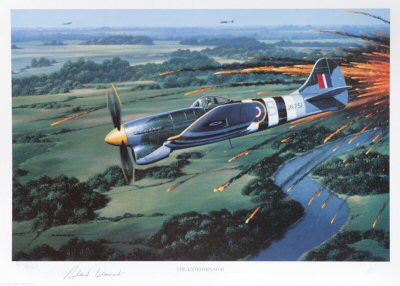
| Tempest | The Hawker Tempest was a much improved development of the Typhoon and first flew in June 1943. and started service with the RAF in April 1944. mainly serving in the attack role in Europe against ground targets including the V1 Flying Bomb installations. It remained in service after the war until 1949 when it was eventually replaced by the Jet Aircraft. but continued for another 4 years in the Indian and Pakistan air forces. In total no less than 1395 Hawker Tempests were built. Speed: 426mph at 18,500 feet, Crew One. Range 800 miles. Armament: Four 20mm Hispano cannons mounted in the wings and a bomb payload of upto 2,000 lbs. |
| Artist Details : Stan Stokes |
| Click here for a full list of all artwork by Stan Stokes |
 Stan Stokes Stan Stokes is a California native with more than 37 years as a full time professional artist, who developed a passion for vintage cars, trains and airplanes at an early age. Model building and RC planes filled the many hours of the young enthusiasts free time. However, unlike most other young aviation enthusiasts Stokes also displayed a great gift for artistic talent. After studying art in College, Stan decided to pursue a career as a professional artist. Stokes initially focused his great talents on depicting uniquely realistic landscapes of the western desert and mountain scenes. More than thirty years ago a good friend suggested that Stan combine his passion for aviation history and flying with his artistic talents, and render an aircraft or two. The rest is history. Stan has won many prestigious awards including the Benedictine Art Award in 1975 and the Smithsonian National Air and Space Museums Golden Age of Flight award in 1985. In May of 2000, Stan was honored with the National Museum of Naval Aviations R. G. Smith Award for Excellence in Naval Aviation Art. Commissioned by the Ronald Reagan Presidential Library in Simi Valley, California, Stans 12 x 120 foot mural of the History of the Flying White House is on permanent display in the Air Force One Pavilion. In addition Stans painting of the USS Ronald Reagan is hanging in the Legacy Room of the library. In 2005 Stan also completed a painting of our nations next aircraft carrier, the USS George H. W. Bush, which is on permanent display at the George H. W. Bush Presidential Library in College Station, Texas. Stan has also completed several impressive murals for the Palm Springs Air Museum including: The Tuskegee Airmen at 12 x 60 feet and contains 51 portraits of the original Tuskegee Airmen. Dauntless at Midway at 12 x 34 feet and Corsair on Approach at 19 x 55 feet. Stans work also hangs in the Air Force art collection, the Pentagon, San Diego Aerospace Museum, and the Smithsonian National Air and Space Museum in Washington DC. Stan has had the pleasure of meeting and working with many of his boyhood aviation heroes, including the late General Jimmy Doolittle, the late Pappy Boyington, Chuck Yeager, and many many others. A true aviation history buff, Stan often spends more time pouring over research materials for his paintings to assure their accuracy to the smallest detail than he does behind the canvas. Noted for his incredible detail and strikingly realistic illustration, Stans canvases have a life-like three-dimensional effect that often leaves viewers spellbound. Today his work encompasses not only aviation and space but also portraits, landscapes, ships, classic cars and his new collection of cat-related fine art paintings. Stan particularly enjoys the tough assignment. During his 37 years as a professional artist, he has been asked to produce literally hundreds of paintings documenting historical events, people and places. Although Stan has logged many hours flying his own airplanes, in recent years pleasure flying has had to take a backseat to the artistic demands of his backlog. Stan was commissioned to paint more than twenty original paintings for an aviation museum being in the Philippines. Since the mid-1980s NASA has also tapped Stans talents from time to time and he has completed more than fifteen paintings ranging from the space shuttles to the SR 71 Blackbird. Stan has also painted numerous works for the cutting edge genius in aviation and space design, Burt Rutan. More about Stan Stokes |
|
Contact Details |
|
Sign Up To Our Newsletter!
This website is owned by Cranston Fine Arts. Torwood House, Torwoodhill Road, Rhu, Helensburgh, Scotland, G848LE Contact: Tel: (+44) (0) 1436 820269. Email: cranstonorders -at- outlook.com |
 |


 Buy 1 Get 1 Half Price!
 Beamont, Roland
  (signed in person)


 Beamont, Roland
  (signed in person)