|
|
|
|
|
|
|
|
 |
 |
 |
 |
 |
 |
 |
 |
 |
 |
 |
 |
 |
 |
|
| |||||||||||||||||||||||||||||||
| ||||||||||||||||||||||||||||||||||||||||||||||||||||||||||||||
| Signatures on this item | |
| *The value given for each signature has been calculated by us based on the historical significance and rarity of the signature. Values of many pilot signatures have risen in recent years and will likely continue to rise as they become more and more rare. | |
| Name | Info |
  Air Commodore John Searby DSO DFC (deceased) *Signature Value : £45 | John Searby joined the RAF in 1929 as a Halton apprentice but was a Sergeant Pilot flying bombers when war broke out. Joining 106 Squadron he flew Lancasters with Guy Gibson and eventually took over as Squadron Commander when Gibson left for 617 Squadron. A specialist in navigation, he was then chosen by Arthur Harris to take command of No.83 Pathfinder Squadron at Wyton. Searby quickly developed a superb reputation as a Pathfinder and was involved in countless precision raids including his role as Master Bomber on the Peenemunde raid, coordinating the attack by over 600 heavy bombers. He died on 14th January 1986. Citation for the award of the Distinguished Service Order Acting Group Captain John Henry SEARBY, D.F.C., Royal Air Force, No.83 Squadron. One night in August, 1943, this officer participated in a bombing attack on an important target at Peenemunde. Enemy fighters were extremely active over the target area, but in spite of this Group Captain Searby executed his difficult task with consummate skill. He displayed faultless leadership, great courage and resolution throughout. (London Gazette – 7 September 1943) |
  Air Vice Marshall Donald Bennett (deceased) *Signature Value : £70 | Born in Australia, Bennet had joined the RAF before the war. He became widely experienced in flying all types of aircraft including fighters, flying boats and heavy bombers commanding 77 squadron, flying Halifaxes. In 1942, whilst commanding 10 Squadron, he was shot down on one of the attacks on the Tirpitz, but evaded capture and returned to England. Widley regarded as a navigation expert beyond comparison, he was personally selected by Arthur Harris to form the Pathfinder Force and his uncompromising attitude and ceaseless devotion to his men made him a legendary figure in WWII history. He died 15th September 1986. |
| Flight Lieutenant David Codd DFC *Signature Value : £10 | Joining the Army in 1938 he initially served with Royal Engineers at Dunkirk before volunteering for aircrew and transferring to the RAF in 1941. He qualified as a navigator and in 1942 joined 10 squadron at Leeming on Halifaxes before moving to 35 squadron with the Pathfinders, again on Halifax bombers. In 1943 his aircraft was shot down near Cologne and he became a POW at Stalagluft 3, having completed 42 operations. He returned to England in May 1945 and left the RAF in 1947. |
| Flight Lieutenant John Rollins DFC AFC (deceased) *Signature Value : £45 | After joining the RAF in 1940 he was called up in early 1941 and entered OTU where he qualified as an observer and was then posted operationally to 466 Sqn at Leconfield on Wellingtons. At the end of 1942 he joined 35 Sqn as a Navigator at Gravely as part of the Pathfinder Force, initially on the Halifax and later converting to Lancasters. He remained with the Pathfinders until 1944 when he was posted to Stoney Cross to convert back to Wellington 1C's as a way of becoming reacquainted with two engined aircraft. he spent the remainder of the war flying Dakotas in the Far East and left the RAF in mid 1946. Died 26th March 2005. |
| Flying Officer Don Carruthers *Signature Value : £40 | Joining the RAF in 1941 he trained as a wireless operator and completed his ops training at Lossiemouth on Wellingtons where he formed up with a crew that was to stay together for his entire operational career in Bomber Command. In 1943 he was posted to 466 squadron at Leconfield on Wellingtons before converting to the Halifax. He and his crew volunteered for the Pathfinder Force and joined 35 squadron on Halifax's and then Lancasters. In 1945 having completed a total of 63 operations he moved to Transport Command flying Dakotas in India with 238 squadron and then Calcutta with 52 squadron. He left the RAF in 1946. |
| Flying Officer Sir Michael Hanham DFC (deceased) *Signature Value : £35 | He joined the RAF straight from school in 1942 and initially qualified as a navigator but then retrained as a flight engineer in 1943. He volunteered for the Pathfinder Force and joined 35 squadron as a flight engineer on Halifaxes and Lancasters, completing 55 operations with this unit. In May 1945 he became a Flying Control Officer and was posted to India, leaving the RAF in 1946. Died 20th May 2009. |
  Group Captain Hamish Mahaddie DSO DFC (deceased) *Signature Value : £70 | Group Captain Thomas Gilbert 'Hamish' Mahaddie. DSO, DFC, AFC.. CzMC. Nos 7, 55, and 77 Squadrons. Born In Keith, Edinburgh, on 19 March 1911. He joined the RAF as a part of the 17th Entry at Halton in 1928 and trained as a metal rigger, after which he was posted to Cranwell on ground servicing duties. In 1933 he boarded a troopship bound for the Middle East where he joined No 4 FTS at Abu Suler for pilot training. He gained his wings in 1935 and his first air crew posting was to No 55 Squadron at Hinaldi flying Westland Wapitis. On his return to England in 1937 he joined No 77 Squadron flying Whitleys from Driffield. During World War II he completed a tour of operations with No 77 Squadron before moving to Klnloss to instruct with No 14 OTU. He completed another tour, this time with No 7 Squadron at Oakington on Stirlings, before joining HQ Staff of No 8 (Pathfinder) Group. Group Captain Mahaddie finished the war as Station Commander at RAF Warboys, home of PFF Navigation Training Unit. In June 1945 he was appointed to command No 111 Wing in Germany followed by a spell at the Staff College, Haifa, In 1947. His postwar duties also included two tours of duty at the Air Ministry, as OC Flying Wing at Binbrook, and also as Station Commander at Sylt and Butzwellerhof in Germany. He finally retired from the RAF in 1958 and has since been involved with the film Industry as an aviation consultant specialising in electronics for all three services. Hamish Mahaddie died 16th January 1997. |
 Squadron Leader Pat Carden DFC AE (deceased) *Signature Value : £45 | Joining the RAF in 1932, after qualifying as a pilot, he served as an instructor until 1942, when he joined 15 Squadron at Mildenhall, flying Lancasters. Volunteering for the Pathfinder Force he joined 35 Squadron at Gravely on Halifaxes, followed by 582 Squadron on Lancasters, taking part in many bombing sorties over Normandy, including two missions on D-Day. He finished the war having completed 66 operations. Pat Carden sadly died 28th June 2008, aged 96. |
| Warrant Officer Ernest Kenwright DFC DFM *Signature Value : £35 | Joining the RAF in 1940 he was initially posted to Cardington as a driver and ended up on the Isle of Sheppey releasing explosive met balloons in order to hamper enemy aircraft. Volunteering for aircrew he attended a gunnery course at Stormy Down in 1942 and shortly after joined 51 squadron at Snaith in Yorkshire, as a Rear Gunner on Halifaxes. In 1943 after many operations with the main force he volunteered for the Pathfinders and joined 35 Squadron at Gravely on both the Halifax and Lancaster. He remained with this unit until the end of the war completing 82 operations and left the RAF in 1946 |
  Warrant Officer Harold Kirby *Signature Value : £40 | Called up in 1942 he attended a flight mechanics course at RAF Halton and then qualified as a flight engineer in 1943, joining 467 Squadron at Waddington on Lancasters. In August 1944 his aircraft was forced to crash land after an operation when a 1000lb bomb from another Lancaster ripped through their port wing and destroyed their undercarriage over France. In September 1944 he joined 97 Squadron at Coningsby on Lancasters as part of the Pathfinders and remained with this unit until the end of the war. He left the RAF in 1946. |
  Wing Commander Ernest Rodley DSO DFC AFC AE (deceased) *Signature Value : £50 | Ernest Rodley initially joined the RAFVR in 1937 and was commissioned and posted to Bomber Command in 1941. Joining 97 Sqn flying Manchesters he was involved in the attack on the Scharnhorst, Prinz Eugen and Gneisenau whilst in Brest harbour and in the famous Augsberg daylight raid for which he received a DFC. At the end of 1942 he joined RAF Scampton helping to convert to Lancaster Bombers before rejoining 97 Sqn at Bourn as a Pathfinder. After a spell at Warboys as an instructor he took command of 128 Sqn at Wyton, flying Mosquitoes as part of the Light Night Strike Force and involvede in doing 7 trips to Berlin. Staying with this unit he finished the war having completed 87 operations. In 1946 Ernest Rodley joined British South American Airways flying Lancastrians across the Atlantic from a tented Heathrow. On 13th April 1950 he was checked out on the new Comet jet airliner by John Cunningham and became the worlds first jet endorsed Airline Transport Pilots Licence holder. Ernest Rodley retired from BOAC in 1968 as a Boeing 707 Captain, joining Olympic Airways a few days later. He amassed an amazing 28000 flying hours. Sadly he died in 2004. |
| The Aircraft : | |
| Name | Info |
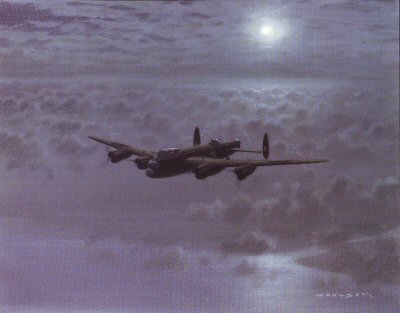
| Halifax | Royal Air Force heavy Bomber with a crew of six to eight. Maximum speed of 280mph (with MK.VI top speed of 312mph) service ceiling of 22,800feet maximum range of 3,000 miles. The Halifax carried four .303 browning machine guns in the tail turret, two .303 browning machines in the nose turret in the MK III there were four .303 brownings in the dorsal turret. The Handley Page Halifax, first joined the Royal Air Force in March 1941 with 35 squadron. The Halifax saw service in Europe and the Middle east with a variety of variants for use with Coastal Command, in anti Submarine warfare, special duties, glider-tugs, and troop transportation roles. A total of 6177 Halifax's were built and stayed in service with the Royal Air Force until 1952 |
| Artist Details : Gerald Coulson |
| Click here for a full list of all artwork by Gerald Coulson |
 Gerald Coulson Gerald Coulson has been painting professionally for over 47 years and has a reputation that is second to none. Entirely self taught, he developed his technique to such a high standard that his work was published as fine art prints, enabling him to begin a full time painting career in 1969. Since that time his work, covering many different subjects, has been published and marketed worldwide as both open and limited edition prints. Gerald has had many one-man shows both in the UK and the USA and his work has been extensively exhibited throughout the world. A recent one man show of his in the UK attracted more than 3000 people in two days. The Fine Art Trade Guild have placed him in the top ten best selling artists no less than fifteen times - three times at number one. Coulson's passion for aircraft stems from childhood. This passion led to an apprenticeship as an aircraft engineer after which he served in the RAF as a technician and with British Airways as an engineer at Heathrow. His knowledge of aircraft engineering, combined with his drawing ability, led to him becoming a Technical Illustrator of service manuals for Civil and Military aircraft. These experiences and technical background have allowed him an insight and intimate knowledge of the aircraft he paints. Along with a unique ability to capture these aircraft on canvas this naturally led to a painting career which he has developed to successfully cover a wide variety of subjects. Following a trip to the 1991 British Grand Prix his interest in Motor racing was fuelled. His ability to capture the technical detail and a talent for painting subjects at speed meant that this was a perfect natural progression alongside his aviation work and he is now also firmly established as one of the worlds leading motor racing artists. A Vice President and founder member of the Guild of Aviation Artists he is a four times winner of the Flight International Trophy for outstanding aviation painting. He qualified for his pilots licence in 1960 and is still actively flying today - mostly vintage aircraft, and can often be seen buzzing over the Fens of Cambridgeshire in a Tiger Moth. Whatever the subject he paints, whether aviation, landscape or portrait, his unique ability to capture the realism and 'mood'of the scene is unsurpassed, making him one of the most widely collected and highly regarded artists in the world today. Between 2003 and 2008 Cranston Fine Arts purchased the remaining back catalogue prints from Gerald Coulson's previous publishers. His early prints are now very sought after and many items which we purchased are now at very low stock levels with many sold out already. At the time of writing, many are down to the last 20 or even as low as the last few prints. We only sell direct to our customers and not through other outlets, which means nearly all these prints are exclusively available direct from us. Sadly Gerald passed away on the 6th of February 2021. More about Gerald Coulson |
|
Contact Details |
|
Sign Up To Our Newsletter!
This website is owned by Cranston Fine Arts. Torwood House, Torwoodhill Road, Rhu, Helensburgh, Scotland, G848LE Contact: Tel: (+44) (0) 1436 820269. Email: cranstonorders -at- outlook.com |
 |


 Rodley, Ernest
  (signed in person)
 Carden, Pat
  (signed in person)