|
|
|
|
|
|
|
|
 |
 |
 |
 |
 |
 |
 |
 |
 |
 |
 |
 |
 |
 |
|
Ship Index |
Naval Signature Index |
Naval Artists Index |
Naval Art by Country |
Naval Art Offers |
|
| Navigation | |
| Page 2 of 22 | Previous .. Page 2 .. Next |
| Special Offer Naval Art |
|
|
|
|
|
|
|
|
|
|
|
|
|
|
|
|
|
|
|
|
| Navigation | |
| Page 2 of 22 | Previous .. Page 2 .. Next |
| Text for the above items : |
Battle of Trafalgar by George Chambers. No text for this item |
HMS Agincourt by Randall Wilson. HMS Agincourt is shown alongside HMS Erin with ships of the 1st Battle squadron of the Grand Fleet, on the eve of the Battle of Jutland. |
Trafalgar Dawn by Graeme Lothian. First daylight on the 21st October, saw the Royal Navy fleets together at a distance of about 12 miles. The day looked fine, a heavy swell from the west gave warning of an approaching storm. As dawn broke HMS Victory, Nelsons flagship and the rest of the fleet could be found in a shapeless huddle, which soon resolved itself into two divisions. Thus the two fleets prepared themselves for the coming battle which commenced just before noon. |
Damnation Seize My Soul by Chris Collingwood. Blackbeard the Terrible, otherwise known as Edward Teach, Thatch or Drummond. Circa 1718. |
The Sinking of U533 by Ivan Berryman. U533 began its first patrol in April 1943, coming under repeated attack from Allied aircraft in 40 days at sea. The U-boat set off from Lorient in France for a second patrol, rounding the Cape of Good Hope and into the Indian Ocean. In the Gulf of Oman on 16th October, the submarine was spotted and attacked by a British Bisley bomber of No.244 Sqn, piloted by Lewis William Chapman. The Bisley was the name originally given to the Mk.V Blenheim aircraft. Already entering a desperate dive to escape, the depth charges immediately caused the submarine to sink nose first, leaving little chance of escape. Of the 53 crew, an officer in the conning tower managed to open the hatch as the submarine passed 50 metres depth, the pressure propelling Günther Schmidt and the unnamed officer to the surface. Schmidt kept the unconscious officer afloat but he died an hour later, while Schmidt kept himself afloat without aid for more than 24 hours before being picked up and taken prisoner - the only survivor of the sinking. |
Bismarck - Pride of the Kriegsmarine by Ivan Berryman. Together with her sister, Tirpitz, the Bismarck was Germany's most modern and formidable warship of WWII. Equipped with the very latest in rangefinder technology and festooned with defensive firepower, perhaps her most daunting weapons were the eight 15 inch guns, arranged in four turrets, that were to prove so effective against almost every other ship that she encountered, the most famous of these arguably being the Royal Navy's HMS Hood, sunk with huge loss of life in the Battle of the Denmark Strait in May 1941. Bismarck is depicted here in company with Prinz Eugen. |
Invisible Enemy by Ivan Berryman. Perhaps among the bravest of those serving within the Regia Marina in WW2, the crews of the Italian SLCs (Siluro a Lavita Corsa, or Slow-Running Torpedoes) carried out some of the most daring submarine raids of the war. At 23ft in length and with a maximum speed of just 4 knots, the Maiali (or Pigs, as they were known, due to their lack of maneuverability) frequently delivered their 300kg warheads direct to their targets with devastating results, as when three Italian SLCs sank the British battleships HMS Valiant and HMS Queen Elizabeth as well as a tanker in Alexandria Harbour on 19th December 1941. Here an SLC has cut its way through the torpedo netting, just one of the many hazards encountered on these highly dangerous covert operations. |
Escort for the Troops - USS New York by Anthony Saunders The Atlantic ocean was the lifeline between Britain and America, as well as millions of tons of raw materials, GIs were also transported over in all manor of hastily converted liners. Protecting the troops from marauding u-boats and German surface ships was of paramount importance to the allied fleets. Although USS New York spent a good deal of the war in the Atlantic, she also participated in the Torch landings off North Africa and took part in the Pacific campaign, seeing action at both Iwo Jima and Okinowa. |
RMS Titanic by Ivan Berryman. The elegant but ill-fated jewel in the White Star crown Titanic was a technical marvel of engineering in its day. At 882 ft long, her perfect proportions and magnificent profile were the envy of other shipping companies. her tragic loss on her maiden voyage was a crushing blow to the White Star Line that left the whole world in shock. |
Breakout by Randall Wilson. The Bismarck is seen taking the lead from the Prinz Eugen on the breakout from Bergen May 1941. |
Bucentaure by Ivan Berryman. Built at Toulon in 1803, Bucentaure was the flagship of Admiral Villeneuve at the Battle of Trafalgar on 21st October 1805 and the first to be almost completely disabled by a massive broadside from HMS Victory as Nelson broke through the enemy line. Bucentaure was taken as a prize by the British fleet, but was lost in the great storm that followed the battle. |
HMS Captain at the Battle of Cape St Vincent by Ivan Berryman. Viewed across the damaged stern of the 80-gun San Nicolas, Nelson drives HMS Captain onto the Spanish vessel in order that she can be boarded and taken as a prize, the British marines and men scrambling up the Captains bowsprit to use it as a bridge. The San Nicholas then fouled the Spanish three decker San Joseph (112), allowing Nelson and his men to take both ships as prizes in a single manoeuvre. A British frigate is moving into a supporting position in the middle distance. |
HMS Blake by Ivan Berryman. The newly converted Command Helicopter Cruiser HMS Blake leaves Grand Harbour Malta at the end of the 1960s. In the background, the old Submarine Depot ship HMS Forth lies at anchor at the very end of her long career. |
USS Tennessee During the Landings at Iwo Jima by Anthony Saunders. In February 1945, 850 square miles of volcanic rock became the most strategically important island in the South Pacific. From Iwo Jima heavy bombers would be able to raid Japanese cities almost at will. Even with its overwhelming military might, the Americans would have to pay a heavy price for such a seemingly small island. |
Boiling Point - USS Missouri by Anthony Saunders Launched on the 29th of January 1944, USS Missouri was the last and one of the finest battleships of any fleet. With a top speed of 33 knots, she earnt the name Fast Battleship, as the Iowa class to which she belonged were known. Bristling with an assortment of anti-aircraft, Missouri was as much a floating anti-aircraft battery as a battleship. With these qualities Missouri was well equiped to counter the desperate aerial attacks faced when she joined the Pacific Fleet. Here Missouri is seen repelling a kamikaze attack on the 11th of April 1945, with the destroyers Melvin (left) and McCord. Although one of the kamikazes did get through the curtain of shell fire, little damage was sustained. |
Hook Down and Homeward Bound by Stan Stokes. The Chance-Vought F4U Corsair was arguably the finest naval aviation fighter of its era. Work on this design dates to 1938 and was headed-up by Voughts Chief Engineer, Rex Biesel. The initial prototype was powered by an 1800-HP Pratt & Whitney double Wasp radial engine. This was the third Vought aircraft to carry the Corsair name. The graceful and highly recognizable gull-wing design of the F4U permitted the aircraft to utilize a 13-foot, three-blade, Hamilton Standard propeller, while not having to lengthen the landing gear. Because of the rigors of carrier landings, this was a very important design consideration. Folding wings were also required for carrier operations. The F4U was thirty feet long, had a wingspan of 41 feet and an empty weight of approximately 7,500 pounds. Another interesting feature was the way the F4Us gear rotated 90 degrees, so it would lay flush within the wing when in the up position. In 1939 the Navy approved the design, and production commenced. The Corsair utilized a new spot welding process on its all aluminum fuselage, giving the aircraft very low drag. To reduce weight, fabric-covered outer wing sections and control surfaces were fitted. In May of 1940 the F4U made its maiden flight. Although a number of small bugs were discovered during early flight tests, the Corsair had exceptional performance characteristics. In October of 1940 the prototype F4U was clocked at 405-MPH in a speed test. The initial production Corsairs received an upgraded 2,000-HP radial giving the bird a top speed of about 425-MPH. The production models also differed from the prototype in having six, wing-mounted, 0.5 caliber machine guns. Another change was a shift of the cockpit about three feet further back in the fuselage. This latter change unfortunately made naval aviators wary of carrier landings with the F4U, due to its limited forward visibility during landings. Other concerns were expressed regarding a severe port wing drop at landing speeds and a tendency of the aircraft to bounce off a carrier deck. As a result, the F4U was initially limited to land-based USMC squadrons. Vought addressed several of these problems, and the Royal Navy deserves credit for perfecting an appropriate landing strategy for the F4U. They found that if the carrier pilot landed the F4U while making a sweeping left turn with the port wing down, that sufficient visibility was available to make a safe landing. With a kill ratio of 11-to-1 in WW II combat, the F4U proved superior in the air to almost every opposing aircraft it encountered. More than 12,000 F4Us were built and fortunately a few dozen remain in flyable condition to this date. |
Japanese Battleship Fuso by Randall Wilson. Fuso, launched 28th March 1914, underwent major reconstruction between 1930-33. Shown here during world war II, Fuso took part in the Leyte Gulf operations and was sunk by two torpedoes from US destroyers on 25th October 1944. |
Aloha Hawaii by Randall Wilson. Battleship USS Pennsylvania off Diamond Head, Hawaii. |
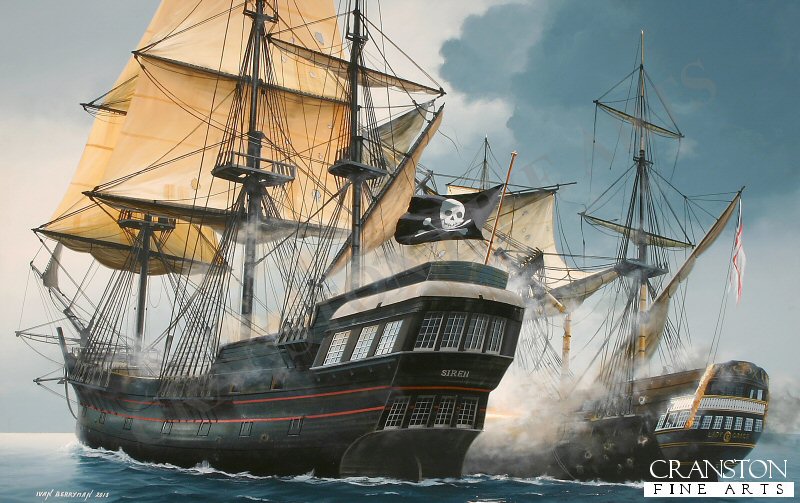
The Taking of the Lady Grace by Ivan Berryman. Although entirely fictitious, this scene depicts a typical action by pirates in the early 1700s, most likely in the Caribbean where the many supply routes from Europe converged and offered rich pickings. Although fraught with danger, the rewards for the buccaneers were rich and plenty, many of them rising to great notoriety for their daring exploits. |
| Navigation | |
| Page 2 of 22 | Previous .. Page 2 .. Next |
|
Contact Details |
|
Sign Up To Our Newsletter!
This website is owned by Cranston Fine Arts. Torwood House, Torwoodhill Road, Rhu, Helensburgh, Scotland, G848LE Contact: Tel: (+44) (0) 1436 820269. Email: cranstonorders -at- outlook.com |
 |