|
|
|
|
|
|
|
|
 |
 |
 |
 |
 |
 |
 |
 |
 |
 |
 |
 |
 |
 |
|
Ship Index |
Naval Signature Index |
Naval Artists Index |
Naval Art by Country |
Naval Art Offers |
|
| Navigation | |
| Page 4 of 7 | Previous .. Page 4 .. Next |
| Special Offer Naval Art |
|
|
|
|
|
|
|
|
|
|
|
|
|
|
|
|
|
|
|
|
|
| Navigation | |
| Page 4 of 7 | Previous .. Page 4 .. Next |
| Text for the above items : |
Attack on the Tirpitz by Stan Stokes. On November 2, 1936 the keel was laid for a new German 35,000 ton-class battleship. On April 1, 1939 the new ship was christened the Tirpitz, and by February of 1941 the giant ship had entered service. The hull of the Tirpitz was 90% welded, and the battleship was very heavily armored, rendering it almost unsinkable in the minds of German naval strategists. In service the Tirpitz actually displaced closer to 53,000 tons. With a crew slightly in excess of 2,000 the ship was capable of making 29 knots. With a range of more than 9,000 miles at a speed of 16 knots, the Tirpitz was certain to take a heavy toll on Allied shipping in the North Atlantic. The Royal Navy and RAF determined that the Tirpitz must never be allowed to become an effective convoy buster, and a multi-year campaign of harassment of the huge German warship was undertaken. In July of 1940, while the ship was still being outfitted, an air attack was launched with little significant damage. After completing its sea trials the Tirpitz was based at the Faettenfjord in Norway. The Tirpitz unsuccessfully attacked two convoys in March of 1942, and itself was attacked by a flight of 12 Albacore torpedo bombers. Three more bombing attacks by Halifax and Lancaster bombers took place in March and April with only marginal success. In July the Tirpitz was moved to Altafjord, and in that month it again attacked a convoy with no success. In October the great ship was sent back to Faeteenfjord for servicing. In 1943 several midget submarine attacks were launched at the battleship, but again with no meaningful impact. No air attacks took place in 1943. In early 1944 the Tirpitz was the target for Soviet bombers, but once again the ship pulled through unscathed. In April of 1944 the Brits once again joined the attack and the Royal Navy sent a large group of 40 Barracudas with about 40 escort fighters to attack the battleship at Kaalfjord. This attack resulted in fifteen hits, generated 400 casualties, and did some serious damage to the upper deck. Follow-up air attacks were called off by bad weather, and it was not until August that three more raids took place. None of these had much impact. In September the Brits changed strategies and commenced attacks on the Tirpitz using 11,000-pound Tallboy bombs. A flight of 32 Lancasters delivered 29 Tallboys to the target in November of 1944. Two direct hits and one near miss were recorded. The great battleships armored deck was pierced by the huge bombs, its magazine exploded, and the ship capsized and sunk with more than 1200 killed. In Stan Stokes painting the attack of April 3, 1944 that was code-named Operation Tungsten is depicted. The Fairey Barracuda despite an ungainly appearance was produced in large numbers (2,500) for use as Royal Navy dive and torpedo bombers. With a crew of 3 and a top speed of only 238-MPH the Barracuda required fighter support during most of its missions to prevent it from becoming an easy target for Axis fighters. |
McKay Clipper Anglo-American by Roy Cross. No text for this item |
Scourge of the Atlantic by Ivan Berryman. The ten German U-Boats of the Type VIIA class operating in the seas around the United Kingdom and Ireland were so deadly in the first part of the war, they were the scourge of the Atlantic. Sinking much Allied merchant shipping in the first months of World War Two, they continued through the 'Happy Time' of the Battle of the Atlantic, where the tally of shipping claimed by U-boats reached a peak, and the crews were regarded as heroes. Famously, U-29 sunk the Royal Navy carrier HMS Courageous on 17th September, the first British warship sunk by German forces in World War Two. By the end of 1940 though, 6 of the boats had been sunk and the remaining 4 were used only for training. In total they had accounted for around 100 vessels sunk, damaged, or captured. |
Bismarck at Hamburg by Ivan Berryman. Bismarck, now complete and newly painted in full Baltic camouflage, returns to Hamburg for the last time as the harsh winter of 1940/41 relents and the pride of the German Kriegsmarine prepares for real action. In the distance, the pre-Dreadnought Schleswig-Holstein awaits her next commission, the old ship alternating between vital ice-breaker and air defence duties at this time. |
USS Independence by Randall Wilson. USS Independence launches multiple aircraft, RA5C Vigilante from the waist cat, and a Crusader from the bow while deployed in the Gulf of Tonkin, Vietnam. |
Pressing Home the Kill by Randall Wilson. Dauntless Dive Bombers Dive on the Battleship Musashi in the Sibuyan Sea, October 1944. |
HMS Belfast During the Battle of North Cape by Randall Wilson. Under lowering arctic skies HMS Belfast (Admiral Burnets Flagship) leads HMS Sheffield and HMS Norfolk in the race to protect convoy JW55B from Scharnhorst. |
HMS Vanguard at the Battle of Jutland by Charles Dixon. HMS Vanguard is followed by HMS Colossus, lit up by flash from the guns, and flanked on the other side by HMS Galatea. |
Enter the Prince by Anthony Saunders HMS Prince of Wales enters Valetta harbour, Malta. |
The Battle of the River Plate by Randall Wilson. Under attack from HMS Ajax, HMS Exeter and HMS Achilles, the German Pocket battleship Graf Spee is shown at speed returning salvos, December 1939. |
HMS Invincible - The Dawn of Jutland by Anthony Saunders. The Battle of Jutland took place on 31st May 1916. It was the largest clash of battleships in history, over 250 ships from the Grand Fleet and the German High Sea Fleet took part. But both fleets struggled to gain supremacy in difficult conditions. The battle started well for HMS Invincible, together with Inflexible and Indomitable she formed part of the 3rd Battlecruiser Squadron under Admiral Hood. She scored eight direct hits on Lutzow which caused the German ship to withdraw from the battle and eventually sink. HMS Invincibles luck finally ran out when she was hit on the midships Q turret, the eventual explosion causing the ship to sink in two halves. Here Invincible is seen prior to the battle from HMS Nestor, one of the destroyer escorts of the 13th Flotilla. |
Scramble for the Marianas by Nicolas Trudgian. On June 19, 1944 American Navy pilots ripped into wave after wave of enemy aircraft. As each new onslaught arrived there were more fighters there to meet them. Other squadrons joined in the melee and the radio circuits crackled with shouts and cries of encouragement. Hell this is like an old time turkey shoot! yelled one pilot - and thus the battle became known as the Great Marianas Turkey Shoot. By the late afternoon two Japanese carriers had been sunk by submarines, and an incredible 373 enemy planes shot down. The U.S. Navy pilots had won an historic victory. Seen hurtling off the deck of the U.S.S. Lexington is the F6F Hellcat of Lt. Alex Vraciu of Fighting Squadron VF-16. With 12 victories already to his credit, Vraciu would add a further 6 to his tally in the space of just 8 minutes on that momentous day. |
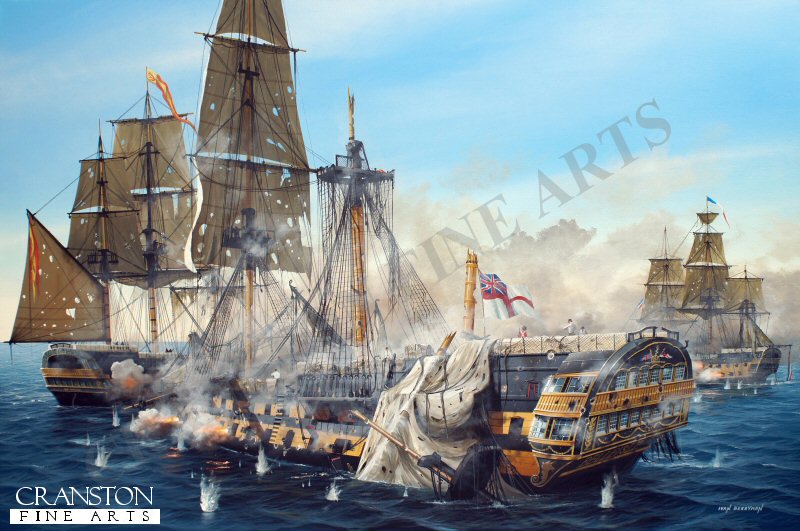
The Tenacious Belleisle by Ivan Berryman. Few ships fought more bravely than HMS Belleisle at the Battle of Trafalgar. Having been second in the line of Collingwood’s leeward division, the 74-gun Belleisle took on a number of opponents including the Monarca, Santa Ana and Indomtable, but soon found herself surrounded by enemy ships that poured weighty broadsides into her. By 2.30 in the afternoon, Bellisle was little more than a floating wreck, having lost all of her masts and bowsprit, yet still she fought bravely on, her colours flying defiantly from the stump of her mizzen mast. Belleisle survived her ordeal and was towed to Gibraltar after the battle where temporary repairs were made, arriving in Plymouth for a refit on 5th December 1805. |
U.123 - The Atik's Revenge by Ivan Berryman. On 27 March 1942, Q-ship USS Atik (AK 101) received a torpedo hit from the U.123, forward of her bridge structure. The ship caught fire and, as her bow dropped in the water, she developed a list to port. U.123 closed in to finish the ship off, at which point USS Atik uncovered her concealed weapons and raked the U-boat with 50mm fire, killing one of the German crew. U.123 was driven off, but she submerged and fired another torpedo into the Atik's engine room which was the final blow for the brave Q-ship. |
U-997 by Ivan Berryman. A Type VIIC U-boat, U-997 was one of lucky ones to survive the war. One of around 700 of the Type VIIs - the workhorse of the German U-boat threat - it was an example of the 91 Type VIIC/41 variety, one of which is the only surviving Type VII in existence (U-995 is a memorial in Germany). U-997 served between September 1943 and the end of the war when the submarine was surrendered and subsequently sunk by Allied aircraft with more than 100 other U-boats during Operation Deadlight, north-west of Ireland. |
Last Voyage of the Yamato by Stan Stokes. The 74,000 ton Yamato and the Musashi were the two largest battleships ever built, and typified the Imperial Japanese Navys attitude that their ships should be superior to anything the United States had. As a comparison the German Battleship Deutschland displaced a mere 15,500 tons. Each of these ships carried nine 18.1 inch guns, the most powerful armament available on any ship at that point in time. The Yamato participated in the attack on Midway, serving as Admiral Yamamotos flag ship, and many of the other significant sea battles in the Pacific. By the time the Allies were preparing to invade Okinawa, the Japanese had been forced to utilize Kikusui tactics which would involve mass suicide attacks and individual suicide missions. The army had made numerous sacrifices, and senior Japanese naval officers realized that the Yamato would need to be sacrificed in the defense of Okinawa, as a matter of pride. The Yamatos 350-mile trip to Okinawa without any meaningful air cover would be a suicide mission, and the ship and its escort vessels were equipped with only enough fuel for a one-way trip. On April 6, 1945 the huge vessel departed and was immediately sighted by two American submarines, the USS Threadfin and the USS Hackleback. The information was passed on to the USN task force, and on April 7 an F6F from the USS Essex spotted the Yamato and relayed its position back to the USS Indianapolis, the flag ship of Admiral Spruance. An initial attack force of 280 USN aircraft were launched from nine American carriers, followed by a second wave of aircraft from four other carriers. Knowing that the Japanese had no air cover, the F6F Hellcats carried 500 pound bombs, and were joined by Avenger torpedo bombers and Curtis SB2C dive bombers. The Americans had learned from their earlier attack on the Musashi to concentrate torpedo attacks on one side of the giant ship. The Yamato was hit with numerous torpedoes and bombs. By 13:00 the giant battleship was listing 20 degrees to port and her antiaircraft guns were inoperative. At 14:10 another torpedo hit jammed the ships rudder, and the Yamato began to circle at about 8 knots. At 14:23 the Yamato rolled over and exploded in a giant mushroom cloud and sank with the loss of nearly 2,500 men. The Grumman TBF Avenger was the first torpedo bomber produced by that company. It bore a resemblance to the F4F Wildcat, and incorporated a unique internal bomb bay capable of carrying a 2,000 lb torpedo or four 500 lb bombs. The TBF was a big aircraft with a wingspan of 54 feet, and an empty weight of 10,080 lbs. It was capable of 271-MPH with a range of 1,215 miles. The Avenger incorporated a light weight electrically driven rear ball turret. The Avenger was so successful that General Motors was also pressed into service producing the aircraft with their version designated as a TBM. |
HMS K17 by Ivan Berryman. K17 was one of the unusual K-class submarines operating in the Royal Navy in World War One. This class were unusual in that they were powered by steam while operating on the surface to allow them the speed to keep up with the fleet. They were also unusual in their notorious poor fortune, gaining the nickname 'Kalamity Class'. None of the class ever successfully engaged with the enemy, and yet 6 were lost in accidents, including K17. Known as the 'Battle of May Island', a series of unfortunate collisions between submarines and surface vessels in the misty darkness of 31st January - 1st February 1918 saw both submarines K4 and K17 sunk, with several other vessels damaged. From a crew of 56, just 9 men escaped from K17 and just 8 survived the freezing waters. Here, K17 is shown cruising on the surface with funnels up in 1917. |
Tribute to Lt Cdr Eric 'Winkle' Brown by Ivan Berryman. One of the most experienced and respected test pilots in history, Eric 'Winkle' Brown carried out the first landing and take off by a jet aircraft on an aircraft carrier on 3rd December 1945. This was accomplished in the second prototype De Havilland Vampire LZ551/G which had been extensively modified for the sole purpose of carrier operations. Not only was an arrester hook added, but the aircraft featured larger flaps and was fitted with the more powerful Goblin 2 engine. The first take off by a jet from an aircraft carrier is depicted here as Lt Cdr Brown lifts away from the deck of HMS Ocean on that momentous day. |
Remember the Maine by Stan Stokes. No text for this item |
Nerves of Steel by Ivan Berryman. Just moments from her devastating opening broadside, HMS Victory prepares to pass the stern of the French flagship, Bucentaure, to break through the line of the combined French and Spanish fleets as the Battle of Trafalgar begins on 21st October 1805. Victorys guns had remained silent until this moment, Lord Nelsons flagship having already suffered severe damage during the approach, but now the gun crews awaited the moment when her double-shotted cannon, her mighty 68-pounder carronade and a shower of musket balls would smash through the French vessel, rendering it at once a useless hulk. |
QE II by Ivan Berryman. Cunard Liner QE II (Queen Elizabeth II) in the late 1980s. The longest serving passenger liner in history, this iconic ship completed her final voyage in November 2008, becoming a permanently moored hotel in Dubai. |
| Navigation | |
| Page 4 of 7 | Previous .. Page 4 .. Next |
|
Contact Details |
|
Sign Up To Our Newsletter!
This website is owned by Cranston Fine Arts. Torwood House, Torwoodhill Road, Rhu, Helensburgh, Scotland, G848LE Contact: Tel: (+44) (0) 1436 820269. Email: cranstonorders -at- outlook.com |
 |