|
|
|
|
|
|
|
|
 |
 |
 |
 |
 |
 |
 |
 |
 |
 |
 |
 |
 |
 |
|
Ship Index |
Naval Signature Index |
Naval Artists Index |
Naval Art by Country |
Naval Art Offers |
|
| Navigation | |
| Page 6 of 7 | Previous .. Page 6 .. Next |
| Special Offer Naval Art |
|
|
|
|
|
|
|
|
|
|
|
|
|
|
|
|
|
|
|
|
|
| Navigation | |
| Page 6 of 7 | Previous .. Page 6 .. Next |
| Text for the above items : |
The Last Navy Biplane Fighter by Stan Stokes. The Grumman Aircraft Engineering Corp. was organized in late 1929. The US Navy ordered 27 production Grumman FF-1 biplane fighters in 1932, the beginning of a relationship that has endured for more than seventy years. The FF-1 was a diminutive staggerwing fighter capable of a top speed of 207-MPH. A large number of aircraft were produced for export by Grumman in the early 1930s, but the company wanted to win a contract for a new and improved USN fighter. In May of 1934 the company succeeded with a contract for 54 F2F-1s. In 1934 the company also won a contract for a new and improved F3F-1. The latter was aerodynamically improved design which overcame some of the design inadequacies of the earlier aircraft. The F3F-2 was delivered in 1937. Three units were equipped with the aircraft, VF-6 operating off the USS Enterprise, VMF-2 based in San Diego, California, and VMF-1 based in Quantico, Virginia. Grumman was working on another variant, but they became concerned about the monoplane design proposed by Brewster Aircraft, so they modified their proposal from the XF4F-1 biplane to the XF4F-2 monoplane which would become the Grumman Wildcat fighter. The F3F was a stretched version of the earlier F2F produced by Grumman and also had larger wings and more modern aerodynamic features. Initial production models were fitted with a 650-HP Pratt & Whitney radial and an 8-foot 6-inch Hamilton Standard prop. The F3F-2 was the primary variant. It utilized a 950-HP engine and was armed with one .30 caliber and one 0.50 caliber machine guns. The F3F-2 was capable of a top speed slightly in excess of 240-MPH, had a service ceiling of 30,000 feet, and an effective range of 825-miles. The F3F-2s were delivered to VF-6 aboard the USS Enterprise, VMF-1 at Quantico Virginia and VMF-2 at San Diego, California. The F3F-3 was similar in design to the F3F-2. The two aircraft were almost indistinguishable, yet the 3 was 8-MPH faster due to a tighter fitting engine cowling, some aerodynamic refinements, and the deletion of the the fuselage vents. By the end of 1941 the last of these Grumman biplane fighters had disappeared from front line service. VMF 111 and VMF 211 were the last two units to relinquish their F3Fs in July and October of 1941, respectively. The1941 color movie Dive Bomber, starring Erroll Flynn, Ralph Bellamy, and Fred McMurray, featured the F3F, and many future naval aviators were motivated to sign-up after seeing this picture. As illustrated in Stan Stokes painting, an F3F aircraft piloted by a young Naval officer of Fighting Six, James E. Howard, lifts off from the USS Enterprise during fleet maneuvers before the War. Howard flew with VF-6 from 1937 through 1941. In mid-41 he resigned his commission to join the AVG Flying Tigers in China, and upon his return to the States he accepted a commission with the USAAF as a Captain. He became commander of the 356th Fighter Squadron flying the P-51 Mustang. Howards most memorable day was on January 11, 1944 when he single handedly protected a bomber squadron from enemy fighter attack on their return from their bombing mission. Labeled a one man air force by one of the bomber pilots, Howard would be awarded the Congressional Medal of Honor for his heroic acts of January 11th. Howard was the only fighter ace in the European theater to be so honored. |
Grenvilles Revenge by Brian Wood. The English fleet pursued the Armada up the English Channel and, as darkness fell, Vice Admiral Drake broke off and captured the Spanish galleon Rosario, Admiral Pedro de Valdes and the crew. The Rosario was known to be carrying substantial funds to pay the Spanish Army in the Low Countries. Drakes ship had been leading the English pursuit of the Armada by means of a lantern. By extinguishing this for the capture, Drake put the fleet into disarray overnight. On the night of 29th July 1588, Vice Admiral Drake organised fire-ships, causing most of the Spanish captains to break formation and sail out of Calais . The next day, Drake was present at the Battle of Gravelines. English losses were comparatively few, and none of their ships were sunk. |
HMS Victory by Randall Wilson. As Admiral Nelsons flagship leads the British fleet toward the Franco-Spanish line, Captain Harveys Temeraire tries to pass Victory in order to be the first to break the enemy column. |
The Armada. The Attack of the Vanguard. No text for this item |
Aloha Hawaii by Randall Wilson. Battleship USS Pennsylvania off Diamond Head, Hawaii. |
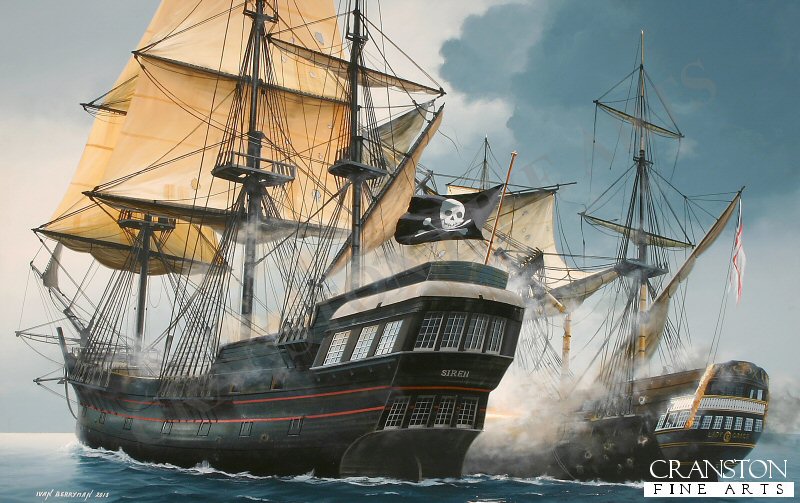
The Taking of the Lady Grace by Ivan Berryman. Although entirely fictitious, this scene depicts a typical action by pirates in the early 1700s, most likely in the Caribbean where the many supply routes from Europe converged and offered rich pickings. Although fraught with danger, the rewards for the buccaneers were rich and plenty, many of them rising to great notoriety for their daring exploits. |
HMS Hood During the Fleet Review of 1935 by Ivan Berryman. Fully dressed and resplendent, HMS Hood is pictured preparing for King George Vs review of the Fleet in July 1935 as other capital ships take up their positions around her. Ramillies can be seen off Hoods port bow, Resolution astern, whilst just beyond her boat deck, the mighty Nelson gently nudges into position. |
Anne Bonney, Mary Reid and Calico Jack Rackam by Chris Collingwood. None among Rackams crew were more resolute or ready to board or undertake anything that was hazardous. Quote taken from Captain C. Johnsons book. A General History of the Robberies and murders of the Most Notorious Pirates. (1724) |
Fast and Furious by Stan Stokes. Thomas Sopwith was a distinguished British aviator who organized the Sopwith Aviation Company. Sopwith produced an aircraft which won the coveted Schneider Trophy race. With the start of WW I, Sopwith Aviation shifted its focus to military aircraft, and was to become one the major suppliers to both the Royal Air Corps and the Royal Naval Air Service. In October of 1914 two Sopwith Tabloids flew a 200-mile round trip strike against the airship sheds at Dusseldorf and Cologne. The Sopwith Strutter firmly entrenched Sopwith as a producer of quality-built aircraft. The Strutter was a precursor of the Sopwith Pup, which would serve as the Royal Navys first carrier aircraft. The first production Pup was delivered to the Royal Navy in 1916. Most Pups were powered by a 80-HP Le Rhone radial engine, which gave the Pup a top speed of 115-MPH and an endurance of three hours. Many Navy Pups were modified to utilize a tripod mounted Lewis gun which could be fired forward or upwards through a cutout in the upper wing. Sopwith Pups were also utilized on battlecruisers. In fact, a Pup launched from the HMS Yarmouth downed the Zeppelin L.23 in August of 1917. The Royal Navys HMS Furious was the first dedicated aircraft carrier in the world. The Furious was initially laid down as a battlecruiser, but the design was modified during construction to include a flying deck forward of the main bridge. This configuration allowed aircraft to be launched as the Furious steamed into the wind. An attempt at recovery by having aircraft side slip on to the deck proved ineffective with one of the early attempts resulting in the death of the pilot, Squadron Commander E. H. Dunning, who had made the worlds first successful carrier landing on a ship underway only days earllier. The Royal Navy decided to further modify the Furious by adding a second deck aft of the bridge. The fore and aft decks were connected by a narrow ramp on either side of the funnel and bridge, and this permitted aircraft to be to moved between the two decks. Sets of longitudinal wires were set across the aft deck, and were designed to catch the skids of the Sopwith Pups during landings. Recovering aircraft was still tricky, and a rope barrier was erected aft of the mainmast to prevent aircraft which overshot from crashing into the superstructure of the ship. The first carrier-based naval air strike in history was carried out against the Zeppelin hangars at Tondern by the Furious on July 19, 1918. Seven Sopwith Camels, each carrying two 50-pound bombs were utilized for this mission. This important moment in the history of naval aviation is captured magnificently in Stan Stokes highly detailed painting entitled Fast and Furious. |
North Atlantic Predator by Ivan Berryman. U-99 was commanded by Otto Kretschmer from launch in 1940 until being sunk in March 1941, less than a year later. However, during this time U-99 became one of the most successful submarines of the war, claiming almost 40 ships sunk. Attached to each side of the coning tower is a horseshoe, dredged up by the anchor, painted gold and positioned here for luck. This luck ran out on 17th March 1941 when the destroyers HMS Walker and HMS Vanoc discovered and successfully attacked U-99. Forced to the surface by severe damage, the submarine was then scuttled while forty of the crew including Kretschmer were rescued to become prisoners of war. |
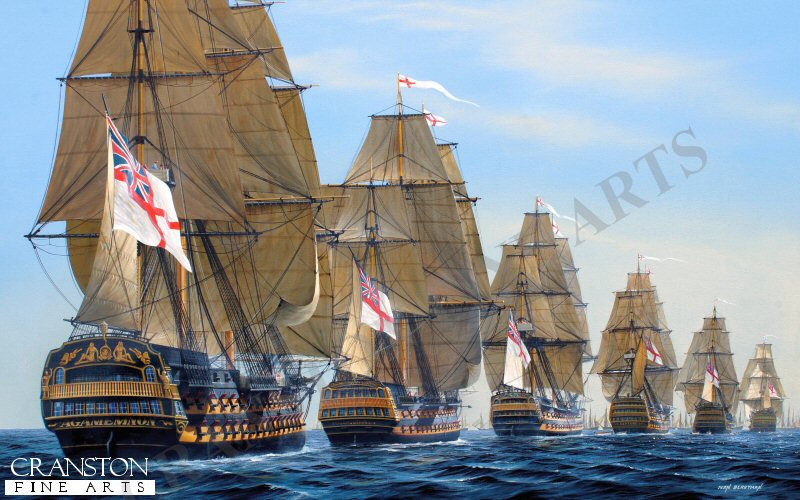
In Destinys Hands, Trafalgar, 12:15 PM by Ivan Berryman It is approximately 12,15 pm on 21st October 1805. With the combined Franco-Spanish enemy line in the far distance, HMS Victory is just beginning to manouevre, having chosen the French flagship Bucentaure as her target. Behind Victory lies Temeraire, then Neptune, followed by the two-deckers, Leviathan and Conqueror and Agamemnon in the foreground. Victory is flying the signal Engage the Enemy Closely from her main mast. Most ships have their studding sails set on the larboard (port) side only trying to harness as much wind as possible to hasten their approach 1n such light airs. At this stage, the stoves will have been extinguished, the guns run out and all decks cleared for action, their floors strewn with sawdust to avoid slipping and to soak up the blood. The Marines will be in position the officers at their posts and gun crews may likely have been singing hearty songs to raise their spirits. Fate alone knew what awaited them, once the firing started. |
HMS Warspite, Shooting from the Hip by Randall Wilson. HMS Warspite is shown in action during the 2nd battle of Narvik, April 1940. |
HMS Speedy - Cochranes Action Against the Gamo by Ivan Berryman On 6 May 1801, HMS Speedy was cruising off the Spanish Coast when a large enemy frigate was sighted, a xebec-rigged vessel named Gamo, commanded by Don Francisco de Torres. Instead of evading the Spanish ship, which was carrying seven times the firepower of the tiny Speedy, Captain Thomas John Cochrane instead brought his ship so close to the Spanish frigate that the Spanish were unable to bring their guns to bear, whilst Speedy was able to fire repeatedly up through the Gamos hull and decks, de Torres being killed in the opening broadside. After repelling boarders, Cochrane despatched his entire crew, bar the ships doctor, to seize the Gamo and take her as a prize, tearing down the Spanish colours to convince her crew that she had struck and fallen to their tiny British opponent. |
Fallen Eagle by Stan Stokes. The McDonnell Douglas A-4 Skyhawk was designed by Ed Heinemann as a successor to the Skyraider attack bomber. The prototype aircraft first flew in 1954. The diminutive Skyhawk was only 42 feet in length, with a carrier friendly wingspan of 27 feet. The Skyhawk was capable of speeds close to 700 MPH, and was produced in several variants through 1979. The Skyhawk was utilized extensively in Vietnam for ground attack and support. As depicted in Stan Stokes painting entitled Fallen Eagle, the A-4 of a young Navy aviator, Everett Alvarez, has just taken off from the USS Constellation at 2:30 PM on August 5, 1964. Alvarez, a native of Salinas California, had attended the University of Santa Clara before joining the Navy. It was a day that Alvarez would not soon forget. About midnight that day the destroyers USS Maddox and USS Turner Joy were under attack from North Vietnamese patrol boats in international waters sixty miles off the coast of North Vietnam. Alvarez unit, the VA-144 Roadrunners, had been scrambled to assist the destroyers, but terrible weather conditions prevented any action. Washington decided to retaliate against these attacks by authorizing the first bombardment of North Vietnam on August 5, 1964. On that day twenty-two aircraft from the USS Ticonderoga attacked North Vietnam military targets at 1:15 PM. Only one aircraft was damaged during this first wave, and its pilot successfully made it back to an airfield in South Vietnam. The USS Constellation would provide a second wave involving 10 Skyhawks, 4 Skyraiders, and a single F-4 to provide fighter cover. Alvarez target was the harbor at Hon Gai, where his mission was to destroy any military patrol boats in the harbor. The lumbering Skyraiders were launched early, and Alvarez was the first of the ten Skyhawks off the Constellation. The Skyhawks rendezvoused at 20,000 feet before climbing to 30,000 feet for the seventy-five minute flight to the target area. Alvarez A-4 was equipped with a belly pod of 19 rockets. The Skyhawks streaked in over the harbor at 500 MPH in a shallow dive. Four torpedo boats and a larger coastal patrol ship were in the harbor. Alvarez made two passes over the harbor, and as he was passing over the southern edge of the town he saw a yellow flash to the port side of his windscreen accompanied by a popping sound. Seconds later the A-4 shook violently, and all the warning lights came on. The cockpit began to fill with smoke and the stick froze. With a final radio transmission, Im getting out! Ill see you guys later!, Alvarez pulled his ejection ring. Within seconds he was in the water. Picked-up minutes later by some very nervous fisherman, Everett Alvarez would become the first pilot shot down and captured over North Vietnam. It would be eight-and-one-half years later that Alvarez would be released, having endured hardships which would have broken anyone of less than the highest faith and courage. Everett Alvarez retired from the Navy in 1980, and was later a Deputy Director of the Peace Corps, and Deputy Director of the Veterans Administration. |
Scratch One Flat Top by Stan Stokes. The Douglas TBD Devastator torpedo-bomber was the first low-wing, all metal monoplane to see service with the US Navy. Delivered in 1937 about 100 TBDs were in service when the Japanese attack at Pearl Harbor thrust the United States into WW II. Powered by a 811-HP Pratt and Whitney radial engine, the TBD had a maximum speed of about 200 MPH and a range of about 700 miles. Unfortunately, given the design of the torpedoes used, attacks had to be made at a maximum speed of only about 110 MPH, and at an altitude of no more than 100 feet. This made the Devastator a sitting duck for both enemy fighters or anti-aircraft gunners. The highlight of the TBDs brief battle career in WW II came during the Battle of the Coral Sea in 1942. This battle, the first ever waged solely between the aircraft of opposing carrier attack groups, involved air groups from the USS Yorktown and USS Lexington. Three Japanese carriers, the Shokaku, the Zuikaku, and the Shoho were involved. On May 7 the Lexington launched fifty aircraft and the Yorktown another 43. Two squadrons of TBDs were involved in the attack. This massed force located the Shoho around 11:00 AM. SBD Dauntless dive bombers initiated the attack, and were successful at fending off fighter attacks by Zeros during their near vertical dives. The large force of SBDs put several 1000-pounders into the Shoho. Minutes later the Devastators from the Lexington attacked, gaining advantage from the smoke and confusion created by the dive bombers. Coming in low and slow the Devastators put six or seven torpedoes into the Shoho. In Stan Stokes painting the TBD flown by Lt. R. F. Farrington, T.R. Wiebe, and Walter N. Nelson of VT-2 from the USS Lexington is depicted. Several more hits by the Dauntlesses sealed the fate of the Shoho which slipped under the waves while still making a headway of about 20 knots. Witnessing the Shohos final moments, Lt. Cdr. Bob Dixon reported by radio at 11:36 AM the following message, Scratch One Flat Top! Dixon to carrier. Scratch one Flat Top! This was the first loss of a significant ship by the Imperial Navy. It also foretold of an end of the era of surface war ships slugging it out in a gunnery duel within sight of each other. The era of the carrier battle group had begun, with destruction delivered to a distant enemy by carrier based aircraft. Weeks following the Battle of the Coral Sea, at the Battle of Midway, the United States Navy would destroy almost 50% of Japans carriers in a momentous battle. The Navys TBDs would be virtually wiped-out at Midway, and would be replaced in front-line service by TBF Avengers and SB2C Helldivers for the balance of the War. |
Floating Fortress by Randall Wilson. The Tirpitz showing her last paint scheme, she sailed from Kaafjord to Hakoy island, Tromso Fjord it was to be her final resting place. Hit by tallboy bombs she capsized and sank. |
HMS Anson at Sydney Harbour, July 1945 by Ivan Berryman. The King George V class battleship HMS Anson is pictured in Sydney Harbour where she joined the Pacific Fleet in July 1945, viewed across the flight deck of HMS Vengeance, where ten of her Vought F4.U Corsairs are ranged in front of a single folded Fairey Barracuda |
Cats First Cruise by Stan Stokes. Grumman Aircraft has had a long tradition of providing rugged aircraft for naval aviators. These Grumman planes were all named Cats. The F-14 Tomcat, the latest in the long line of Grumman carrier cats, evolved from Grummans involvement as a subcontractor in the ill-fated TFX development program. Ever since the WW II Battle of Midway, the Navy has been concerned about the vulnerability of its carriers to attack. Super carriers, the largest mobile machines ever developed by mankind, are vulnerable to attack from ground, sea or air-launched missiles. To protect its carriers, the Navy has long recognized the critical need for high speed, long-range, heavily-armed, interceptors. The first two jet-powered aircraft to fill this role were the F-8 Crusader and the F-4 Phantom II. The F-14 Tomcat was developed to provide an improved interceptor capable of carrying the heavier Phoenix missile, and advanced avionics. The first Tomcat prototype flew on December 21, 1970. By late 1972 full scale production of the F-14 had commenced. The Tomcat is big and heavy. It can operate at altitudes in excess of 50,000 feet, can exceed speeds of 1,500 MPH, and has a maximum range in excess of 2,000 miles. Despite its size and high performance the Tomcat is an agile bird. With its variable-geometry wings, the F-14 can be configured on the fly to change its flying and handling characteristics. The aircraft is equipped with a 20mm cannon, and can carry a large assortment of highly lethal guided missiles. The aircraft got its Tomcat name because of Admiral Tom Connollys involvement in the project, and the fact that Grumman was the designer and builder of the F-14. The Tomcat, like the F-4 before it, carries a two-man crew. Grumman designed the aircraft with upgradability in mind. This has permitted improved engines, improved avionics, and improved missals to be incorporated into the basic air frame with remarkable effectiveness. Highly regarded aviation artist Stan Stokes, in his dramatic painting entitled Cats First Cruise, shows an F-14 of the Navys VF-1 Wolfpack squadron on final approach to the USS Enterprise. The Wolfpack, and the VF-2 Bounty Hunters were the first two squadrons of Tomcats deployed for carrier duty. Their first cruise was in 1974. By 1980 the Navy had deployed Tomcat squadrons on nearly all its active carriers. The Tomcat has proven itself in actual combat and no doubt will continue to serve as the Navys primary long range carrier-based interceptor for many more years. |
Quite a Pair by Stan Stokes. The US Navys first two effective aircraft carriers were the USS Lexington and the USS Saratoga; both converted from battle cruiser hulls in 1927. The Lexington, CV-2, was built in Quincy, Massachusetts, and commissioned in December of 1927. The Saratoga, CV-3, was built in Camden, New Jersey and commissioned in November of 1927. During fleet exercises in the early 1930s the capabilities and limitations of these two great ships had a huge impact on the evolution of carrier tactics. The speed of these big carriers allowed them to operate as an independent task force, and they would therefore need to carry an air group that would provide for a balance between offensive and defensive forces. The Lexington was in the Pacific during the attack on Pearl Harbor. She was involved in raids on Japanese strongholds in the southwestern Pacific in early 1942. She joined the Yorktown in the Battle of the Coral Sea. Her aircraft participated in attacks on the Japanese carriers Shoho, Shokaku, and Zuikaku. On May 8 the Lady Lex herself was the target of Japanese carrier aircraft. She took three bomb hits, and two torpedo hits. She was scuttled by her crew, becoming the first carrier lost by the US during the War. The Saratoga was in San Diego when the Pearl Harbor attack occurred. She served admirably in the Pacific sustaining repairable damage on several occasions. She took leave of the Pacific theater for a year to assist the British. The Big E met an ignominious demise as part of the Bikini Atoll atomic bomb tests. Showing her toughness she survived the first blast she was exposed to, but an underwater blast from only 500 yards away sunk the ship in August 1946. The Saratoga and the Lexington are depicted in Stan Stokes painting during maneuvers in the early 1930s. A Boeing FB fighter passes overhead. The Boeing Aircraft was founded in 1916 and initially built floatplanes. The companys first contract for a fighter/pursuit aircraft came in 1921 when it won the contract to build the Thomas-Morse designed MB-3 fighter. Boeings engineers began developing a fighter of their own design that would utilize a welded steel tube frame instead of the normal wooden frame. The Army tested the Model 15 prototype in 1923. Although they liked many of the features the Army opted to purchase the competing Curtiss design. They did order a couple of the Boeing planes for testing, and about a year later they placed an order for 25 PW-9s. The Navy also decided in 1924 to purchase the design, designating it as the FB-1. Improved variants were designated FB-2/3/4/5/6 etc. Boeing built a total of nearly 600 aircraft in this family, making it one of the most widely produced aircraft in the between Wars era. The FB-2/3/4 variants included modifications for carrier use and a more powerful 510-HP Packard-IA engine. With the additional power, a taller rudder assembly was deemed necessary to provide adequate flight stability. The Navy ordered twenty-seven FB-5s and began taking deliveries in 1927. The upper wing of the FB-5 variant was moved forward while the lower wing was moved backwards. In addition a slightly more powerful Packard engine was utilized. |
The Battle of Trafalgar by Stan Stokes. The HMS Victory crosses the T in a most unorthodox naval maneuver, leading to the defeat of the Franco-Spanish fleet. Admiral Nelson would lose his life as a result of the epic battle, and forever earn a revered place in the minds and hearts of his countrymen. |
Stalemate at Hampton Roads by Stan Stokes. The USS Monitor and CSS Virginia. |
| Navigation | |
| Page 6 of 7 | Previous .. Page 6 .. Next |
|
Contact Details |
|
Sign Up To Our Newsletter!
This website is owned by Cranston Fine Arts. Torwood House, Torwoodhill Road, Rhu, Helensburgh, Scotland, G848LE Contact: Tel: (+44) (0) 1436 820269. Email: cranstonorders -at- outlook.com |
 |