|
|
|
|
|
|
|
|
 |
 |
 |
 |
 |
 |
 |
 |
 |
 |
 |
 |
 |
 |
|
Ship Index |
Naval Signature Index |
Naval Artists Index |
Naval Art by Country |
Naval Art Offers |
|
| Navigation | |
| Page 5 of 7 | Previous .. Page 5 .. Next |
| Special Offer Naval Art |
|
|
|
|
|
|
|
|
|
|
|
|
|
|
|
|
|
|
|
|
|
| Navigation | |
| Page 5 of 7 | Previous .. Page 5 .. Next |
| Text for the above items : |
Fast Cats by Stan Stokes. The F8F Bearcat and the F7F Tigercat were the final family members in Grummans fabulous series of prop driven USN fighter aircraft. The F7F Tigercat evolved from the work of a three-man design team at Grumman, which included Bob Hall, Dick Hutton, and Gordon Israel. The Navy gave an OK to the development of a prototype in mid-1941, however it would not be until April 1944 that the first production Tigercat was delivered. The Navy planned to use the first two hundred F7Fs as night fighters, but due to unsatisfactory carrier suitability trials; the decision was made to scale back the order and equip only shore-based Marine squadrons with this aircraft. Performance tests of the first production F7Fs were impressive. The F7F was almost 80-MPH faster than an F4U Corsair in level flight at sea level. As WW II wound down, the USN changed its plans for the F7F. Newer variants were developed with the most common being the F7F-3N. The 3N was the first F7F to pass carrier qualification on the USS Shangri La in February of 1946. The final variant was the F7F-4N that included a taller rudder, a stronger wing and fuselage, and improved landing gear and tailhook. During the Korean War these aircraft were utilized in the night fighter role. The F8F was the successor to the successful F6F Hellcat fighter which was the US Navys primary fighter during most of WW II. Grummans test pilot, Bob Hall recommended to Grummans President that the successor to the F6F be small and lightweight and faster than anything flying at that time. In competition with both Curtis and Boeing, the Grumman design utilized a 2,100-HP Pratt and Whitney radial engine driving an enormous propeller more than twelve feet in diameter. The prop was so large that the Bearcat needed very tall landing gear. During its early testing the Bearcat was capable of speeds in excess of 440-MPH. The F8F was ordered into production in mid-1944, and the Navy wanted all the Bearcats it could get before November of 1945, which was the presumed date for an invasion of Japan. One interesting design feature of the initial production Bearcats was a break-away section at each wing tip, which was designed to break-off if overstressed, in order to prevent a catastrophic failure of the complete wing. Also unique was the utilization of a bubble canopy, the first on a Navy aircraft. On February 17, 1945 LCDR Robert Elder flew the F8F in its first carrier suitability trials on the USS Charger. Despite terrible weather conditions, Elder made fifteen successful arrested landings. The F8F passed these trials with flying colors. Too late to see action in WW II, the F8F would also see service in Korea, in both the reconnaissance and night fighting roles. In Stan Stokes painting an F8F accompanies an F7F-4N during the carrier qualification of the F7F-4N on the USS Franklin Roosevelt (CV-42) in 1946. |
The Mighty Intrepid by Anthony Saunders USS Intrepid was laid down in 1941 and was one of a class of 24 ships of the Essex class. This was the largest fleet of aircraft carriers ever constructed and proved the industrial might of the United States beyond doubt. Carrying 90 aircraft each, they formed the main air strength and striking power of the US Pacific Fleet against the Japanese. The Intrepid saw her first action in January 1944 supporting operations at Kwajalein. While operating in raids on Truk in February 1944 Intrepid was hit by a torpedo which damaged her steering gear, requiring repairs which kept her from the war zone until June. She then took part in operations off the Palaus, the Philippines, Okinawa and Formosa. She was struck twice by kamikazes in late 1944. Returning to action in March 1945, she participated in strikes against the Japanese home islands and Okinawa, suffering another kamikaze hit in April of 1945 - she survived the most hits of any other US carrier in the war. Here the Intrepid is seen in October 1944 whilst with TG38.2 flanked by the cruiser USS Vincennes and the destroyer USS The Sullivans. |
The Arctic Run by Anthony Saunders Arctic Convoy. Forcing their way through adverse conditions bordering on the limitations of human endurance, The Allied convoys faced appalling odds of survival in the endeavour to supply raw materials to Russias only ice free port of Murmansk. |
Undaunted by Ivan Berryman. A Viking Long Ship surges forward in a heavy sea, powered along by oars and sail. |
HMS Victory at the Battle of Trafalgar by Graeme Lothian. The time is 1.35pm. (ten minutes after Admiral nelson had been fatally shot) HMS Temeraire and HMS Victory, are seen broadside to the redoubtable, which by 2pm had lost most of her crew, (out of a crew of 643 - 487 were dead, 81 died soon after, and only 25 were fit to crew) |
Veterans of the Med by Ivan Berryman. Alone in the aerial defence of Malta in the early part of WW2, these three Gloster Gladiators, nicknamed Faith, Hope and Charity, saw such intense action against the invading Italian air force that the enemy's commanders were convinced that a much bigger force existed on Malta. They are depicted here making a low pass over the destroyer HMS Dainty as she heads out of Grand Harbour from Sliema Creek. Herself a veteran of much action in the early part of the war, HMS Dainty was lost to dive bombers off Tobruk on 24th February 1941. |
Bismarck - The Final Voyage by Anthony Saunders. One of the finest battleships of all time, Bismarck was built by the Blohm and Voss shipyard in Hamburg and launched in February 1939. Her first duty was for commerce raiding in the north Atlantic. Together with the heavy cruiser Prinz Eugen, the destroyers Z10, Z16 and Z23 and a minesweeper. The Bismarck, commanded by Vice Admiral Gunther Lutjens, left her last anchorage at Grimstadt Fjord in Norway. Once Bismarcks departure was confirmed all available British forces were deployed to meet the threat. On the 24th of May 1941 the Bismarck sailed into naval history - sinking the battlescruiser and pride of the British fleet - HMS Hood. But Bismarck would have little time to celebrate, she was sunk by a scorned British fleet three days later. Here Bismarck is depicted on the evening of the 21st May 1941 entering the open sea on her fateful final voyage. |
Destination Tokyo by Anthony Saunders. The daylight raid on Tokyo, led by Lt Col James H. Doolittle on Sunday 18 April 1942, has rightfully entered the history books as one of the most daring and courageous operations of the Second World War. On that day, in mid ocean, Doolittle had launched his B-25 Mitchell bomber from the heaving, spray-soaked flight deck of an aircraft carrier, a deck too short to land on, and flown on to bomb Tokyo. He knew there would be no return to the USS Hornet, either for him or the 15 heavily laden B-25s behind him, for this was a feat never before attempted, and for every crew member the mission was a one-way ticket. Yet, under the leadership of Jimmy Doolittle, they all dared to survive. The mission for the 16 bombers was to bomb industrial targets in Tokyo and surrounding areas, to slow production of strategic war material, then fly on to land in the part of south-west China that was still in the hands of friendly Nationalist forces. All being well, the mission would be so unexpected it would plant the first seeds of doubt into enemy minds. It worked – the Japanese were forced to quickly divert hundreds of aircraft, men and equipment away from offensive operations to the defence of their homeland. There was, however, another reason behind the Doolittle's raid – to lift the morale of an American public devastated by the attack on Pearl Harbor four months earlier. And the success of the mission provided the boost that was needed. If any had doubted America's resolve in the face of uncertainty, the courage, determination and heroism displayed by Lt Col Doolittle and his band of aviators restored their determination. Although it might take years, and the price would be high, America and her allies understood that the fight could, and would, be won. Commissioned to commemorate the 75th Anniversary of the Doolittle Tokyo Raid the painting portrays the dramatic moment that Lt Col Jimmy Doolittle lifts his B-25 off the pitching deck of the USS Hornet. Having timed his launch to perfection he climbs steeply away, ready to adjust his compass bearing for a direct line to Tokyo. On the sodden deck behind him the crews of the remaining 15 aircraft, whose engines are warmed, ready and turning, will quickly follow their commanding officer into the murky sky. |
Bombardment of Algiers by George Chambers. Depicts the attack by the British and Dutch fleets against the Barbary Corsairs on the 27th August 1816. The bombardment lasted 10 hours and the losses on both sides were very high but it was a great success with over 1650 enslaved prisoners liberated. |
Captain Morgan by Chris Collingwood No text for this item |
The Aircraft That Found the Bismarck by Ivan Berryman. In early May 1941, in conditions of strict secrecy because the United States was not yet at war, seventeen pilots of the US Navy had arrived in Britain and been attached to Catalina squadrons of Coastal Command. These experienced PBY pilots were there to assist the Royal Air Force to become familiar with the Catalina, and also to gain operational experience for the US Navy. On 26th May 1941 Catalina Z of No.209 Sqn, commanded by Flying Officer Dennis Briggs RAF, with Ensign Leonard B Smith USN as co-pilot, joined the search for the Bismarck. At 1015 the aircraft was being flown in poor visibility at an altitude of 500ft when Ensign Smith sighted the Bismarck at a range of eight miles. The Catalina was flown towards the contact so that a positive identification could be made and emerged from the cloud only 500 yards from the German ship. The aircraft met a hail of anti-aircraft fire but was able to make its escape. As a result of the sighting report from Catalina Z the Bismarck was again engaged by ships and aircraft of the Royal Navy and was sunk at 1040 on 27th May 1941. Leonard Smith can be considered therefore, the first American to be directly involved in action in World War Two. He was awarded the Distinguished Flying Cross (American) for his actions. |
The Raid on St Nazaire 28th March 1942 by David Rowlands. In early 1942 Britains very survival was threatened by the success of German U-Boat raids on shipping in the Atlantic. their mighty battleship Tirpitz posed even a greater threat. Operation Chariot a sea -borne commando attack was launched on a huge Normandie dock in the heavily defended St Naziare harbour. Destruction of the dock would deprive the Germans of the only repair site on the Atlantic coast big enough for the 50,000 ton Tirpitz. Accompanied by 18 small craft of Coastal Forces. HMS Campbletown boldly steamed up three Loire estuary under intense German fire, and struck the caisson of the dry dock at 0134 hrs. The Commandos rapidly disembarked from the bows and set about destroying the dock installations, Of the 622 who set out from Falmouth 169 died, 200 became prisoners and only 242 returned home. Five Victoria Crosses, four DSOs, seventeen DSCs and eleven MCs were awarded in the daring and brilliantly successful raid. |
Bucentaure by Ivan Berryman. Built at Toulon in 1803, Bucentaure was the flagship of Admiral Villeneuve at the Battle of Trafalgar on 21st October 1805 and the first to be almost completely disabled by a massive broadside from HMS Victory as Nelson broke through the enemy line. Bucentaure was taken as a prize by the British fleet, but was lost in the great storm that followed the battle. |
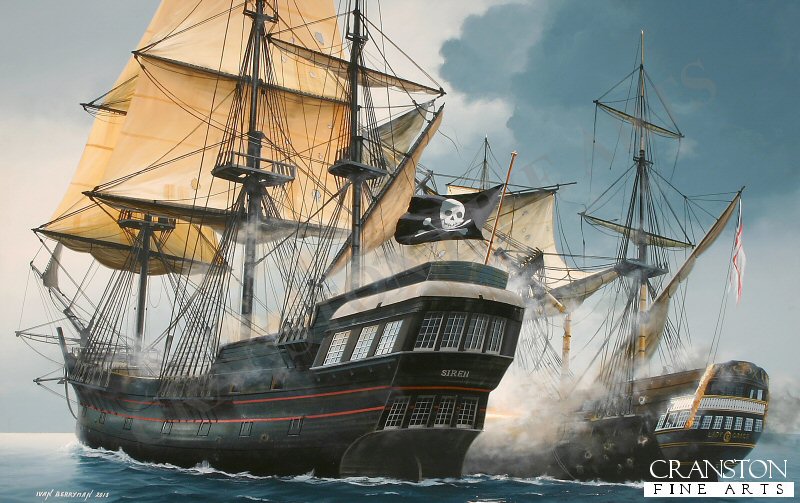
The Taking of the Lady Grace by Ivan Berryman. Although entirely fictitious, this scene depicts a typical action by pirates in the early 1700s, most likely in the Caribbean where the many supply routes from Europe converged and offered rich pickings. Although fraught with danger, the rewards for the buccaneers were rich and plenty, many of them rising to great notoriety for their daring exploits. |
HMS Temeraire Departing Plymouth by Ivan Berryman. One of the most iconic ships ever to serve in the Royal Navy, The three-decked second rate HMS Temeraire was built at Chatham in 1798 and spent many years blockading the French port of Brest before her finest hour at Trafalgar on 21st October 1805 when she came to the rescue of HMS Victory before capturing two prizes, the Redoutable and Fougueux, spending much of the battle with her captives lashed to her sides. After spending her final years first as a prison hulk, then as a guard ship in the Medway, she was finally sold for scrap in 1838, her last journey being the subject of JMW Turner's most famous painting. In this view, Temeraire is shown leaving Plymouth in her pre-Trafalgar state before receiving her 'crowned head' figurehead. |
One Way Trip by Ivan Berryman. Having strung their deadly payload from the bilge keels of another victim, the two man crew of an Italian SLC, or Maiale, prepare to make their getaway in the murky waters of an Allied harbour in the early part of WW2. Having set clamps on the bilge keels, the nose of the manned torpedo was detached and suspended on a steel cable strung between the clamps. A timer was set in motion and, a little over two hours later, the resulting explosion would rip through the ship's hull. Such was the fate of the British battleships HMS Queen Elizabeth and HMS Valiant as they lay in the harbour at Alexandria on 3rd December 1941. The fate of the frogmen was rarely a good one, most attacks resulting in almost certain capture - and often death - as there was no way back to the 'mother' submarine and they were forced to make their own way to whatever sanctuary they could find, having completed their audacious mission. |
HMS/M Thrasher by John Pettitt. HMS Thrasher was on her 8th patrol when on the 16th June 1942, an unsuccessful torpedo attack was made on the German merchant vessel Arkadia off Crete. Later, at 1155 hours, they spotted a deeply laden merchant vessel of about 3000 tons and turned to attack. The vessel had 5 escorts and aircraft circling overhead. At 1234 hours they fired the first salvo from 2000 yards, and immediately the submarine shook from a muffled explosion - probably a bomb from an aircraft, and machine gun bullets were heard striking the water above soon after. Three minutes later, two distant explosions were heard a few seconds apart - perhaps the torpedoes exploding or it may have been depth charges. Thrasher dived and at 1245 experienced the first of 33 depth charges, an uncomfortable experience with minor damage caused to the submarine. The following day, at 0150 hours, the crew discovered a large hole in the side of the gun platform and an unexploded bomb laying on the casing just forward of the gun. With a protion of its tail still attached, the bomb could not roll off of the casing. At 0240 hours, Thrasher went full astern and lowered into the water to dislodge the bomb. After, it was discovered that a further unexploded bomb was inside the casing and lying on the pressure hull. To remove this meant dragging the device 20 feet through the casing with great danger of it exploding. Lt P S W Roberts and PO T W Gould carried out this task and safely disposed of the bomb over the side at 0330 hours. For this action, they were both awarded the Victoria Cross. The painting depicts HMS Thrasher in her blue liver heading for Alexandria at the end of this patrol. |
HMS Sceptre by Ivan Berryman. Commissioned in 1943, HMS Sceptre was built by Scotts Shipbuilding in Greenock, Scotland. In a short career, Sceptre under the command of Lieutenant Ian McIntosh was involved with the X-Craft midget submarine attacks on German capital ships and floating docks in Norway. In addition, she sunk four enemy merchant ships and an enemy naval vessel between March and September 1944. HMS Sceptre was then refitted as a target submarine late in 1944, and was scrapped in 1949. |
U-47 by Ivan Berryman. Under the command of Günther Prien, the deadly U-47 became the 10th most successful U-Boat of World War Two in terms of tonnage sunk. However, on 8th October 1939 she sank the British battleship HMS Royak Oak within Scapa Flow, the main British naval base of the war, despite the anti-submarine measures in place. The submarine was presumed lost with all hands when she failed to return from her 10th patrol in March 1941, although no definitive explanation for her loss exists. |
HMS Bristol departing Portsmouth by Ivan Berryman. The only Type 82 destroyer to be built for the Royal Navy, HMS Bristol (D23) was designed for a role that never materialised, the rest of her class being cancelled when the intended CVA-01 class of aircraft carriers that she was intended to escort and defend were themselves cancelled in the late 1960s. Bristol enjoyed a long and varied career however, her size making her a suitable flagship for Operation Ocean Safari 81 before going in for a refit and joining the Royal Navy Task Force in the South Atlantic during the Falklands Campaign. Paid off in 1991, she is now moored permanently at Whale Island, Portsmouth, as a training ship. HMS Bristol is depicted here slipping quietly out of Portsmouth Harbour in the 1970s. |
Working Up by Robert Barbour. T class submarine HMS Thorn surfaces during the work up exercises off the west coast of Scotland in late 1941. Taking part is an escort sloop of the Black Swan class and a Sunderland from 201 Squadron, RAF Coastal Command. |
| Navigation | |
| Page 5 of 7 | Previous .. Page 5 .. Next |
|
Contact Details |
|
Sign Up To Our Newsletter!
This website is owned by Cranston Fine Arts. Torwood House, Torwoodhill Road, Rhu, Helensburgh, Scotland, G848LE Contact: Tel: (+44) (0) 1436 820269. Email: cranstonorders -at- outlook.com |
 |