|
|
|
|
|
|
|
|
 |
 |
 |
 |
 |
 |
 |
 |
 |
 |
 |
 |
 |
 |
|
Ship Index |
Naval Signature Index |
Naval Artists Index |
Naval Art by Country |
Naval Art Offers |
|
| Navigation | |
| Page 1 of 4 | Page 1 .. Next |
| Special Offer Naval Art |
|
|
|
|
|
|
|
|
|
|
|
|
|
|
|
|
|
|
|
|
|
| Navigation | |
| Page 1 of 4 | Page 1 .. Next |
| Text for the above items : |
HMS Fearless by Ivan Berryman Ships of the South Atlantic Task Force gather in San Carlos water during the Falklands Campaign of 1982. LCMs from HMS Fearless (L10) manoeuvre around their mother ship, with the logistic Ship RFA Sir Galahad (L3005) and the frigate HMS Argonaut (F56) in close attendance. |
Slow Ahead by Randall Wilson. H.M.A.S Hobart glides past Mount Fuji for the surrender ceremony with Missouri in the Background. Tokyo Bay 1945. |
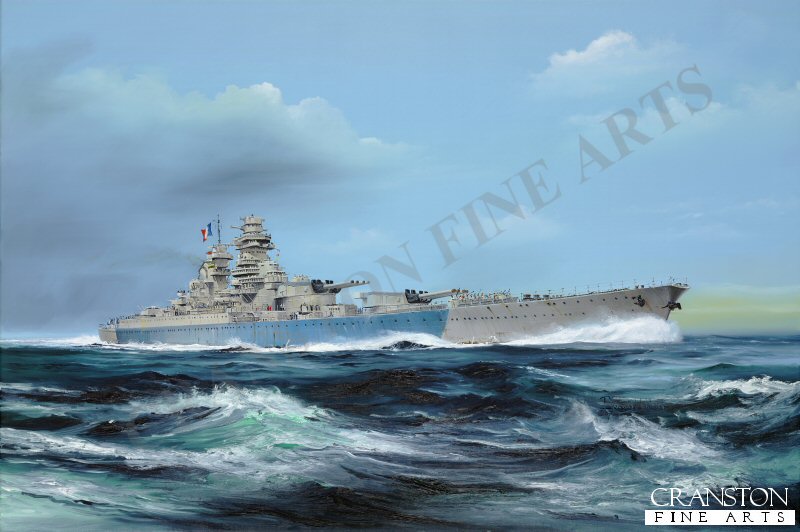
Richelieu at Sea by Randall Wilson. (GL) Richelieu in the Indian Ocean, 1945. |
HMS Vanguard and HMS Indefatigable by Ivan Berryman Britains last great Battleship HMS Vanguard along with the Carrier HMS Indefatigable lie at anchor in Scapa Flow in July 1951. |
HMS Ark Royal and HMS Sheffield off the Mole, Gibraltar by Ivan Berryman. Having played a vital part in the battle for the Mediterranean for over two years, HMS Ark Royal finally succumbed to a U-Boats torpedo in November 1941. She is shown here with a pair of Swordfish Mk1s of 821 Sqn ranged on the deck, passing the cruiser HMS Sheffield off the Mole, Gibraltar, earlier that same year. |
Sink the Bismarck by Geoff Lea. Shows the action on 26th May 1941 by Swordfish from HMS Ark Royal on the German battleship Bismarck. Fresh from her triumphant encounter with HMS Hood, Bismarck was struck by Swordfishs torpedo which jammed her rudder and was finished off by the home fleet on 27th May 1941. |
The Battle of Manila Bay by Anthony Saunders A splendid little war was how John Hay, ambassador to Britain, described the Spanish-American war of 1898. Though the war was small in scope it was large in consequences; it promoted the regeneration of the American Navy and the emergence of the United States as a major world power. Fought primarily at sea, the war created an American naval legend in its opening encounter between the pacific squadrons of Spain and the United States at Manila Bay on the 1st of May 1898. At sunrise Admiral Dewey, leading the American fleet in his flagship the USS Olympia, had caught the Spanish fleet, under Admiral Patricio Montojo, by surprise - still anchored off Sangley Point at Manila Bay in the Philippine Islands. Defeat for the Spanish was total and heralded the end of a once extensive Spanish empire in the Americas. Montojos flagship, Reina Cristina, is seen here under fire from the Olympia. |
HMS Pegasus by Ivan Berryman. The last seaplane carrier built for the Admiralty, HMS Pegasus was launched in 1917 and benefited from all the lessons learned from her predecessors, possessing a flying-off platform forward, served by twin derricks, and a hangar and cranes aft, capable of carrying up to nine aircraft. She is shown here with one of her Short 184s (N9290) about to take off, whilst a similar aircraft is preparing to be lowered into the water in the background. |
Canberra and HMS Argonaut by Ivan Berryman. The P & O cruise liner Canberra lies in San Carlos Water, Falkland Islands, in May 1982, looking very weather-beaten after her punishing journey south during the conflict with Argentina, whilst HMS Argonaut keeps a watching vigil by her side. Both Argonaut and Canberra repeatedly came under air attack in San Carlos Water during the disembarkation of 42 Commando, both surviving the encounters, unlike the unfortunate HMS Ardent which was hit and sunk. |
USS Hornet, Eye of the Storm by Anthony Saunders Late October 1942 in the waters east of Guadalcanal, the Battle of Santa Cruz saw the sinking of the US carrier Hornet, in what proved to be the last major carrier battle of the South Pacific theatre. |
Bismarck at Hamburg by Ivan Berryman. Bismarck, now complete and newly painted in full Baltic camouflage, returns to Hamburg for the last time as the harsh winter of 1940/41 relents and the pride of the German Kriegsmarine prepares for real action. In the distance, the pre-Dreadnought Schleswig-Holstein awaits her next commission, the old ship alternating between vital ice-breaker and air defence duties at this time. |
Prelude to D-Day by Bill Bishop. Shrouded in secrecy, the fleet gathers alongside the Semaphore tower and under cover of dusk begins to move out to the channel preparing for its daunting task. |
Break Out by Anthony Saunders. As Me109s from 3./JG77 and Me110s from ZG76 provide aerial cover, the pride of the Kriegsmarine - the battleships Bismarck - together with the heavy cruiser Prinz Eugen, destroyers Z10 Hans Lody and Z16 Friedrich Eckholdt, and a support escort fleet break out from Norwegian waters into the open sea on the evening of 21st May 1941. Heading for the rich pickings of the North Atlantic convoy routes, her ill-fated voyage would last only a few days. After a shattering victory over HMS Hood, Bismarck was caught and sunk by the Royal Navy Home Fleet a few days later on 27th May 1941. There were just 115 survivors from her complement of over 2000 men. |
Dawn Enterprise by Anthony Saunders The first light of dawn silhouettes the massive outline of the Yorktown class carrier USS Enterprise, in mid April 1944 she was partnered by the new Essex Class carrier USS Lexington. |
HMS Euryalus Arriving at Spithead by Ivan Berryman. The 36-gun frigate HMS Euryalus is shown arriving to join Nelsons flagship HMS Victory off St Helens, Isle of Wight, at around 8.00am on the morning of 12th September 1805. These two ships would depart together just three days later to join His Majestys ships Ajax and Thunderer off Plymouth before heading south to Spanish waters and the Battle of Trafalgar. |
The Eagle in San Francisco by Stan Stokes. The USCG tall ship Eagle is shown under full sail in San Francisco Bay. Alcatraz Island, site of the infamous federal prison, is in view and in the distance is the waterfront of downtown San Francisco. The Eagle, originally named the Horst Vessel and built in Germany in 1936, was received as a war reparation payment. The Eagle represents America in many tall ship events, and serves as a primary USCG training vessel. |
Canberra at San Carlos by Ivan Berryman. Looking slightly the worse for wear after her journey south to the Falkland Islands in 1982, the P&O cruise liner Canberra, requisitioned as a troop carrier at the outbreak of the conflict, is shown in the midst of an attack by Argentine Mirage aircraft in San Carlos Water during May. Believed by the Argentine pilots to be a hospital ship, Canberra herself was never targeted, but her proximity to other ships of the British task force meant that she was constantly in danger. |
The Fighting Temeraire by Ivan Berryman. Few ships availed themselves better at the Battle of Trafalgar on 21st October 1805 than HMS Temeraire. Here, she is depicted engaging the French Fougeuex, the two ships inflicting the most terrible damage upon one another in the early stages of the battle. Some crew members can be seen on Temeraire’s foredeck, trying to cut away the fallen fore yard and sail while her fore topsail flaps helplessly above after being set on fire. The acrid gun smoke soon became so bad that Captain Harvey ordered the Temeraire’s larboard guns to stop firing briefly so that he could check that he was not firing on his own ships. Temeraire would eventually take both the Fougeuex and The Redoutable as prizes, at one point having one enemy ship lashed to each side of her hull. As an aside, Temeraire was most likely the only ship at Trafalgar to have no figurehead. Having been built during a more austere period, she lacked much of the decoration of her contemporaries. It is believed, however, that her crew funded a figurehead after the battle from their own prize money, as a ship with no figurehead was considered a ship with no eyes and no soul. A modest crowned head featured at her bow until she was broken up at Beatson’s Yard in Rotherhithe between 1838 and 1839. |
Mission Beyond Darkness by Robert Taylor Following the attack against Admiral Ozawas Japanese carrier fleet on June 20, 1944, Admiral Mitscher defies all rules of naval engagement: In total darkness, with the ever-present danger of enemy submarines, he orders every ship in his Task Force 58 to switch on lights to guide over 100 returning carrier-borne aircraft, all desperately low on fuel. Amid the confusion, unable to get a landing slot aboard the USS Lexington, and now out of fuel, a pilot and his gunner scramble from their ditched SB2B Curtiss Helldiver, as a Fletcher class destroyer manoeuvres to make the pick up. |
HMS Dreadnought S101 by Ivan Berryman. Launched on Trafalgar Day, 1960, HMS Dreadnought was the Royal Navy's first nuclear powered submarine, entering service in 1963. She is depicted here in the Firth of Forth with the iconic Forth Bridge in the background in December 1963 when she was docked at Rosyth for re-coating of her hull and a general examination. |
Lone Wolf by Ivan Berryman. The Type VII U-Boat became the standard design for German submarine warfare during the Second World War, sometimes hunting in packs, but more often alone. This Type VIIC has just claimed another victim, surfacing under the cover of night to observe the fiery demise of another victim. |
| Navigation | |
| Page 1 of 4 | Page 1 .. Next |
|
Contact Details |
|
Sign Up To Our Newsletter!
This website is owned by Cranston Fine Arts. Torwood House, Torwoodhill Road, Rhu, Helensburgh, Scotland, G848LE Contact: Tel: (+44) (0) 1436 820269. Email: cranstonorders -at- outlook.com |
 |