|
|
|
|
|
|
|
|
 |
 |
 |
 |
 |
 |
 |
 |
 |
 |
 |
 |
 |
 |
|
Ship Index |
Naval Signature Index |
Naval Artists Index |
Naval Art by Country |
Naval Art Offers |
|
| Special Offer Naval Art |
|
|
|
|
|
|
|
|
|
|
|
|
|
|
|
|
|
|
|
|
|
| Text for the above items : |
On the Step by Ivan Berryman. The mainstay of the Royal Navy's Coastal Forces fleet from 1941, the 72-foot Vosper MTBs were among the fastest and most successful ever built. With their three Packard 1400hp engines and bigger fuel tanks, these boats could reach speeds of up to 39 knots with a maximum range of 400 miles. Armament varied from boat to boat, but those depicted are fitted with the standard 21-inch torpedo tubes and a twin .5 inch MkV Vickers machine gun mounting. Crew was typically two officers and eleven ratings. |
Albacore at Cape Matapan by Ivan Berryman. A Fairey Albacore of 826 Naval Air Squadron releases its torpedo at the Battle of Cape Matapan, 28th March 1941. With intelligence from deciphered Italian communications aiding them, the British fleet had a distinct advantage from the outset of this battle. However, gaining a torpedo hit on the well protected battleship Vittorio Veneto came at a price - Lt Com Dalyell-Stead and the crew of his Fairey Albacore got close enough to launch their torpedo and damage the battleship, but were killed when their aircraft was brought down by the hail of anti-aircraft fire returned. Ultimately, the battle was a massive British victory with several Italian capital ships sunk, but it was a notable victory for innovation and intelligence, with British ship-borne radar decisive in a night action, and code-breaking by Bletchley Park aiding the British fleet. |
Tribute to William F Dickson by Ivan Berryman. 19th July 1918 - the Tondern raid, the first raid in history carried out from an aircraft carrier. Captain Dickson is shown in his Sopwith Camel 2F.1 departing HMS Furious just after 3am, and along with 5 other aircraft would successfully attack the German Zeppelin sheds at Tondern in Denmark. They destroyed two airships in their hangar, and the entire base was subsequently abandoned. 7 aircraft began the raid : one turned back with engine trouble, three landed in Denmark afterwards while another failed to return to the British fleet. Only Dickson and Captain B Smart ditched in the sea near the British ships and were recovered. For this raid, Dickson was awarded the Distinguished Service Order. He later moved to HMS Revenge and HMS Queen Elizabeth then flew on HMS Argus and was a test pilot at the Royal Aircraft Establishment. In World War Two he helped to plan the Allied invasion of occupied Europe. He remained in the RAF post war, retiring in 1959 as Marshal of the Royal Air Force. He died in 1987. |
U-861 - Tribute to Jürgen Oesten by Ivan Berryman. Launched in 1943, U-861 was a Type IXD2 submarine commanded by Jürgen Oesten. Having previously commanded U-61 and U-106 successfully, he took U-861 to the Far East on a journey that took several months, sinking ships off Brazil and Madagascar on the way. Returning in early 1945, the submarine struck an iceberg off Greenland but managed to reach Trondheim in Norway without any casualties. Here, the U-boat was surrendered. Scuttled off the north of Ireland by the Allies, the wreck is now a dive site. Jürgen Oesten was awarded the Knight's Cross and sunk a shipping tonnage in excess of 100,000. He died in 2010. |
Fast Cats by Stan Stokes. The F8F Bearcat and the F7F Tigercat were the final family members in Grummans fabulous series of prop driven USN fighter aircraft. The F7F Tigercat evolved from the work of a three-man design team at Grumman, which included Bob Hall, Dick Hutton, and Gordon Israel. The Navy gave an OK to the development of a prototype in mid-1941, however it would not be until April 1944 that the first production Tigercat was delivered. The Navy planned to use the first two hundred F7Fs as night fighters, but due to unsatisfactory carrier suitability trials; the decision was made to scale back the order and equip only shore-based Marine squadrons with this aircraft. Performance tests of the first production F7Fs were impressive. The F7F was almost 80-MPH faster than an F4U Corsair in level flight at sea level. As WW II wound down, the USN changed its plans for the F7F. Newer variants were developed with the most common being the F7F-3N. The 3N was the first F7F to pass carrier qualification on the USS Shangri La in February of 1946. The final variant was the F7F-4N that included a taller rudder, a stronger wing and fuselage, and improved landing gear and tailhook. During the Korean War these aircraft were utilized in the night fighter role. The F8F was the successor to the successful F6F Hellcat fighter which was the US Navys primary fighter during most of WW II. Grummans test pilot, Bob Hall recommended to Grummans President that the successor to the F6F be small and lightweight and faster than anything flying at that time. In competition with both Curtis and Boeing, the Grumman design utilized a 2,100-HP Pratt and Whitney radial engine driving an enormous propeller more than twelve feet in diameter. The prop was so large that the Bearcat needed very tall landing gear. During its early testing the Bearcat was capable of speeds in excess of 440-MPH. The F8F was ordered into production in mid-1944, and the Navy wanted all the Bearcats it could get before November of 1945, which was the presumed date for an invasion of Japan. One interesting design feature of the initial production Bearcats was a break-away section at each wing tip, which was designed to break-off if overstressed, in order to prevent a catastrophic failure of the complete wing. Also unique was the utilization of a bubble canopy, the first on a Navy aircraft. On February 17, 1945 LCDR Robert Elder flew the F8F in its first carrier suitability trials on the USS Charger. Despite terrible weather conditions, Elder made fifteen successful arrested landings. The F8F passed these trials with flying colors. Too late to see action in WW II, the F8F would also see service in Korea, in both the reconnaissance and night fighting roles. In Stan Stokes painting an F8F accompanies an F7F-4N during the carrier qualification of the F7F-4N on the USS Franklin Roosevelt (CV-42) in 1946. |
Captain Charles Vane by Chris Collingwood. Captain Charles Vane was born in 1680, and was an English pirate who preyed upon English and French shipping. Vane began piracy in 1716 and lasted 3 years. Vane captured a Barbados sloop and then a large 12-gun brigantine, which he renamed the Ranger. Vane was among the pirate captains who operated out of the Bohama at the notorious base at New Providence after the colony had been abandoned by the British. His pirate attacks made Captain Charles Vane well known to the Royal Navy and in February of 1718 Vincent Pearse, commander of HMS Phoenix cornered Vane on his ship the Lark. Vane had heard of the recent royal pardons that had been offered to pirates in exchange for a guarantee they would quit plundering, so Vane claimed he had actually been en route to surrender to Pearse and accepted the pardon on the spot, Charle Vane gained his freedom but as soon as he was free of Pearse he ignored the pardon and resumed his pirate ways. Charles Vane was again captured and in 1721 was executed by hanging at Gallows Point, Port Royal, Jamaica on March 29th 1721. |
Nelsons Victory at Trafalgar by Anthony Saunders Undoubtedly the most famous and decisive battle in the history of naval warfare. The battle of Trafalgar was fought on a calm, almost windless day, on 21st October 1805. Nelsons revolutionary battle plan was to cut apart the larger Franco-Spanish fleet of Vice-Admiral Villeneuve by sailing in two single column divisions directly at right angles into the combined fleet and thus rendering almost half of the leading ships useless until they could turn and join the fight, which in such calm conditions could take hours. The battle raged for five hours in which time not one British ship was lost, however, Nelson would tragically lose his life at the very moment of his triumph, a triumph which rendered the British Navy unchallenged in supremacy for over a century. Here, Nelsons flagship, HMS Victory, followed by HMS Temeraire is seen breaking the Franco-Spanish line and commencing her murderous hail of gun fire into the stern of Villeneuves flagship, Bucentaure. Meanwhile the Victory herself is being fired upon by the French Neptune. Redoutable can be seen at the far right. |
Nellie by Randall Wilson. Passing Port Said, HMS Nelson is shown transversing the Suez Canal after her tour in the pacific at the end of World War Two. |
HMS Hood at Malta 1896 By Randall Wilson. HMS Hood makes a turn to port, while in line and astern is HMS Collingwood. Valetta can be seen in the distance. |
Three Lions by Ivan Berryman. Representing three distinctive types operated by the Royal Navy in the 1980s, HMS Invincible (RO5) is depicted in company with HMS Naiad (F39), an Ikara Leander frigate and the unique Type 82 destroyer HMS Bristol (D23). |
Bartholomew Roberts (Black Bart) by Chris Collingwood. Bartholomew Roberts was born in Wales in the village of Little Newcastle which lies between Fishguard and Haverfordwest in Pembroekshire in 1682. His name was originally John Roberts, but he took up the name of Bartholomew Roberts which he may have taken after hearing of a well known pirate Bartholomew Sharp. It is believed in 1695 at the age of 13 Bartholomew Roberts went to sea but was not heard of until 1718 when he was a mate on a Barbados Sloop. In the following year he served on a slave ship the Princess of London as the third mate serving under Captain Abraham Plumb. In June 1718 the Princess of London was captured by two pirate shipe, the Royal Rover and the Royal James as she lay at anchor at Anomabu on the Gold Coast. The pirates were led by a Welshman named Captain Howell Davis. It seems that Davis liked Roberts who along with many of the crew of the Princess of London joined the pirates. Roberts soon showed his worth as a good navigator, and would often talk to Davis in welsh so that the other pirates would not understand their conversation. Bartholomew Roberts pirate career latest between 1719 and 1722 and he was the most successful pirate of this period, capturing over 470 ships, far more ships than some of the best-known pirates of this era such as Blackbeard and Captain Kidd. Although never used during his life time he is now often refered to as Black Bart. Captain Roberts was killed on the 10th of February 1722 , at Cape Lopez while trying to avoid and escape the British warship HMS Swallow. He was killed by grapeshot fired form the Swallow - while standing on the deck was hit in the throat. His wish was to be buried at sea and his crew quickly wrapped his body in sail and weighted it down, so that it would not be captured by the British. His body was never found. |
MTB107 by Ivan Berryman. Commanded by Lord John Cameron, MTB107 took part in Operation Dynamo - the evacuation of Dunkirk in the first week of June 1940. Working with the destroyer HMS Vivacious, the Vosper Thornycroft experimental Motor Torpedo Boat delivered blockships overnight into June 3rd, partially blocking the channel of the port of Dunkirk. The next night, MTB107 worked with HMS Shikari to deliver two more blockships to complete the blocking of the channel. A third blockship was sunk in collision en-route, MTB107 picking up seven of the crew. |
Agamemnon off the Needles by Ivan Berryman. Considered by Lord Nelson as The finest 64 in the Service - indeed, his favourite ship, HMS Agamemnon was a two-deck third rate warship, lighter and faster than most 74s. Launched at Bucklers Hard in 1781, she saw action in many great battles, among them the Battle of Ushant, the Battle of Copenhagen and Trafalgar, by which time she was a veteran of 24 years service. |
The Sinking of U533 by Ivan Berryman. U533 began its first patrol in April 1943, coming under repeated attack from Allied aircraft in 40 days at sea. The U-boat set off from Lorient in France for a second patrol, rounding the Cape of Good Hope and into the Indian Ocean. In the Gulf of Oman on 16th October, the submarine was spotted and attacked by a British Bisley bomber of No.244 Sqn, piloted by Lewis William Chapman. The Bisley was the name originally given to the Mk.V Blenheim aircraft. Already entering a desperate dive to escape, the depth charges immediately caused the submarine to sink nose first, leaving little chance of escape. Of the 53 crew, an officer in the conning tower managed to open the hatch as the submarine passed 50 metres depth, the pressure propelling Günther Schmidt and the unnamed officer to the surface. Schmidt kept the unconscious officer afloat but he died an hour later, while Schmidt kept himself afloat without aid for more than 24 hours before being picked up and taken prisoner - the only survivor of the sinking. |
Trafalgar by Brian Wood. Undoubtedly the most famous battle in the history of naval warfare. The battle of Trafalgar was fought on a calm, almost windless day, on 21st October 1805. Nelsons revolutionary battle plan was to cut apart the larger Franco-Spanish fleet of Vice-Admiral Villeneuve by sailing in two single column divisions directly at right angles into the combined fleet and thus rendering almost half of the leading ships useless until they could turn and join the fight, which in such calm conditions could take hours. The battle raged for five hours, in which time not one single British ship was lost, however, Nelson would tragically lose his life at the very moment of his triumph, a triumph which rendered the British Navy unchallenged in supremacy for over a century. |
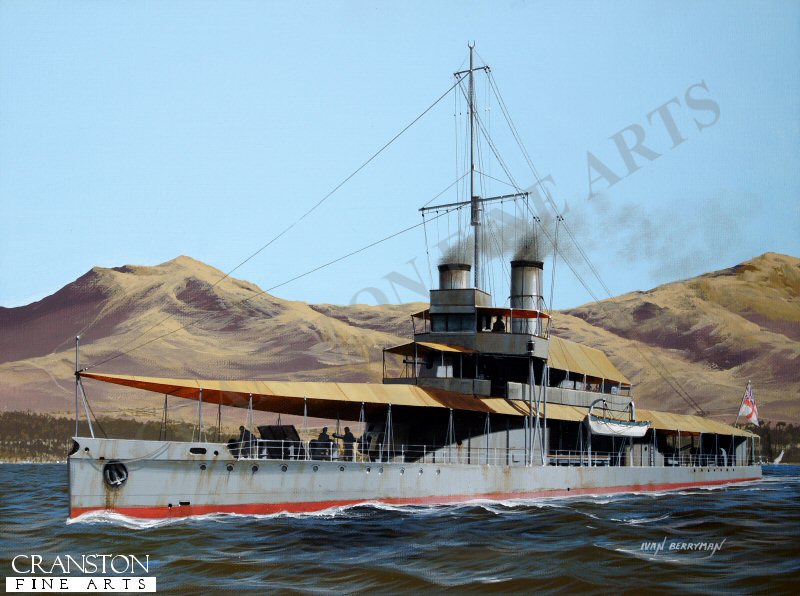
HMS Mantis by Ivan Berryman. An Insect class river gunboat, HMS Mantis took part in operations on the River Tigris in modern-day Iraq in World War One. A British Army advance up the Tigris in 1915 took the town of Kut-al-Amara, but this army of more than 10,000 men were besieged by the Turks here, eventually surrendering in April 1916. With other river gunboats, HMS Mantis had attempted to help break the siege from early March 1916, and remained on the River Tigris until again called upon to assist an expedition in early 1917. As part of a fleet of nearly 20 river gunboats, HMS Mantis helped the forces of Sir Stanley Maude recapture Kut-al-Amara on 24th February 1917. The ship had a long career, briefly serving in north Russia during their civil war in 1919 before serving in China during the 1920s. Still operational at the beginning of World War Two, HMS Mantis was eventually scrapped in 1940. |
HMS Sickle by Ivan Berryman. An S-Class submarine of the Royal Navy, HMS Sickle took part in operations in the Mediterranean in the Second World War after an uneventful first patrol off Norway. On the morning of 23rd of April 1943, five days into her second war patrol, HMS Sickle intercepted the Italian merchant Mauro Croce as it left Spanish waters from Valencia. Two torpedoes were fired but passed under the target. Immediately the submarine surfaced and, as seen in this painting, opened fire with the 76mm deck gun, scoring 15 hits from 19 rounds fired before the weapon jammed. HMS Sickle dived and broke off the action, but Italians later claimed three killed and four wounded in their complaint that the attack happened in Spanish territory. That May, HMS Sickle went on to attack German U-Boat U-755 unsuccessfully, but next day torpedoed and sank U-303. On her 11th war patrol in June 1944, HMS Sickle disappeared and is thought to have been lost to mines while returning to Malta. |
Tribute to Midget Submarine HMS XE-3 by Ivan Berryman. The midget submarine HMS XE-3 made a successful attack on the Japanese cruiser Takao in Johore Strait, Singapore on 31st July 1943. Having evaded anti-submarine defences to reach their target, the Commander Ian Fraser and his diver James Magennis are shown preparing to attach limpet mines to the cruiser. Fraser then managed with great skill to position the main explosives directly under the ship before retreating back through the defended waters to safety. Both were awarded the Victoria Cross for their actions that day. |
Tribute to Ian Edward Fraser VC by Ivan Berryman. Joined the Royal Naval Reserve in 1939, and served on several destroyers before joining HMS Sahib in 1943 - the same year he was awarded the Distinguished Service Cross for bravery and skill on submarine patrols. He volunteered for sevice aboard HMS Bonaventure - a depot ship for X-Craft midget submarines. Commander of the midget submarine HMS XE-3 in the successful attack on a the Japanese Atago Class heavy cruiser Takao, moored in Johore Strait, Singapore, 31st July 1945. HMS XE-3 is seen here making its way to its target on that day. Fraser and his diver - James Magennis who went out to place the limpet mines - were both awarded the Victoria Cross for this attack. He died on 1st September 2008. |
Farewell the Hood by Simon Atack. HMS Hood, Britains largest warship and pride of the Royal Navy, steams majestically through the Swept Channel on 22 May, 1941. Having fuelled at the Scapa Flow naval base in Scotland, she steers clear of floats suspending torpedo and submarine nets, as she heads for open water and the North Sea. The crew of a naval cutter wave farewell as the mighty battleship departs upon what will prove to be her final voyage. |
Surprise Attack by Ivan Berryman. The German crew of a Type VII U-boat man the guns as their submarine comes under a surprise attack from a Beaufighter of Coastal Command. |
|
Contact Details |
|
Sign Up To Our Newsletter!
This website is owned by Cranston Fine Arts. Torwood House, Torwoodhill Road, Rhu, Helensburgh, Scotland, G848LE Contact: Tel: (+44) (0) 1436 820269. Email: cranstonorders -at- outlook.com |
 |