|
|
|
|
|
|
|
|
 |
 |
 |
 |
 |
 |
 |
 |
 |
 |
 |
 |
 |
 |
|
Aircraft Index |
Squadron Index |
Aviation Art by Country |
Aviation Signatures Index |
Aviation Artists Index |
Aviation Art Offers |
|
|
No.403 Sqn RAF
Founded :
|
No.403 Sqn RAF
| Aces for : No.403 Sqn RAF | ||
| A list of all Aces from our database who are known to have flown with this squadron. A profile page is available by clicking the pilots name. | ||
| Name | Victories | Info |
| George Frederick Beurling | 31.50 | |
| Alan Christopher Deere | 22.00 | The signature of Alan Christopher Deere features on some of our artwork - click here to see what is available. |
| Aircraft for : No.403 Sqn RAF | |||
| A list of all aircraft known to have been flown by No.403 Sqn RAF. A profile page including a list of all art prints for the aircraft is available by clicking the aircraft name. | |||
| Squadron | Info | ||

Manufacturer : Supermarine Production Began : 1936 Retired : 1948 Number Built : 20351 | Spitfire Royal Air Force fighter aircraft, maximum speed for mark I Supermarine Spitfire, 362mph up to The Seafire 47 with a top speed of 452mph. maximum ceiling for Mk I 34,000feet up to 44,500 for the mark XIV. Maximum range for MK I 575 miles . up to 1475 miles for the Seafire 47. Armament for the various Marks of Spitfire. for MK I, and II . eight fixed .303 browning Machine guns, for MKs V-IX and XVI two 20mm Hispano cannons and four .303 browning machine guns. and on later Marks, six to eight Rockets under the wings or a maximum bomb load of 1,000 lbs. Designed by R J Mitchell, The proto type Spitfire first flew on the 5th March 1936. and entered service with the Royal Air Force in August 1938, with 19 squadron based and RAF Duxford. by the outbreak of World war two, there were twelve squadrons with a total of 187 spitfires, with another 83 in store. Between 1939 and 1945, a large variety of modifications and developments produced a variety of MK,s from I to XVI. The mark II came into service in late 1940, and in March 1941, the Mk,V came into service. To counter the Improvements in fighters of the Luftwaffe especially the FW190, the MK,XII was introduced with its Griffin engine. The Fleet Air Arm used the Mk,I and II and were named Seafires. By the end of production in 1948 a total of 20,351 spitfires had been made and 2408 Seafires. The most produced variant was the Spitfire Mark V, with a total of 6479 spitfires produced. The Royal Air Force kept Spitfires in front line use until April 1954. | ||
| Signatures for : No.403 Sqn RAF | |||||
| A list of all signatures from our database who are associated with this squadron. A profile page is available by clicking their name. | |||||
| Name | Info | ||||
 Air Commodore Alan Deere DSO DFC* Click the name or photo above to see prints signed by Air Commodore Alan Deere DSO DFC*
| Air Commodore Alan Deere DSO DFC* Top scoring New Zealand Ace with 22 victories, Deere was born in Auckland on December 12th 1917. Alan Deere would become one of the RAFs finest pilots. Joining the RAF in 1937, in September 1938 Al Deere was posted to No.54 Sqn at the time flying Gloster Gladiators, then in early 1940 the Squadron converted to Spitfires. His first brush with death happened when his oxygen failed while at altitude and ke blacked out, coming to only in time to pull his aircraft out of a dive and certain death. At the beginning of May 1940 Deere took part in the intensive air war over Dunkirk and on 23rd May 1940 Deere took part in a daring rescue operation. He and Pilot Officer Allen escorted their flight commander, James Leathart, to France where he was to land a Miles Master trainer and pick up the CO of 74 Squadron who had made a forced landing on the airfield at Calais-Marck. While the pick up was made, Alan Deere was at low level with Pilot Officer Allen at 8000 feet. As Flight Commander James Leathart prepared for take off in the Master, Pilot Offcier Allen spotted a flight o Bf109s coming their way. Deere scored his first victory, as a strafing Bf109 pulled out of its dive, presenting a perfect target. Deere fired a short burst and the aircraft stalled and then crashed into the sea. Deere, climbing to help Allen, crossed the path of two 109’s, one of which turned towards him. Deere also turned, firing at the second one, which rolled over and dived away. Pursuing the first one, he caught up at treetop height and pursued him, firing off his remaining ammunition before the German headed for home. During the whole event Deere and Allen accoutned for three Bf109s shot down and three damaged. All three aircraft returned to their base at RAF Hornchurch. During four days - 23rd to 29th May - Deere shot down three Bf109’s and three Bf110’s but his luck ran out and he was shot down over Dunkirk while attacking a Dornier Do17 and luckily managed a forced landing in Belgium where he optained a bicycle and cycled to Dunkirk where he managed to get on a destroyer and returned to Hornchurch within 30 hours of taking off. In June he was decorated with the DFC by the King at a special ceremony at Hornchurch. Alan Deere destroyed seven more enemy fighters and one bomber during the Battle of Britian and was awarded a Bar to the DFC. In January 1941 became an Operations Room Controller. He returned to operations on 7th May 1941, joining 602 Squadron in Scotland as a Flight Commander. On August 1st 1941 Alan Deere took command of 602 Squadron and on that day destroyed a Bf109. When his second operational tour ended in January 1942 Deere went to the USA to lecture on fighter tactics. In May 1942, he took command of 403 Squadron, commanding the squadron until August before being posted to staff duties. During a temporary attachment to 611 Squadron in February 1943 Deere destroyed an Fw190. Some days later he was appointed Wing Leader at Biggin Hill. He flew 121 sorties during his six months leadership and by this time his tally was twenty-two confirmed victories, ten probables and eighteen damaged. He was also awarded the DSO and a bar to his DFC. Alan Deere was also awarded the Croix de Guerre and the DFC (USA) and in May 1945 He was awarded an OBE. In December 1977 Air Commodore Deere retired form the Royal Air Force. Iin 1959 Air Commodore Alan Deere wrote of his experiences in his book, ’Nine Lives’. Sadly, he passed away on 21st September 1995. | ||||
 Lt Col Douglas Duke Warren DFC CD Click the name or photo above to see prints signed by Lt Col Douglas Duke Warren DFC CD
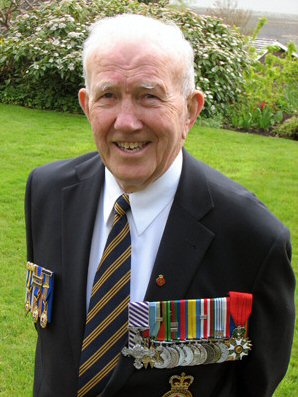
| Lt Col Douglas Duke Warren DFC CD Douglas Duke Warren was Born in Nanton, Alta., in 1922, along with his twin brother Bruce joined the Royal Canadian Air Force (RCAF) at the age of 18. After advanced training, the Warren twins flew two tours of operations with Royal Air Force Spitfire squadrons. After joining 403 Squadron, Duke Warren flew as part of 165 Squadron in the air battles over Dieppe. He fought over Falaise, and also served with 66 Sqn and 11 Group at Biggin Hill. In 1945, they were both awarded Distinguished Flying Crosses by King George VI at Buckingham Palace. He returned to Canada in May 1945, and along with Bruce joined the permanent RCAF in October 1946. Douglas became a Flight Commander with 421 Squadron flying DH Vampire jet aircraft at Chatham, New Brunswick. On April 5th, 1951, his brother Bruce was killed as a test pilot at AV Roe aircraft company in Toronto flying the prototype CF100 jet fighter. Duke became Commanding Officer of the F-86 Sabre-equipped 410 Squadron in 1952. The following year, he was attached to the United States Air Force and flew Sabres in Korea. Duke Warren flew 253 combat missions, including flying the F-86 Sabre in Korea. Sadly Duke Warren passed away Saturday August 27th 2011 in Comox at the age of 89.
| ||||
About our Signatures on Artwork
|
Contact Details |
|
Sign Up To Our Newsletter!
This website is owned by Cranston Fine Arts. Torwood House, Torwoodhill Road, Rhu, Helensburgh, Scotland, G848LE Contact: Tel: (+44) (0) 1436 820269. Email: cranstonorders -at- outlook.com |
 |