|
|
|
|
|
|
|
|
 |
 |
 |
 |
 |
 |
 |
 |
 |
 |
 |
 |
 |
 |
|
Aircraft Index |
Squadron Index |
Aviation Art by Country |
Aviation Signatures Index |
Aviation Artists Index |
Aviation Art Offers |
|
|
No.165 Sqn RAF
Founded : 6th April 1942
Ceylon Infensa virtuti invidia - Envy is the foe of honor
Flew Mustangs from January 1944. |
No.165 Sqn RAF
| Aircraft for : No.165 Sqn RAF | |||
| A list of all aircraft known to have been flown by No.165 Sqn RAF. A profile page including a list of all art prints for the aircraft is available by clicking the aircraft name. | |||
| Squadron | Info | ||

Manufacturer : North American | Mustang The ubiquitous North American P-51 Mustang, which many consider to be the best all-around fighter of WW II, owes its origins to the British Air Ministry. Following Britains entry into WW II in 1939, the RAF was interested in purchasing additional fighter aircraft from American sources, particularly the Curtiss P-40. Curtiss, which was busy, was unable to guarantee timely delivery so the British approached North American Aviation as a possible second source for the P-40. North American chose to propose its own fighter design which would use the same Allison engine as the P-40. Utilizing new laminar flow wings, the North American fighter was expected to have performance better than the P-40. Developed in record time the new aircraft was designated as a Mustang I by the Brits, whereas the USAAF ordered two for evaluation which were designated XP-51 Apaches. Intrigued with the possibility of using this aircraft also as a dive bomber, North American proposed this to the USAAF which decided to order 500 of the P-51 aircraft to be modified for dive bombing use. Designated as the A-36 Invader, this version of the Mustang utilized dive flaps, and bomb racks under each wing. Some reinforcing of the structural members was also required because of the G-forces to be encountered in dive bombing. A-36s entered combat service with the USAAF prior to any P-51s. In early 1943 the 86th and 27th Fighter Bomber Groups of the 12th Air Force began flying A-36s out of Northern Africa. Despite some early problems with instability caused by the dive flaps, the A-36 was effective in light bombing and strafing roles. It was not, however, capable of dog fighting with German fighters, especially at higher altitudes. Despite these drawbacks one USAAF pilot, Captain Michael T. Russo, who served with the 16th Bomb Squadron of the 27th Fighter Bomber Group, was credited with five confirmed aerial victories in the A-36, thereby becoming the first mustang ace. | ||

Manufacturer : Supermarine Production Began : 1936 Retired : 1948 Number Built : 20351 | Spitfire Royal Air Force fighter aircraft, maximum speed for mark I Supermarine Spitfire, 362mph up to The Seafire 47 with a top speed of 452mph. maximum ceiling for Mk I 34,000feet up to 44,500 for the mark XIV. Maximum range for MK I 575 miles . up to 1475 miles for the Seafire 47. Armament for the various Marks of Spitfire. for MK I, and II . eight fixed .303 browning Machine guns, for MKs V-IX and XVI two 20mm Hispano cannons and four .303 browning machine guns. and on later Marks, six to eight Rockets under the wings or a maximum bomb load of 1,000 lbs. Designed by R J Mitchell, The proto type Spitfire first flew on the 5th March 1936. and entered service with the Royal Air Force in August 1938, with 19 squadron based and RAF Duxford. by the outbreak of World war two, there were twelve squadrons with a total of 187 spitfires, with another 83 in store. Between 1939 and 1945, a large variety of modifications and developments produced a variety of MK,s from I to XVI. The mark II came into service in late 1940, and in March 1941, the Mk,V came into service. To counter the Improvements in fighters of the Luftwaffe especially the FW190, the MK,XII was introduced with its Griffin engine. The Fleet Air Arm used the Mk,I and II and were named Seafires. By the end of production in 1948 a total of 20,351 spitfires had been made and 2408 Seafires. The most produced variant was the Spitfire Mark V, with a total of 6479 spitfires produced. The Royal Air Force kept Spitfires in front line use until April 1954. | ||
| Signatures for : No.165 Sqn RAF | |||
| A list of all signatures from our database who are associated with this squadron. A profile page is available by clicking their name. | |||
| Name | Info | ||
 Flight Lieutenant Ken Evans DFC Click the name above to see prints signed by Flight Lieutenant Ken Evans DFC | Flight Lieutenant Ken Evans DFC Joining the RAF in 1939, Ken Evans was posted to 600 Squadron, where he flew night operations. In September 1941 he was posted to 130 Squadron to fly Spitfires, and in early 1942 was ordered to Malta. Arriving in Gibraltar he joined the carrier HMS Eagle. On 18 May he flew his Spitfire to Malta from the Eagle, to join 126 Squadron. Seeing much action over the island in June and July, in August he returned to Gibraltar to lead a new flight back to Malta, this time embarking on the carrier HMS Furious. One of 126 Squadrons most successful pilots on Malta, Ken was awarded the DFC on 1st December 1942, and credited with 5 destroyed, 3 probables and 3 damaged. Commissioned on Malta, he returned to the UK, and in September 1943 was posted to 165 Squadron as a flight commander. | ||
 Squadron Leader Arthur Roscoe DFC Click the name above to see prints signed by Squadron Leader Arthur Roscoe DFC | Squadron Leader Arthur Roscoe DFC American Art Roscoe joined the RAF in February 1941, through the Clayton Knight Committee that was recruiting American civilian pilots for the RAF. Arriving in England he joined 71 Eagle Squadron, where he made his first claims. In June 1942 he volunteered for service on Malta and flew off the carrier HMS Furious on 11th August to join 229 Squadron. During his final combat on 12th October he was shot down, wounded and evacuated from the island in a Liberator, which in turn crashed on landing in Gibraltar. On recovery, he was posted to join 165 Squadron, then 242 Squadron, and in May 1944 was given command of 232 Squadron. He had destroyed 4 enemy aircraft and probably 3 more. | ||
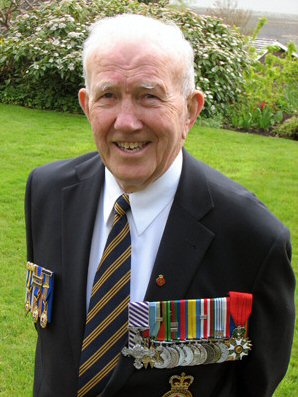
 Lt Col Douglas Duke Warren DFC CD Click the name or photo above to see prints signed by Lt Col Douglas Duke Warren DFC CD
| Lt Col Douglas Duke Warren DFC CD Douglas Duke Warren was Born in Nanton, Alta., in 1922, along with his twin brother Bruce joined the Royal Canadian Air Force (RCAF) at the age of 18. After advanced training, the Warren twins flew two tours of operations with Royal Air Force Spitfire squadrons. After joining 403 Squadron, Duke Warren flew as part of 165 Squadron in the air battles over Dieppe. He fought over Falaise, and also served with 66 Sqn and 11 Group at Biggin Hill. In 1945, they were both awarded Distinguished Flying Crosses by King George VI at Buckingham Palace. He returned to Canada in May 1945, and along with Bruce joined the permanent RCAF in October 1946. Douglas became a Flight Commander with 421 Squadron flying DH Vampire jet aircraft at Chatham, New Brunswick. On April 5th, 1951, his brother Bruce was killed as a test pilot at AV Roe aircraft company in Toronto flying the prototype CF100 jet fighter. Duke became Commanding Officer of the F-86 Sabre-equipped 410 Squadron in 1952. The following year, he was attached to the United States Air Force and flew Sabres in Korea. Duke Warren flew 253 combat missions, including flying the F-86 Sabre in Korea. Sadly Duke Warren passed away Saturday August 27th 2011 in Comox at the age of 89.
| ||
About our Signatures on Artwork
|
Contact Details |
|
Sign Up To Our Newsletter!
This website is owned by Cranston Fine Arts. Torwood House, Torwoodhill Road, Rhu, Helensburgh, Scotland, G848LE Contact: Tel: (+44) (0) 1436 820269. Email: cranstonorders -at- outlook.com |
 |