|
|
|
|
|
|
|
|
 |
 |
 |
 |
 |
 |
 |
 |
 |
 |
 |
 |
 |
 |
|
|
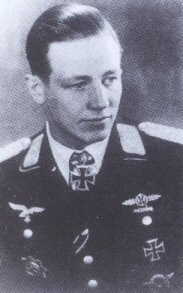
Major Martin Drewes (deceased)
One of the great Luftwaffe night fighter pilots; between 1941-45 he completed 235 combat missions flying the Me110, and with 52 aerial victories was one of the highest scoring night fighter Aces. After serving as a Destroyer pilot with II./ZG76, he was posted to Iraq, where he shot down a Gloster Gladiator, before transferring to night fighters. In March 1944 he was promoted to Kommandeur III./NJG1, a post he held until the end of the war. Martin Drewes flew total of 235 missions, and was awarded the Knight's Cross with Oak Leaves. He died on 13th October 2013.
|
Items Signed by Major Martin Drewes (deceased) |
  | Duel in the Dark by Robert Taylor (B) SOLD OUT | The air war fought throughout World War II in the night skies above Europe raged six long years. RAF Hurricanes sent up to intercept the Luftwaffes nightly blitz on British cities had no more equipment than the fighters that fought the Battle of Bri...... | NOT AVAILABLE |
  | Lancaster Under Attack by Robert Taylor. SOLD OUT | A Lancaster of 626 Squadron takes evasive action during a raid over Osterfeld in December 1944, as a Messerschmitt Me110 G.4 night-fighter makes a pass beneath the bomber. ...... | NOT AVAILABLE |
Packs with at least one item featuring the signature of Major Martin Drewes (deceased) |
| Squadrons for : Major Martin Drewes (deceased) | ||
| A list of all squadrons known to have been served with by Major Martin Drewes (deceased). A profile page is available by clicking the squadron name. | ||
| Squadron | Info | |
Country : Germany Click the name above to see prints featuring aircraft of NJG1 | NJG1 Full profile not yet available. | |
Country : Germany Click the name above to see prints featuring aircraft of NJG3 | NJG3 Nachtjagdgeschwader 3 (NJG 3) was a Luftwaffe night fighter-wing of World War II. NJG 3 was formed on 29 September 1941 in Stade from Stab./Zerstörergeschwader 26. 1./NJG3 operated in the Mediterranean area between Feb 1941 and Oct 1941 (Feb 1941 - May 1941 Sicily, Argos [X. Fliegerkorps]; May 1941 - Aug 1941 Benghazi [Fl. Fü. Afrika], Aug 1941 - Oct 1941 Derna [Fl. Fü. Afrika]). 2./NJG3 operated in the Smolensk area from Feb 1942 - Mar 1942 (Luftwaffenkommando Ost), and was stationed at Wittmundhafen Mar 1942 to Apr 1944 (1. NJ-Div., from May 1942 2. JD). 3./NJG3 was detached at Kastrup/Copenhagen, at least between Aug 1943 and Mar 1944 (2. JD). 4./NJG3 was detached at Westerland from Sep 1941 to 21 Jan 1944 (1. NJ-Div., from May 1942 2. JD). Another detachment operated from Mainz-Finthen in late 1941 (1. NJ-Div.). 7./NJG3 was detached at Lüneburg from Nov 1941 to Apr 1943, Kastrup/Copenhagen Apr 1943 to Nov 1943, and Nordholz Nov 1943 to Apr 1944. 8./NJG3 was detached at Lüneburg from Apr 1943 to Apr 1944. Other detachments were based at Ingolstadt and Wunstorf. (All under 1. NJ-Div., later 2. JD) Known aircraft that the squadron had shot down 31 December 1944: 1 Short Stirling , LJ 914 620 Sqn. Crew unknown. Near Lister (this is most likely by NJS Norwegen) 22 February 1945: 1 Short Stirling Mk IV. LK 566. 190 Sqn. Crew killed. Near Tvedestrand 25 February 1945: 1 Handley Page Halifax MK III. NA 103. 298 Sqn. Crew killed. Near Arendal 25 February 1945: 1 Short Stirling MK IV. LJ 925. 196 Sqn. 3 Bailed out, 3 killed. Near Arendal 30 March 1945: 1 Short Stirling MK IV. LK 119. 161 Sqn. Crew Killed. Near Tvedestrand 30 March 1945: 1 Short Stirling MK IV. LK 332. 299 Sqn. Crew Killed. Risör 30 March 1945: 1 Short Stirling MK IV. LJ 888. 196 Sqn. Crew Killed. Arendal | |
Country : Germany Click the name above to see prints featuring aircraft of ZG26 | ZG26 Full profile not yet available. | |
Country : Germany Click the name above to see prints featuring aircraft of ZG76 | ZG76 Zerstörergeschwader 76 was formed on 1 May 1939 with the I. Gruppe and II. Gruppe without a Geschwaderstab. The II. Gruppe was initially equipped with the Messerschmitt Bf 109 and was known as Jagdgruppe 176. The Geschwaderstab was created on 15 April 1940 in Köln-Wahn. The III. Gruppe was raised on 26 June 1940 in Trier-Euren. On 1 September 1939 Germany attacked Poland although bad weather initially precluded a large scale deployment of ZG 76. I./ZG 76 engaged Polish fighters formations and made their first claims, although also suffered their first losses. Future 'ace' Leutnant Helmut Lent participated in the attack on Poland, destroying several aircraft on the ground and a PZL P.11 fighter in the air on 2 September 1939 for his and (I./ZG 76) first victory. However, on 12 September, following the destruction of an aircraft on the ground he was attacked by another fighter and his starboard engine was hit and put out of action. This necessitated a forced-landing, fortunately behind his own lines, in which he received minor injuries. On 29 September, I./ZG 76 was withdrawn to the Stuttgart area to provide Reichsverteidigung (Defense of the Reich) against the Western Allied Air Forces. I./ZG 76 claimed 31 kills during the campaign, of which 19 were confirmed. On 18 December 1939 the Royal Air Force sent a force of Vickers Wellingtons to raid Wilhelmshafen during the day. I./ZG 76 under Hptm. Gunther Reinecke, intercepted. Staffelkapitän of 2./ZG 76, Wolfgang Falck, and wingman Uffz. Heinz Fresia were the first to engage, claiming two Wellingtons each, though Falck's aircraft was hit by defending fire and he crash-landed on Wangerooge. Others of I./ZG 76 intercepted at intervals, unit claims totalling 15 Wellingtons shot down. The RAF lost 12, with total Luftwaffe unconfirmed claims being 38 | |
| Aircraft for : Major Martin Drewes (deceased) | |||
| A list of all aircraft associated with Major Martin Drewes (deceased). A profile page including a list of all art prints for the aircraft is available by clicking the aircraft name. | |||
| Squadron | Info | ||
Manufacturer : Messerschmitt Production Began : 1938 | Me110 The Bf-110 grew out of Herman Gorings specifications for a multipurpose aircraft capable of penetrating deep into enemy airspace to clear the sky of enemy fighters in advance of German bomber formations. The aircraft would also be utilized as a long range interceptor, and as a ground support and ground attack bomber. The Bf-110 prototype first flew in 1936. The prototype was under powered with its Daimier Benz DB 600A engines. Several months passed before a go ahead was given for large scale production which commenced in 1938. Utilizing improved DB 601 engines, the early production 110s were as fast as any single engine fighter at that time, and had superior fire power. Their biggest apparent weakness was in the areas of armor protection for the crew, and in terms of maneuverability when compared to single seat fighters. The 110 was produced in large numbers and in many different variants. The 110D was the long range model. An additional belly tank was fitted to that aircraft, with several later variants having the more traditional drop tanks. The first serious test for the Bf-110 came during the Battle of Britain. About 300 Bf-110s were involved. They became easy prey for Hurricane and Spitfire pilots, and Bf-109s were often required to assist the 110s in their own defense. On August 15, 1940, which became known as Black Tuesday, the Bf-110s were ravaged by the RAF, and for the month over 100 aircraft were lost. On the Eastern Front the Bf-110 performed admirably in the early stages of Operation Barbarossa. With the Soviet Air Force weakened in the first several weeks of the attack, 110s were effectively utilized in a ground attack role. Ultimately, the Luftwaffe re-equipped a significant number of its 110s as night fighters. The aircraft performed well in this role because it was a good gun platform with sufficient speed to overtake the RAF night bombers. Such night missions were typically carried out with no Allied fighter escort, so the 110 night fighters would not have to engage or elude Allied fighters in this role. | ||
About our Signatures Search for more Signatures
|
Contact Details |
|
Sign Up To Our Newsletter!
This website is owned by Cranston Fine Arts. Torwood House, Torwoodhill Road, Rhu, Helensburgh, Scotland, G848LE Contact: Tel: (+44) (0) 1436 820269. Email: cranstonorders -at- outlook.com |
 |