|
|
|
|
|
|
|
|
 |
 |
 |
 |
 |
 |
 |
 |
 |
 |
 |
 |
 |
 |
|
|
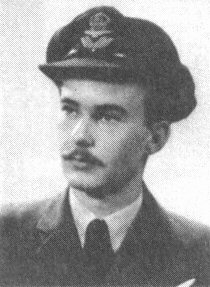
Flying Officer Charles Parker DFM
Joining the RAF in 1943 he qualified as a Navigator and was posted to fly Mosquitoes with 128 Sqn in late 1944. He then moved to 163 Sqn flying over 50 missions to Germany, including 20 on Berlin, as part of the Light Night Strike Force.
|
Items Signed by Flying Officer Charles Parker DFM |
  | Dangerous Coast by Robert Taylor. (AP) Price : £310.00 | Mosquitoes from RAF Coastal Command's Banff Strike Wing race through a deep-sided Norwegian fjord following a successful rocket strike against enemy coastal shipping. The de Havilland Mosquito was arguably the finest multi-role combat aircraft ...... | |
| | Dangerous Coast by Robert Taylor. (B) Price : £225.00 | Mosquitoes from RAF Coastal Command's Banff Strike Wing race through a deep-sided Norwegian fjord following a successful rocket strike against enemy coastal shipping. The de Havilland Mosquito was arguably the finest multi-role combat aircraft ...... |
Packs with at least one item featuring the signature of Flying Officer Charles Parker DFM |
     | Moquito Aviation Art Trade Discount Pack. Pack Price : £450.00 Saving : £385 | Aviation Print Pack. ...... Titles in this pack : Dangerous Coast by Robert Taylor. (B) A De Havilland Beauty by Ivan Berryman. (C) The Blackest Friday by Ivan Berryman. Return From Leipzig by Anthony Saunders. Sunday Afternoon by Geoffrey R Herickx. Night Raiders by Ivan Berryman. (C) |
| Squadrons for : Flying Officer Charles Parker DFM | ||
| A list of all squadrons known to have been served with by Flying Officer Charles Parker DFM. A profile page is available by clicking the squadron name. | ||
| Squadron | Info | |
Country : UK Founded : 20th March 1918 Fate : Disbanded 23rd August 1963 Who shall stop us | No.144 Sqn RAF No 144 Squadron, RFC, was formed at Port Said, Egypt, on 2Oth March 1918. On 14th August it came under the orders of the Palestine Brigade, Royal Air Force, and by the end of the month it had been fully equipped as a bombing squadron with DH9s at Junction Station. On the opening of the final offensive in Palestine, No 144 Squadron was with the 4Oth (Army) Wing and had 13 DH9s on charge. There was no special air activity before the offensive so that the enemy should not be warned of our intentions, but No. 144 Squadron made two important bombing raids on Der'a station in conjunction with the operations of the Arab Northern Army under Sherif Feisal and Colonel TE Lawrence (Lawrence of Arabia) in the eastern area on the 16th and 17th September. When the offensive began on the coastal sector on 19th September an initial bombing offensive was directed against the main Turkish telegraphic and telephonic centres whose positions were known from intelligence sources and from air photographs. No 144 Squadron bombed the central telephone exchange at El 'Affule and the headquarters and telephone exchange of the Turkish Seventh Army at Nablus, and (it seems) effectively cut the enemy's telephone communications at a vital time. By 20th September the enemy was in headlong retreat. In the west the Turkish Eighth Army had been shattered and its remnants, together with the Seventh Army in the centre, were retiring to their doom. On the following day they were trapped in the Wadi el Far'a and completely wiped out by air attack with all RAF squadrons being concentrated in the attack. No 144 Squadron then co-operated in the advance east of the Jordan, which resulted in the capture of the Turkish Fourth Army. At the end of September a flight of No 144 Squadron was stationed at Haifa to co-operate with the XXI Corps during its advance on Beirut, but elsewhere, with the rapid pursuit of the enemy, the opportunities and facilities for bombing had diminished. In October the squadron moved to Mudros, Greece, but by the end of the year it had returned to England. It was disbanded at Ford Junction on 4th February 1919. The squadron was still equipped with Hampdens on the outbreak of the Second World War in September 1939, flying its first mission on 26 September, when it dispatched 12 aircraft to search for, and attack if found, German naval forces in the North Sea. On this occasion, however, it encountered no allowable targets. Three days later, the squadron sent out 11 aircraft over the Heligoland Bight in another search for German warships. The strike force split into two groups; while one formation spotted but failed to hit two German destroyers, the second formation was intercepted by Luftwaffe Messerschmitt Bf 109 fighters, which shot down all five Hampdens. The first occasion on which No 144 Squadron flew over the German mainland was the night of 24/25th February 1940, when propaganda leaflets or Nickels were dropped on Hamburg. On 6th March, by which time it had Nickelled several other German towns and by which time also it had flown a number of security patrols, the squadron took part in Bomber Command's first attack on a German land objective - the minelaying-seaplane base at Hornum. Just over two months later (by which time minelaying had been added to its duties) No 144 shared in another notable "first" - the first big bombing attack on the German mainland (the exits of München-Gladbach). As a result of the Channel Dash in February 1942, when the German battleships Scharnhorst and Gneisenau and the heavy cruiser Prinz Eugen managed to break the British blockade and sail from France through the English Channel to Germany, indicated to the RAF that their anti-shipping strike strength was inadequate, and it was decided to convert two Hampden squadrons to the torpedo bomber role, with 144 Squadron being one of the two chosen for conversion.[10] The squadron transferred from Bomber Command to 18 Group Coastal Command on 21 April 1942, moving to RAF Leuchars on the East coast of Scotland. It flew its first torpedo bomber mission on 27 July 1942. ] In September 1942, 32 Hampdens of 144 Squadron and 455 Squadron RAAF were sent to Murmansk in Northern Russia in order to support the Arctic convoy PQ 18, and to attack any German warships that might sortie from bases in Norway against the convoy. The squadron lost 5 Hampdens on the flight to Russia, with a further four of 455 Squadron's also lost. The German surface warships did not attack PQ 18, and the squadron's personnel returned to Britain aboard a cruiser in October, leaving its aircraft behind to be handed over to the Soviets. In January 1943 the Squadron converted to the more capable Bristol Beaufighter, staying in the torpedo bomber role. After working up, it transferred to Algeria in June 1943, flying anti-shipping strikes over the Mediterranean until it returned to the United Kingdom in August. It continued anti-shipping operations over the North Sea from RAF Wick in Scotland, moving to RAF Davidstow Moor in Cornwall in May 1944 in preparation for Operation Overlord, the Allied invasion of Normandy, where it was tasked with protecting the invasion forces from German E-boats. It moved to RAF Strubby in Lincolnshire in July for operations against E-boats and German convoys off the Dutch coast. In September it moved to Banff, Aberdeenshireas part of the Banff Strike Wing, for operations off Norway. In January 1945, the squadron abandoned the torpedo role, concentrating in anti-flak suppression for the Strike Wing. It disbanded on 25 May 1945 at RAF Dallach | |
Country : UK Founded : 1st June 1918 Fate : Disbanded 14th July 1946 Click the name above to see prints featuring aircraft of No.163 Sqn RAF | No.163 Sqn RAF Full profile not yet available. | |
| Aircraft for : Flying Officer Charles Parker DFM | |||
| A list of all aircraft associated with Flying Officer Charles Parker DFM. A profile page including a list of all art prints for the aircraft is available by clicking the aircraft name. | |||
| Squadron | Info | ||

Manufacturer : De Havilland Production Began : 1940 Retired : 1955 Number Built : 7781 | Mosquito Used as a night fighter, fighter bomber, bomber and Photo-reconnaissance, with a crew of two, Maximum speed was 425 mph, at 30,300 feet, 380mph at 17,000ft. and a ceiling of 36,000feet, maximum range 3,500 miles. the Mosquito was armed with four 20mm Hospano cannon in belly and four .303 inch browning machine guns in nose. Coastal strike aircraft had eight 3-inch Rockets under the wings, and one 57mm shell gun in belly. The Mossie at it was known made its first flight on 25th November 1940, and the mosquito made its first operational flight for the Royal Air Force as a reconnaissance unit based at Benson. In early 1942, a modified version (mark II) operated as a night fighter with 157 and 23 squadron's. In April 1943 the first De Haviland Mosquito saw service in the Far east and in 1944 The Mosquito was used at Coastal Command in its strike wings. Bomber Commands offensive against Germany saw many Mosquitos, used as photo Reconnaissance aircraft, Fighter Escorts, and Path Finders. The Mosquito stayed in service with the Royal Air Force until 1955. and a total of 7781 mosquito's were built. | ||
About our Signatures Search for more Signatures
|
Contact Details |
|
Sign Up To Our Newsletter!
This website is owned by Cranston Fine Arts. Torwood House, Torwoodhill Road, Rhu, Helensburgh, Scotland, G848LE Contact: Tel: (+44) (0) 1436 820269. Email: cranstonorders -at- outlook.com |
 |