|
|
|
|
|
|
|
|
 |
 |
 |
 |
 |
 |
 |
 |
 |
 |
 |
 |
 |
 |
|
|
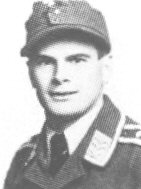
Feldwebel Oscar Boesch (deceased)
Already a pilot of gliders, he joined the Luftwaffe in 1943 and after training was eventually posted to JG3. He volunteered for the Sturmstaffel 1 unit, a specialist anti-bomber unit flying modified Fw190s with better armour. After just a few days, his unit was merged into a unit of JG3. He scored his first victory on 29th April 1944 claiming a Flying Fortress, immediately followed by another of the bombers targetting Berlin. By November he had claimed another five bombers. The rest of his 18 victories were scored against Russian aircraft, except for an RAF Spitfire on 1st January 1945. In the final days of the war he survived a mid-air collision with a Russian fighter. He died in May 2004.
|
Items Signed by Feldwebel Oscar Boesch (deceased) |
  | Clipped Signature - Oscar Boesch. Price : £30.00 | German Ace with 18 victories from 120 missions starting in mid 1944. ...... | |
  | The Long Short Days by Robert Taylor. (C) SOLD OUT | It was known as the Jagdverbande, the fighter arm of the Luftwaffe, and by June 1940 it boasted some of the world's greatest fighter pilots. With tactics honed to perfection, these battle-seasoned veterans dominated the skies of Europe. But as...... | NOT AVAILABLE |
  | Knight of the Reich by Robert Taylor. (C) SOLD OUT | On the morning of 15th October 1943, as Bf109G's from III./JG52 dive into attack a group of Russian fighters high over Zaporozhye in south-east Ukraine, their Kommandeur Hauptmann Gunther Rall pounces on a Soviet La-5 to claim his 222nd victory....... | NOT AVAILABLE |
  | The Blond Knight by Robert Taylor. (C) SOLD OUT | It is a record likely to stand for all time, Erich Hartmann's tally of 352 victories is more than any other pilot in history. Posted to JG52 over Russia in August 1942 his new Kommodore, Dieter Hrabak, placed the novice pilot under the guidance...... | NOT AVAILABLE |
Packs with at least one item featuring the signature of Feldwebel Oscar Boesch (deceased) |
 | Oscar Boesch Print and Clipped Signature Pack. Pack Price : £60.00 Saving : £35 | ...... Titles in this pack : Tribute to Oscar Boesch by Ivan Berryman. (B) Clipped Signature - Oscar Boesch. |
| Squadrons for : Feldwebel Oskar Bosch | ||
| A list of all squadrons known to have been served with by Feldwebel Oskar Bosch. A profile page is available by clicking the squadron name. | ||
| Squadron | Info | |
Country : Germany Click the name above to see prints featuring aircraft of JG3 | JG3 Jagdgeschwader 3 (JG 3) Udet was a Luftwaffe fighter-wing of World War II. The Geschwader operated on all the German fronts in the European Theatre of World War II. It was named after Ernst Udet in 1942. Commanders of IV./JG 3 Major Franz Beyer, 1. June 1943 Hauptmann Heinz Lang , 11 February 1944 Major Friedrich-Karl Müller, 26 February 1944 Hauptmann Heinz Lang , 11 April 1944 Major Wilhelm Moritz, 18 April 1944 Hauptmann Hubert-York Weydenhammer, 5 December 1944 Major Erwin Bacsila, 5 January 1945 Oberleutnant Oskar Romm, 17 February 1945 Hauptmann Gerhard Koall, 25 April 1945 Hauptmann Günther Schack, 1 Mai 1945 | |
| Aircraft for : Feldwebel Oskar Bosch | |||
| A list of all aircraft associated with Feldwebel Oskar Bosch. A profile page including a list of all art prints for the aircraft is available by clicking the aircraft name. | |||
| Squadron | Info | ||

Manufacturer : Fokke-Wulf Production Began : 1940 Retired : 1945 | Fw190 The Focke-Wulf 190 development project began in 1937. Conceived as a hedge against total dependence on the Messerchmitt 109, the 190 was designed by Kurt Tank utilizing a radial engine. This was against generally accepted design criteria in Germany, and many historians believe that the decision to produce a radial engine fighter was largely due to the limited manufacturing capacity for in-line, water-cooled engines which were widely used on all other Luftwaffe aircraft. Despite these concerns, Tanks design was brilliant, and the 190 would become one of the top fighter aircraft of WWII. The first prototype flew in mid-1939. The aircraft had excellent flying characteristics, a wonderful rate of acceleration, and was heavily armed. By late 1940 the new fighter was ordered into production. Nicknamed the butcher bird, by Luftwaffe pilots, early 190s were quite successful in the bomber interceptor role, but at this stage of the war many Allied bombing raids lacked fighter escort. As the war dragged on, Allied bombers were increasingly accompanied by fighters, including the very effective P-51 Mustang. The Allies learned from experience that the 190s performance fell off sharply at altitudes above 20,000 feet. As a result, most Allied bombing missions were shifted to higher altitudes when fighter opposition was likely. Kurt Tank had recognized this shortcoming and began working on a high-altitude version of the 190 utilizing an in-line, water-cooled engine. Utilizing a Jumo 12-cylinder engine rated at 1770-HP, and capable of 2,240-HP for short bursts with its methanol injection system, the 190D, or Long Nose or Dora as it was called, had a top speed of 426-MPH at 22,000 feet. Armament was improved with two fuselage and two wing mounted 20mm cannon. To accommodate the changes in power plants the Dora had a longer, more streamlined fuselage, with 24 inches added to the nose, and an additional 19 inches added aft of the cockpit to compensate for the altered center of gravity. By mid 1944 the Dora began to reach fighter squadrons in quantity. Although the aircraft had all the right attributes to serve admirably in the high altitude interceptor role, it was not generally focused on such missions. Instead many 190Ds were assigned to protect airfields where Me-262 jet fighters were based. This was due to the latter aircrafts extreme vulnerability to Allied attack during takeoff and landing. The 190Ds also played a major role in Operation Bodenplatte, the New Years Day raid in 1945 which destroyed approximately 500 Allied aircraft on the ground. The High Command was impressed with the 190Ds record on this raid, and ordered most future production of the Doras to be equipped as fighter-bombers. In retrospect this was a strategic error, and this capable aircraft was not fully utilized in the role for which it was intended. | ||
About our Signatures Search for more Signatures
|
Contact Details |
|
Sign Up To Our Newsletter!
This website is owned by Cranston Fine Arts. Torwood House, Torwoodhill Road, Rhu, Helensburgh, Scotland, G848LE Contact: Tel: (+44) (0) 1436 820269. Email: cranstonorders -at- outlook.com |
 |