|
|
|
|
|
|
|
|
 |
 |
 |
 |
 |
 |
 |
 |
 |
 |
 |
 |
 |
 |
|
Aircraft Index |
Squadron Index |
Aviation Art by Country |
Aviation Signatures Index |
Aviation Artists Index |
Aviation Art Offers |
|
|
No.208 Sqn RAF
Founded : 1st April 1918
Vigilant
|
No.208 Sqn RAF
No.208 Sqn RAF Artwork |
No.208 Sqn RAF Artwork Collection |
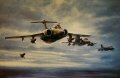  Blue -Fire! by Michael Rondot. |   Balloon Buster by Robert Taylor. |
| Aircraft for : No.208 Sqn RAF | |||
| A list of all aircraft known to have been flown by No.208 Sqn RAF. A profile page including a list of all art prints for the aircraft is available by clicking the aircraft name. | |||
| Squadron | Info | ||
| Buccaneer The Buccaneer. Designed for high-speed, deep penetration attacks at ultra low level, the Buccaneer has always been immensely popular with its aircrews. The design may be old, but the concept was brilliant, and the Buccaneer still retains a unique combination of range, war load and speed, unmatched by any other aircraft in RAF service. Pressed into service during the Gulf War, Buccaneers finally proved in the most spectacular manner what many had known for years - that the only suitable replacement aircraft for the Buccaneer is another Buccaneer. | ||

Manufacturer : Sopwith Production Began : 1916 Number Built : 5714 | Camel SOPWITH CAMEL: was the most successful fighter of World War one. Claiming almost 3,000 air victories. The prototype of the Sopwith camel first flew in December 1916, and its first combat mission began in June 1917. joined 4 squadron RNAS based near Dunkirk. The first Royal Flying Corp squadron to receive the aircraft was no. 70 squadron. The Sopwith camel was the first designed fighter to have two forward firing machine guns. Its design gave it amazing maneuverability and aerobatic qualities. and was perfectly suited for aerial dog fighting. Squadron after squadron was re equipped with the camel and by the end of February 1918 13 squadrons were fully operational with the aircraft along the western front. Also used on the Italian Front with 3 squadrons equipped. This figure increased with a total of 19 squadrons equipped on the western front by August 1918. This included two squadrons no. 151 and 152 for night fighter duties. in June 1918. There was also a naval version of the Sopwith camel. the 2F.1s which gradually replaced the Sopwith Pup and other naval aircraft. The Naval version most memorable fete was done by Lt S D Culley who took off from a towed wood platform and destroyed the Zeppelin L.53 on the 10th August 1918. also on the 18th July six aircraft took off from the forward deck of HMS Furious to bomb the Zeppelin base at Tondern which they successfully did destroying two Zeppelins L.54 and L.60. This was the first time carrier borne aircraft had destroyed a land base installation. In total 5597 F.1s and 317 2F.1s were ordered but there may have been 200 less built. Performance. speed: 113mph at 10,000 feet. service ceiling 19,000 feet. Armament: two fixed forward firing Vickers .303 machine Guns. or one .303 forward firing and one .303 Lewis Gun | ||

Manufacturer : Hawker Production Began : 1936 Number Built : 14533 | Hurricane Royal Air Force Fighter, the Hawker Hurricane had a top speed of 320mph, at 18,200 feet and 340mph at 17,500, ceiling of 34,200 and a range of 935 miles. The Hurricane was armed with eight fixed wing mounted .303 browning machine guns in the Mark I and twelve .303 browning's in the MKIIB in the Hurricane MKIIC it had four 20mm cannon. All time classic fighter the Hurricane was designed in 1933-1934, the first prototype flew in June 1936 and a contract for 600 for the Royal Air Force was placed. The first production model flew ion the 12th October 1937 and 111 squadron of the Royal Air Force received the first Hurricanes in January 1938. By the outbreak of World war two the Royal Air Force had 18 operational squadrons of Hurricanes. During the Battle of Britain a total of 1715 Hurricanes took part, (which was more than the rest of the aircraft of the Royal air force put together) and almost 75% of the Victories during the Battle of Britain went to hurricane pilots. The Hawker Hurricane was used in all theatres during World war two, and in many roles. in total 14,533 Hurricanes were built. | ||
| Lysander Full profile not yet available. | ||
| Signatures for : No.208 Sqn RAF | |||
| A list of all signatures from our database who are associated with this squadron. A profile page is available by clicking their name. | |||
| Name | Info | ||
Flight Lieutenant Paul Binns Click the name above to see prints signed by Flight Lieutenant Paul Binns | Flight Lieutenant Paul Binns Jaguar pilot, No.16 Sqn. Flight Lieutenant Paul Binns joined the Royal Air Force in 1988 and completed his Officer Training at the Royal Air Force College, Cranwell. Following flying training on the Jet Provost and the Hawk, he was posted to Lossiemouth in 1990 to 237(R) Squadron, the Buccaneer Operational Conversion Unit. After his conversion course, Paul was posted to 12(B) Squadron to fly the Buccaneer S2B in the maritime Strike/Attack Role. When 12(B) Squadron re-roled, Paul was posted 208 Squadron to continue flying the Buccaneer. With the demise of the Buccaneer in 1994, Paul was posted to 6 Squadron at Coltishall, flying the Jaguar GR1A. He has flown on exercises throughout Europe, North America and the Middle-East in addition to flying on peace-keeping operations over the former Yugoslavia. In 1998 Paul completed the Jaguar Qualified Weapons Instructor Course and was posted to the instructional staff of 16(R) Squadron, the Jaguar Operational Conversion Unit at Lossiemouth. When not displaying, his job on the Squadron is to teach pilots to fly and operate the Jaguar. | ||
 Flight Lieutenant Henry Botterell Click the name or photo above to see prints signed by Flight Lieutenant Henry Botterell
| Flight Lieutenant Henry Botterell First World War fighter pilot with the Royal Flying Corps. Born in 1896, Henry Botterell joined the Royal Naval Air Service in Canada, and in 1916 sailed for England where he trained as a pilot to fly fighters. In 1917 he was posted to France, joining an operational squadron on the Western Front, butan engine failure on his second take off brought his flying to an abrupt conclusion, forcing him to spend several months in hospital and convalescing back in England, where he was demobilised. After a chance meeting with pilots on leave in England with whom he had trained, Henry applied to rejoin the service and was accepted. Re-qualifying as a fighter pilot, in early 1918 he returned to operational combat flying in France with 208 Squadron Royal Flying Corps. Flying Sopwith Camels he saw active service with 209 Squadron for the remainder of the war until the Armistice in November. Staying in France as part of the continuing Force he eventually returned to Canada in 1919 - bringing back with him a fence post which the wing of his Camel had collected on one of his many low level sorties. The post now resides in the War Museum in Ottawa. Henry died in 2003. | ||
About our Signatures on Artwork
|
Contact Details |
|
Sign Up To Our Newsletter!
This website is owned by Cranston Fine Arts. Torwood House, Torwoodhill Road, Rhu, Helensburgh, Scotland, G848LE Contact: Tel: (+44) (0) 1436 820269. Email: cranstonorders -at- outlook.com |
 |


