|
|
|
|
|
|
|
|
 |
 |
 |
 |
 |
 |
 |
 |
 |
 |
 |
 |
 |
 |
|
AMERICAN CIVIL WAR PRINTS SECTION
YOU ARE VIEWING: MILITARY PRINTS --> AMERICAN CIVIL WAR PRINTS
| Navigation | |
| Page 1 of 5 | Page 1 .. Next |
| Military Art Collecton - American Civil War |
|
|
|
|
|
|
|
|
|
|
|
|
|
|
|
|
|
|
|
|
|
| Navigation | |
| Page 1 of 5 | Page 1 .. Next |
| Text for the above items : |
Brother Against Brother by Chris Collingwood. The American Civil War saw not only the split between north and south but also even between family members. |
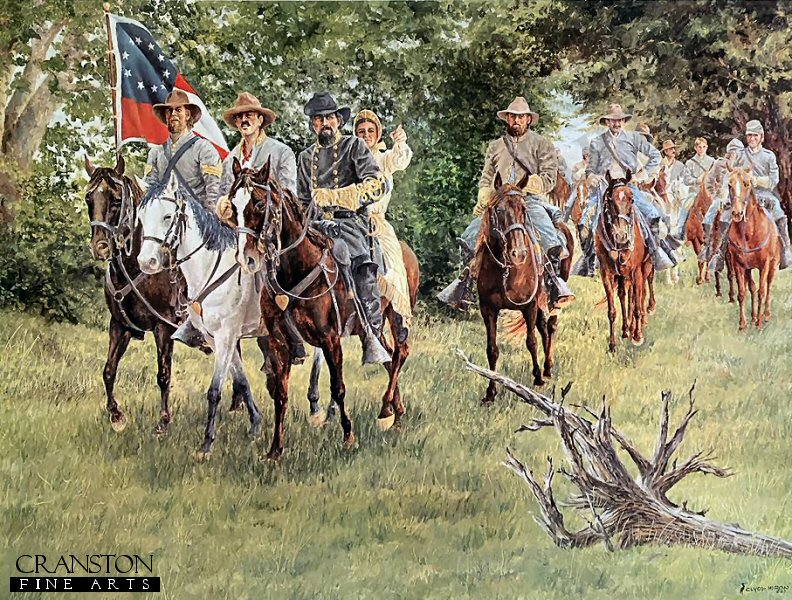
Forrest's Pursuit of Streight by Clyde Heron. At Black Creek, Gadsden, Alabama 2nd May 1863. Brigadier General Nathan Bedford Forrest, Col J B Biffle (9th Tennessee Regiment), Captain W S McLemore (Commanding Starnes 4th Tennessee Regiment), Captain Bill Forrest Scots (The renowned Forty Thieves), Lt R G Jones (Ferrell's Regiment). |
Robert E Lee by William Meijer. Inspired by the heroism of Ulysses S Grant, Robert E Lee, David G Farragut and JEB Stuart the artist William Meijer has created four portraits. Each portrait has been painstakingly researched in order to create an authentic likeness of each sitter and to honor the achievements of these great men. |
The Battle of Bull Run - July 21st 1861 by Louis Kurz The Battle of Bull Run, was the first major land battle of the American Civil War. It took place near Manassas Junction, Virginia between the Union Army, commanded by General Irvin McDowell and the Confederate Army, led by Generals Pierre G.T. Beauregard and Joseph E. Johnston. The battle ended in a decisive Confederate victory as Union forces were forced to retreat in disarray back to Washington, D.C. |
McClellan at Antietam - September 17th, 1862 by Henry Alexander Ogden (PC) George B. McClellan was the Union commander at the Battle of Antietam fought on September 17, 1862. Despite having a larger force, McClellan hesitated to aggressively pursue Confederate General Robert E. Lee resulting 1n a bloody and tactical stalemate. The battle was the bloodiest single day in American history, with significant casualties on both sides and although it ended inconclusively, it provided President Lincoln the political opportunity to issue the Emancipation Proclamation, shifting the war’s focus to the issue of slavery. |
73rd New York Volunteers Private (2nd Fire Zouaves) 1864 by Richard Knotel. Copyright Anne S K Brown Collection. |
Thomas Jonathan (Stonewall) Jackson by Chris Collingwood. Stonewall Jackson with the Stonewall Brigade during the Valley Campaign of 1862. |
146th New York Volunteers Corporal (5th Oneida Regiment) 1863 by Richard Knotel Copyright Anne S K Brown Collection. |
Berdan's Sharpshooters by Tom Lovell. One secondary market prints available, numbered 211 / 1500. |
Between the Lines by Gilbert Gaul. No text for this item |
Furling the Flag by Richard Brooke. No text for this item |
Always Ready by Keith Rocco. It was the morning of September 17, 1862 -- a day destined to become the bloodiest 24 hours in American history -- and the 9th New York quietly steadied themselves for the trial to come. The Ninth New York was one of the Federal Army's most colorfully-uniformed commands, clad in exotic regalia inspired by the famed French colonial troops called Zouaves. Like many Yankee Zouave units, at the outbreak of war in April, 1861 these sons of Manhattan had raillied to the cause behind a dashing and charismatic leader Rush Hawkins. Colonel Hawkins was not present at Antietam; ten days earlier he had returned to New York on leave of absence, and the Ninth would go into battle under the command of Lieutenant Colonel Edgar. A. Kimball. While lacking Rush Hawkins good looks and sartorial splendor, Kimball was equally determined that the Ninth New York live up to the inscription emblazoned on the red silk of the regimental colors: Toujours Pret--Always Ready. Morning had given way to afternoon and hundreds of men had fallen in repeated attempts to storm the lower bridge of the Antietam before Isaac Rodmans Federal division got underway. With the Ninth New York and Colonel Harison Fairchild's brigade leading the way, Rodmans troops began crossing the creek at Snavelys Ford, just south of the position held by General Robert Toombs stalwart Georgians. As the Confederates fell back before Burnsides troops, Southern artillery on the heights directed their fire at the ponderous Federal masses. The Practice of the rebel artilleryment was something wonderful in its accuracey, Second Lieutenant Matthew J. Graham recalled; they dropped shot and shell right into our line repeatedly. Lieutenant Graham was hugging the earth with his comrades in Company H. when he heard his commander shout Get up the Ninth! I turned over quickly to look at Colonel Kimball, who had given the order, Graham later wrote, thinking he had become suddenly insane. The Lieutenant rose from the ground, firmly believing that the regiment would not last one minute after the men got fairly on their feet. But Kimball led his Zouaves forward, over the undulating, steadily rising ground. The air was filled with a deluge of bullets, grape, canister and shell, wrote Charles Johnson, who fell with a shot through the left hip. The mental strain was so great, David Thompson observed, the whole landscape for an instant turned slightly red. Awed by Libaires desperate act of gallantry, the New Yorkers regained their momentum. Captain Lawrence Leahy raised the other banner, and followed Libaire, as did Lieutenant Colonel Kimball, Adjutant Homer, and First Lieutenant Robert McKechnie of Company H -- all shouting Forward! With their flags and surviving officers at the very apex of the charge, the Zouaves surged ahead to the wall, forcing Draytons troops from the corpse-strewn breastwork. Ahead of the thinning Federal line, across 500 yards of open meadow, Georgians and South Carolinians of Brigadier General Thomas F. Draytons brigade awaited the oncoming Yankees from the shelter of a low stone Wall. When the Ninth New York had approached to within 200 yards of the Rebel position at the stone wall, Lieutenant Colonel Kimball shouted the command Double quick, charge! A deadly volley blazed out from the muskets of Draytons Confederates, and at such close range the destruction in the Zouave ranks was terrible. Scores of men fell on top of one another, Private Wright recalled, while Lieutenant Graham, his right let shattered at the knee, noted We all went down together. Struggling to rise, Graham discovered that the Color Guard had been obliterated, and the regimental flags lay on the ground. One or two men staggered to their feet and reached for the colors, the officer remembered, but were shot down at once. Suddenly Captain Adolphe Libaire, the 22 year old French-born commander of Company E--the Zouaves Color Company--dashed forward and snatched up the fallen regimental banner. According to Lieutenant Homer, Libaire was habitually quiet, modest and unassuming. But rising to the crisis, the soft-spoken Captain was a man possessed. Raising the flag, Libaire waved it over his head and yelled, Up, dam you, and forward! -- then sprinted for the wall. That Forward, I for one will never forget while I live, Zouave William Cockefair wrote 35 years later; all he required was that we follow him. He showed the way. It was a deed that would later earn the young Frenchman the Medal of Honor. |
1st Virginia Cavalry 1861 by Jim Lancia. No text for this item |
53rd New York Volunteers (DEpineuil Zouaves) 1861 by Richard Knotel Copyright Anne S K Brown Collection. |
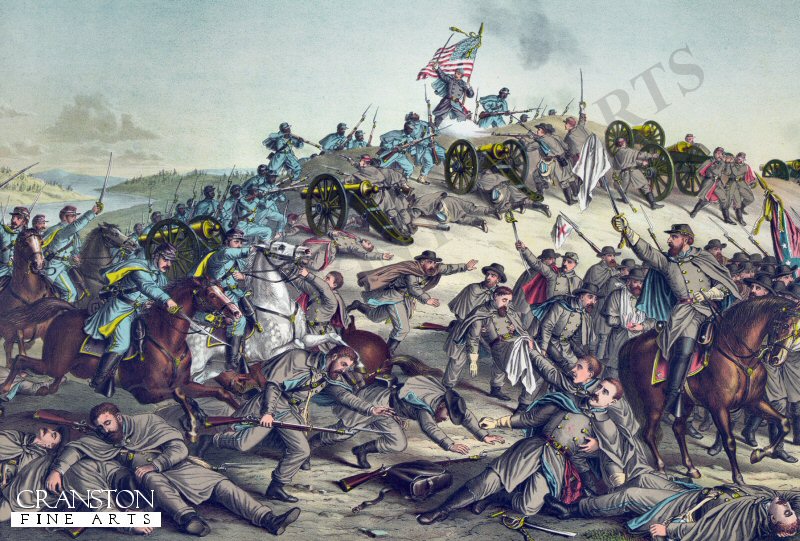
The Battle of Nashville - December 15-16th 1864 by Louis Kurz The Battle of Nashville pitted Union forces under Major General George H. Thomas against Confederate General John Bell Hood's army in Tennessee. The battle resulted in a decisive Union victory as Thomas's troops overwhelmed Hood's forces with a combination of superior numbers and effective tactics. |
Farragut on the Hartford at Mobile Bay - August 5th, 1864 by Henry Alexander Ogden (PC) The USS Hartford played a crucial role in the Unions naval campaign notably in the capture of New Orleans and the Battle of Mobile Bay where Farragut famously ordered his fleet to Damn the torpedoes, full speed ahead! |
Rebel Advance by Chris Collingwood. Depicting the 5th Virginia Infantrymen advancing across open ground. |
The Mud March attributed to Ponticelli. Union troops are shown moving towards Fredericksburg during winter. |
Original Oil Study of the Battle of Gettysburg painting by Mark Churms. (P) No text for this item |
The Siege of Vicksburg - May 16th to July 4th, 1863 by Henry Alexander Ogden The Siege of Vicksburg was a pivotal campaign in the American Civil War where Union forces, led by General Ulysses S. Grant encircled the Confederate stronghold of Vicksburg, Mississippi. The citys strategic location on the Mississippi River made it vital for supply and communication lines. After weeks of relentless bombardment and dwindling supplies, the Confederate defenders surrendered, giving the Union complete control of the Mississippi River and a significant advantage in the war. This victory, along with the simultaneous Battle of Gettysburg, marked a turning point in the conflict. |
Victory or Death by Keith Rocco. For many who study the American Civil War, April 6, 1865, has come to be known as Black Thursday for the Confederacy. Three days earlier, General Robert E. Lees Army of Northern Virginia had evacuated the defenses protecting Richmond and Petersburg with the intention of heading towards North Carolina. Unfortunately for the Southern army, such plans were not meant to be. On April 5, as Lee departed Amelia Court House with his army, he found the Federal army entrenched across his path at Jetersville station on the Richmond & Danville Railroad. Choosing not to bring on an engagement, instead the Confederate commander determined he would make a night march around the Union roadblock. The Confederate army now began heading in a westward direction toward Farmville. At this point he was told, rations would be available for his men before they continued on with their journey to North Carolina. All went well through most of the morning of the 6th. Finally in mid-afternoon, while the army was crossing a small watercourse known as Little Sailors Creek, Union cavalry began a series of hit and run tactics on the Confederate column. Confederate General Ewells corps was preparing for an impending attack by Union infantry which was now arriving on the scene. The two armies would first come in contact around the farmhouse of James Moses Hillsman which overlooked the creek. After brief skirmishing around the house, the Confederate forces fell back and across the creek, digging in on the high ground overlooking it. Shortly after 5:00 P.M., Union artillery now positioned around the Hillsman house opened fire on Ewells line. The Confederates, having no artillery with which to reply, were on the receiving end of a bombardment which would last approximately a half-hour. Upon its deadly completion, two divisions moved down to and over the creek, reforming to assault Ewells position on the heights. As the Federal infantry moved up the slope against the Southern battleline, some of the Union soldiers would actually wave handkerchiefs as an invitation for Ewells men to surrender. In response to this Ewells men rose and fired a volley into the enemy ranks, breaking a portion of the Federal line. Those Confederate forces in front of this breach then made a counter-attack, pushing some of the Union soldiers all the way back to the creek. Leading this impromptu offensive was Colonel Crutchfield, formerly Stonewall Jacksons Chief of Artillery. In the ensuing struggle, Crutchfield would be killed and Major Robert Stiles of the Chaffins Bluff Garrison would assume command. Eventually General Custis Lee would order these men back to their original post as the Federal army was now preparing for a second major assault upon their line. With both of Wrights divisions now across Little Sailors Creek and reassembled, the Southerners prepared for another attack. This time the Union battleline actually overlapped both flanks of the Confederate position. As the two forces locked themselves in deadly hand-to-hand combat, slowly groups of Ewells men began surrendering. The scene being depicted in this painting shows the last stand of the Savannah Volunteer Guards as it is about to receive the final Federal attack. By this time, the Guards can only muster eighty-five men. With the colors being planted on the road side, Union soldiers of the 121st New York Infantry are reaching the crest of the ridge. Sergeants Richard Millen and Simeon Morton rally the Guards around the battalion flag. Soon, both men will be shot down. Finally, Major Basinger, seeing the hopelessness of the situation, signals for surrender. It was shortly thereafter, that Harris S. Hawthorne of the 121st would retrieve the battalion's flag; he is also credited with the capture of General Custis Lee. In the 1870s the flag would be returned to the surviving Guards, a member writing, it was lost without dishonor and recovered without humiliation. |
| Navigation | |
| Page 1 of 5 | Page 1 .. Next |
|
Contact Details |
|
Sign Up To Our Newsletter!
This website is owned by Cranston Fine Arts. Torwood House, Torwoodhill Road, Rhu, Helensburgh, Scotland, G848LE Contact: Tel: (+44) (0) 1436 820269. Email: cranstonorders -at- outlook.com |
 |