|
|
|
|
|
|
|
|
 |
 |
 |
 |
 |
 |
 |
 |
 |
 |
 |
 |
 |
 |
|
MEDIEVAL ERA MILITARY PRINTS SECTION
YOU ARE VIEWING: MILITARY PRINTS --> MEDIEVAL ERA MILITARY PRINTS
| Navigation | |
| Page 1 of 8 | Page 1 .. Next |
| Military Art Collecton - Medieval |
|
|
|
|
|
|
|
|
|
|
|
|
|
|
|
|
|
|
|
|
|
| Navigation | |
| Page 1 of 8 | Page 1 .. Next |
| Text for the above items : |
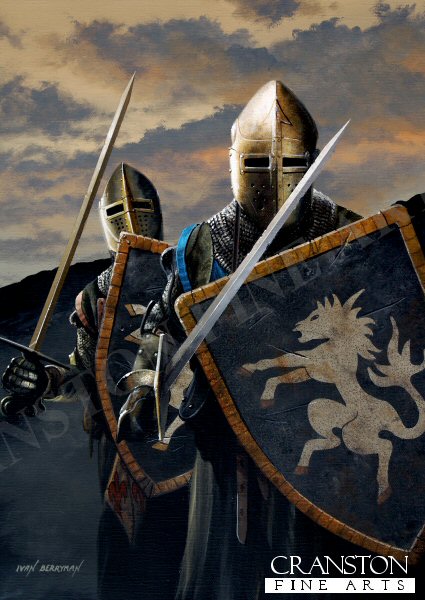
The Guardian by Ivan Berryman No text for this item |
The Battle of Bannockburn by Mark Churms. With the full might of Englands Army now gathered to do battle before the besieged Stirling Castle, the young Edward II Plantagenate is confident of victory over the enemy. To the west of the Bannockburn, Robert Bruce, King of Scots kneels to pray with his men and commends his soul to God. The Scottish battle lines are prepared. The Cavalry is in reserve to the rear behind the spearmen and archers (known as Flower of the forest) in tightly packed Schiltrons patiently awaiting the coming onslaught. Unknown to the English, the open marshy ground of no mans land conceals hidden pits and trenches, major obstacles for any mounted charge. Despite Cliffords and de Beaumonts premature and unsuccessful attempt to relieve the castle the day before, years of victory have taught the brave English knights to regard their Scottish foes with contempt. So, without waiting for the bowmen to effectively weaken the enemy lines the order is hurriedly given to attack! With one rush hundreds of mounted knights led by the impetuous Earl of Gloucester thunder headlong through the boggy ground straight for the impenetrable forest of spears and into defeat and death. With dash and courage the knights try to force a way through the mass of spears but the Scots stand firm. The momentum of the charge is lost and there is no room to manoeuvre. Everywhere horses and men crash to the ground, casualties amongst the English are horrific. Robert Bruce seizes the moment and orders the exultant army to advance. The Englishmen are slowly pushed back into the waters of the Bannockburn. All discipline is lost as the soldiers and horses madly scramble for the far bank of the burn. Many drown or perish in the crush to escape the deadly melee. Edward II, with his army destroyed, flees with his bodyguard for the safety of Stirling Castle but is refused refuge and has to fight his way south to England. For Robert Bruce and Scotland victory is complete. Text by Paul Scarron-Jones. |
A Fear of the Knight by Ivan Berryman. (PC) No text for this item |
The March from Leicester by Graham Turner King Richard III leads his army out of Leicester, past Austin Friars and over Bow Bridge, en-route to Bosworth and his fateful confrontation with the invading army of his adversary for the throne, Henry Tudor. |
Richard III at the Battle of Bosworth, 22nd August 1485 by Mark Churms. The decisive battle of the War of the Roses was fought near Market Bosworth. Richard of Gloucester, the last Plantagenate King of England was to try consequences with Henry Tudor, Earl of Richmond. The bloody conflict began in the traditional manner with the opposing armies drawn up in line. facing one another, except for the forces of Thomas Neville, Lord Stanley, as yeyt uncommitted to either side. King Richard, the Third of that name, is seated astride his grey charger in his fine blued harness. He is accompanied by his personal standard and the royal standard, alongside that of Lord Zouch to his right. His herald, trumpet are at his side. To his left Richards Chamberlain and Admiral, Viscount Lord Lovel, sits ready, astride his mount. To the rear we see the rest of the household and choice force of cavalry, kept out of shot to avoid unnecessary casualties amongst the expensive war horses. After the opening deadly arrow storm, boys hurriedly collect fallen arrows for Richards men to shoot back. In the front line crossbowmen return fire from behind the safety of their decorated pavaises (painted with the suns and white roses of York and the white boar, Richards badge). Close by a gentleman at arms, mortally wounded by an iron ball fired from a hand gonne is dragged from the field by his page. Sir Walter Devereux (Lord Ferrers) accompanied by his standard is encouraging his household (soldiers wearing his livery colours ) to attack. However, there is a marked reluctance on both sides to join the vicious close quarter combat of handstrokes and only in the centre is there any heavy fighting. Richard is informed by his herald that Henry and his household have been recognised and are now within charge distance. Faced with his armies reluctance to come to grips with the enemy, he decides to force battle himself by leading his own household, the Choice Force, in a desperate charge against Henry seeking to engage him in single combat. Characteristically leading from the front Richard slays many a knight, including William Brandon (Henrys standard bearer) in his vain attempt to kill his rival. At this crucial moment Lord Stanley decides to join Henrys cause, attacks the choice force and drives it from the field. In the brutal hand to hand fighting the king is unhorsed and though surrounded, fights to the end. -KingRichard alone was killed fighting manfully in the thickest press of his enemies - his courage was high and fierce and failed him not even at the death which when his men forsook him, he preferred to take by the sword, rather than by foul flight to prolong his life- (Polydore Virgil) |
After the Battle by Sir William Allen. Robert the Bruce, the victor of Bannockburn is shown asleep with sword in hand in one of the smaller historical paintings by Sir William Allen. |
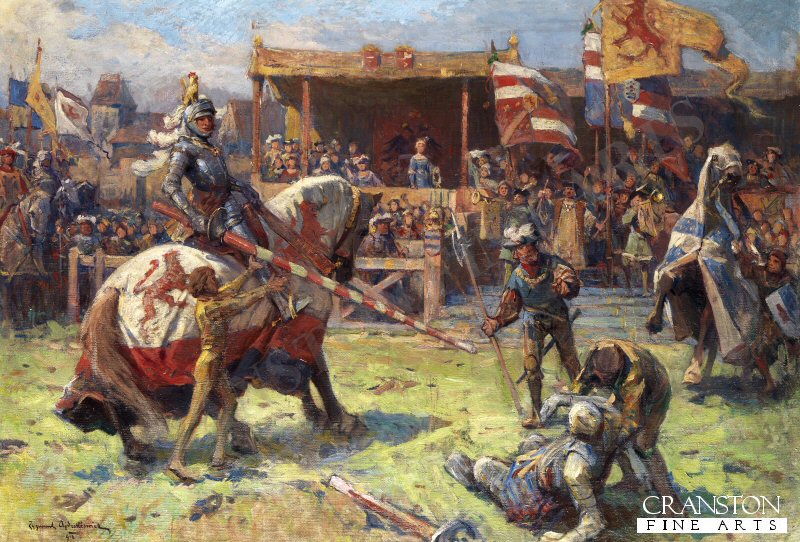
Knight's Tournament by Zygmunt Ajdukiewicz Jousting was a popular martial sport and form of entertainment where two knights on horseback charged at each other with blunted lanes, aiming to unseat their oponent. It was often held during tournaments to display skill, bravery and chivarly. Despite the lances being blunt, the sport was still dangerous and many knights would die taking part. |
Return of Frithiof by August Malmstrom (PC) Frithiof's Saga tells the story of Frithiof, a heroic Viking who embarks on a journey filled with adventure, love, and betrayal. Written in 14th century Iceland, but taking place in Norway during the 8th century, the saga narrates bow Frithiof falls in love with the beautiful Princess Ingeborg, but their romance is thwarted by her father, King Ring, who demands that Frithiof prove his worth by completing a series of heroic deeds. |
William the Conqueror at the Battle of Hastings by Matania. William the Conqueror feigned a withdrawal of his cavalry, the Saxon infantry again could not resist to break ranks and pursue the cavalry. Halfway down the hill Williams knights turned and charged the Saxon infantry. King Harold at this time was mortally wounded from an arrow in the eye and the victory was won by the Normans. Each side lost a quarter of their men and during the fighting William the Conqueror had three horses killed under him. Later he ordered the building of Battle Abbey on the battlefield. The way was clear to London and William the Conqueror was crowned King of England on Christmas day at Westminster Abbey. |
The Power of the Sword by Ivan Berryman. A knight's one-handed sword was a study in balance-blade long enough for reach, yet light enough for quick recovery behind a shield. Its double edge tapered to a precise point, suited for both cutting through mail and thrusting into the joints of plate. The crossguard flared straight and simple, protecting the hand without burdening it, and the pommel served to counterbalance the blade's weight. |
The Vikings by Brian Wood. This, my personal interpretation of the viking period attempts to highlight aspects of their rich and diverse culture. A superstitious and pagan society, their influence was felt far beyond their native Scandinavia. 1 . The upper background deals with their pagan worship and tales from their mythology. This is represented by Odin & Thor, their principal Gods along with the saga of Sigurd the Dragonslayer. 2. The dominant figure at the centre is Aegir, God of the Sea whose goodwill was all important to the seafaring Viking. The scene now comes into the real world of their ships and seamanship, expertise for which they had no peer. 3. The extension of their seafaring was to raid, trade and pillage foreign shores, resulting in colonisation and settlement, with scant respect for Christianity or the Church. They ventured still further, exploring the unknown world, this is suggested in the two lower corners. 4. In England, the only King to successfully rise up against these Norsemen was Alfred the Great, a Saxon, represented in the lower centre drawing his sword from a swamp. This symbolises the raising of his army from the marshes of Wessex. Their legacy remains with us today, in language and art. |
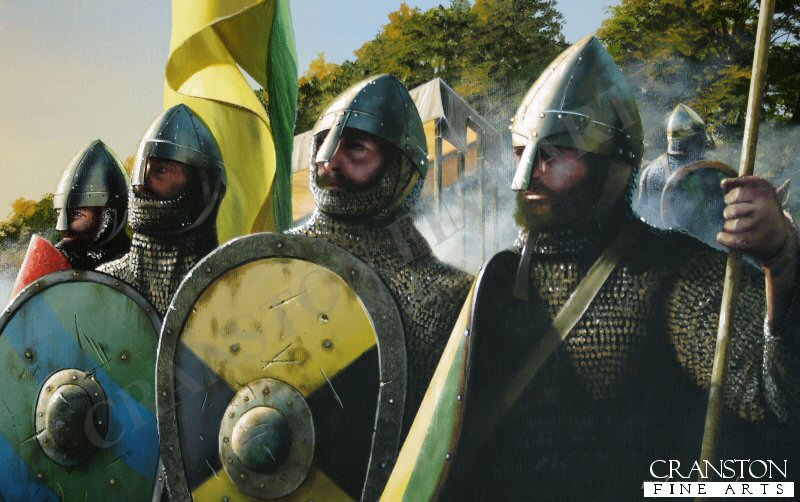
Awaiting Orders by Ivan Berryman. Dawn broke cold over Senlac Hill, Norman soldiers look on across the slope, the English gathered around their king's banner, the golden dragon flying high above a wall of shields. |
Death of King Arthur by John Mulcaster. King Arthur received his wounds at the Battle of Camlann where he killed the dark knight Sir Mordred. Sir Bedevere (the Last of the Knights of the round table) with the dying King Arthur and from the haze a great black swan-like barge appears. On the barge are nine noble ladies, one of which is Queen Morgan Le Fay, and another being the lady of the Lake. They have come to take King Arthur to the isle of Avalon. |
Samurai Warriors by Chris Collingwood. Samurai Warriors of the Sekighahara campaign 1600. The most important and decisive battle in the history of Japan, Sekigahara was the culmination of the Power struggle triggered by the death of the great warlord Toyotomi Hideyoshi. The two rivals for power were Ishida Mitsunari and Tokugawa Ieyasu. The contest was ultimately settled by force of arms in a small mountain valley in central Japan. By the end of the day 40,000 heads had been taken and Ieyasu was master of Japan. Within three years the Emperor would grant him the title he sought - Shogun. |
Field of the Cloth of Gold by Sir John Gilbert. Depicts Henry VIII on his way to the Historic meeting with Francis I of France in 1520. |
Yorkist Soldier by Chris Collingwood. No text for this item |
The Joust of Peace (The Black Knight) by Mark Churms. Edward Plantagenet, Prince of Wales turns his charger once more to engage his opponent in a joust of courtesy using blunt lances. |
Battle of Hastings by Tom Lovell. Stand Fast! Stand Fast! shouts Bishop Odo,.. Fear nothing, for if God please, we shall conquer yet. So they took courage, - wrote 12th century chronicler Master Wace. - He...sat on a white horse, so that all might recognize him. In his hand he held a mace, and wherever he saw most need he...Stationed the knights, and often urged them on to assault...the enemy. |
The Arrivall by Graham Turner Edward IV enters London through Bishopsgate to reclaim the throne on the 11th April 1471. |
Guillaume de Clermont defending Ptolemais (Acre) 1291 by Dominque Louis. The second battle of Acre the Turkish Army of 60,000 horsemen and 100,000 foot soldiers laid siege to the city. Eventually the Marmalukes took the outer wall on May 15th and three days later stormed the inner gates, bursting into the city and most of the Christian defenders died fighting them. Acre was thoroughly destroyed and all fortifications demolished, May 18th 1291. |
The Battle of Bosworth - the Melee - Norfolk versus Oxford by Graham Turner When Richard III succeeded his brother, Edward IV, in 1483, he found his throne threatened by the Lancastrian Henry Tudor, who was then exiled in France. Two years later, Henry landed in Wales with a small force and on the 22nd August 1485, he confronted the Royal army near Market Bosworth in Leicestershire. |
| Navigation | |
| Page 1 of 8 | Page 1 .. Next |
|
Contact Details |
|
Sign Up To Our Newsletter!
This website is owned by Cranston Fine Arts. Torwood House, Torwoodhill Road, Rhu, Helensburgh, Scotland, G848LE Contact: Tel: (+44) (0) 1436 820269. Email: cranstonorders -at- outlook.com |
 |