|
|
|
|
|
|
|
|
 |
 |
 |
 |
 |
 |
 |
 |
 |
 |
 |
 |
 |
 |
|
MEDIEVAL ERA MILITARY PRINTS SECTION
YOU ARE VIEWING: MILITARY PRINTS --> MEDIEVAL ERA MILITARY PRINTS
| Navigation | |
| Page 2 of 8 | Previous .. Page 2 .. Next |
| Military Art Collecton - Medieval |
|
|
|
|
|
|
|
|
|
|
|
|
|
|
|
|
|
|
|
|
|
| Navigation | |
| Page 2 of 8 | Previous .. Page 2 .. Next |
| Text for the above items : |
In Single Combat by Mark Churms. Robert The Bruce dispatches Sir Henry De Bohun before the Battle of Bannockburn. Far ahead of Edward IIs main army, marching from Falkirk to relieve Stirling Castle, rides the English vanguard. Late on that day, 23rd June 1314, these horsemen advance along the Roman road and cross Bannockburn. Eager for combat Gloucesters bold Barons and Knights spur on their chargers towards the gathered Scottish infantry. Robert the Bruce, King of Scots, not yet fully dressed for battle, sits astride a grey pony. He rides out ahead of his formations to observe the enemys advance. One of the English Knights, Sir Henry De Bohun, seeing the Kings vulnerable position, gallops ahead of his fellows to engage Bruce in single combat. Undaunted, the King holds his ground. Skillfully turning his mount away from the thrust of the Knights deadly lance in one movement he swings his battle axe down upon his enemys head with such force that the handle is shattered and the unfortunate attackers skull is split in two. In triumph, Bruce returns to the cheers of his countrymen who before the day is out will soon deliver a similar fate upon many other English noblemen. As the light fades the Riders retire but both armies know well that the main battle of Bannockburn has yet to begin. |
Richard Lionheart at the Battle of Acre by Matania. Richard the Lionhearts tactical skills and military training played a substantial role in the capture of Acre in 1191 by the Crusaders. But Richard the Lionheart was ruthless and after the capture of the city he marched 2,700 Muslim soldiers onto the road of Nazareth and in front of the Muslim army positions, had them executed one by one. But Richard the Lionheart was up against a great leader in Saladin and the crusades did not always go his way. After he negotiated the Treaty of Jaffa with Saladin and secured the granting of special rights of travel around Palestine and in Jerusalem for Christian pilgrims, Richard the Lionheart started his journey back to England in 1192. He was shipwrecked, and captured by the German Emperor Henry VI, only being released after a 150,000 mark ransom was paid. This money was raised by taxes in England. |
Edward II at the Battle of Bannockburn by Jason Askew. King Edward the 2nd on the field at Bannockburn with his body guard near. He would later leave the battle in his escape as the battle was lost to Robert the Bruce. |
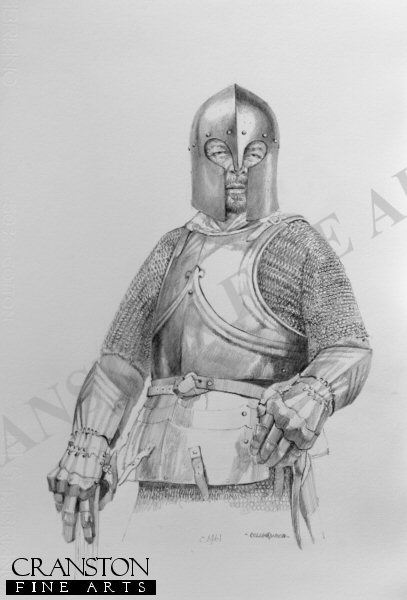
Man at Arms, 1461 by Chris Collingwood (P) No text for this item |
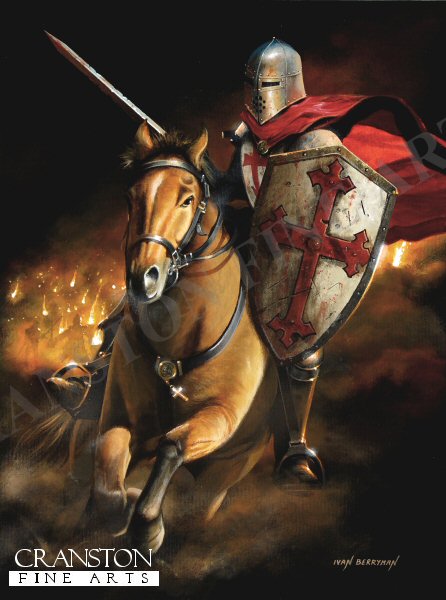
The Blood Red Cross by Ivan Berryman. No text for this item |
William III by Chris Collingwood. Showing William III in full Black Armour at the time of the Battle of Boyne. |
Reflection by Ivan Berryman (PC) A lone knight of the Knight's Templar sits in prayer and reflection. |
Sun in Splendour by Chris Collingwood. Soldiers of the Yorkist cause c.1461. Crossbowman, Man at arms and knight with the standard of the Sun in Splendour. |
Frithiof's Courtship by August Malmstrom. (PC) Frithiof's Saga tells the story of Frithiof, a heroic Viking who embarks on a journey filled with adventure, love, and betrayal. Written in 14th century Iceland, but taking place in Norway during the 8th century, the saga narrates bow Frithiof falls in love with the beautiful Princess Ingeborg, but their romance is thwarted by her father, King Ring, who demands that Frithiof prove his worth by completing a series of heroic deeds. |
Robert the Bruce by Chris Collingwood. In 1306 Robert the Bruce was crowned King of the Scots. In 1309 Bruce controlled most of Scotland north of the Firth and Clyde. Over the next few years Bruce conquered the English Garrisons of Perth, Dundee, Roxburgh, Dumfries and St. Andrews, leaving only Stirling in English hands. On 24th June 1314 Robert the Bruce defeated the English army at Bannockburn. The war dragged on until the peace treaty was signed in 1328, recognising Robert the Bruce as King Robert I of Scotland, and Scotland an independent Kingdom. He died the following year. |
The Battle of Evesham, August 4th 1265 by William Barnes Wollen. No text for this item |
Mary Queen of Scots Returning from Exile by Charles Cattermole. Charles Cattermole was the son of R. Cattermole and the nephew of G. Cattermole whose subject matter he adopted. He exhibited from 1858 and was elected Associate of the New Watercolour Society in 1863, rising to full Member in 1870, serving as Secretary for many years. He was also the Secretary of the Artists Society at Langham Chambers. He exhibited at the Royal Academy, the Royal Society of British Artists, to which he was elected Member in 1876, the Royal Institute, to which he was elected Associate Member in 1862, rising to full Membership in 1870, the Royal Institute of Oil Painters, to which he was elected Member in 1883, the Royal Society of Artists Birmingham, Glasgow Institute of the Fine Arts, Walker Art Gallery Liverpool and the Suffolk Street Galleries. Examples of work by Charles Cattermole are in the British Museum, the Victoria and Albert Museum, Leicester Gallery, Paisley Art Gallery, the Royal Shakespeare Theatre Stratford and Sydney Art Gallery. |
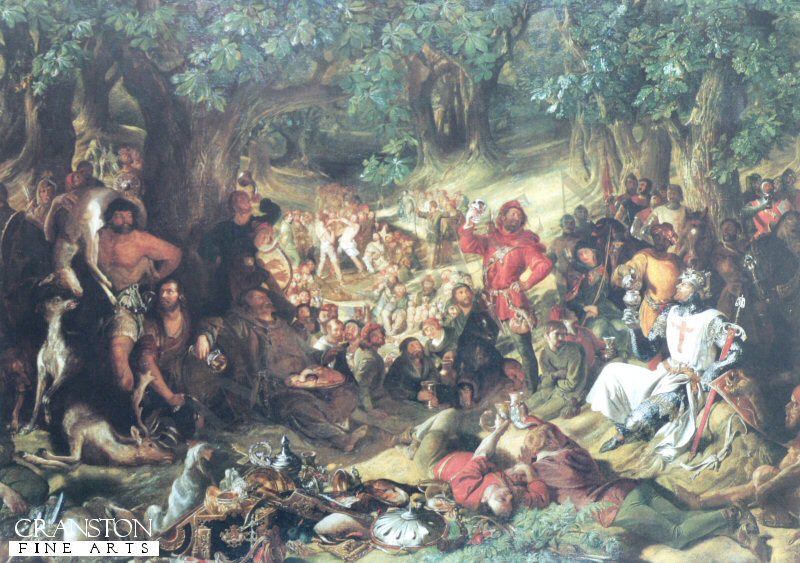
Robin Hood by Daniel Maclise. Robin Hood is shown with Will Scarlet, Friar Tuck, Little John and his outlaws in Sherwood Forest celebrating the arrival of Richard the Lion Heart, back from the Crusades. |
Edward the 1st in Wales by David Pentland. Edward departs from his almost completed Rhuddlan Castle at the conclusion of his second Welsh campaign. |
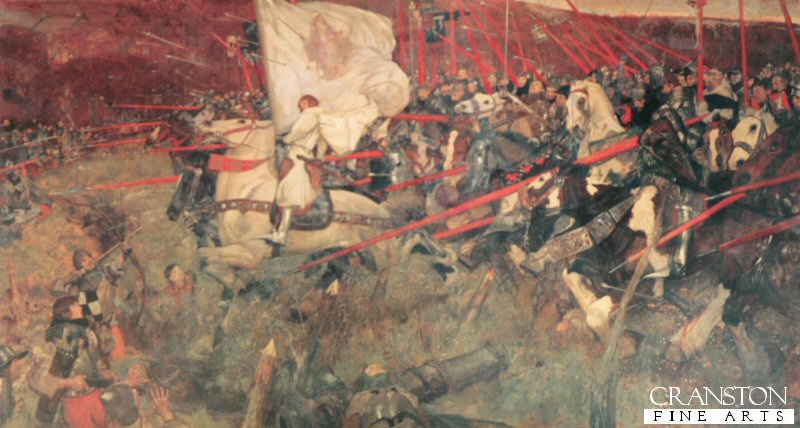
La Pucelle! Joan of Arc, The Maid of Orleans at the Head of French Cavalry by Frank Craig (1874-1918) . Saint Joan of Arc ca. 1412 - 30 May 1431. In France she is a national heroine and a catholic saint. Joan of Arc was a peasant girl born in eastern France, she led the French army to several important victories during the Hundred Years War, claiming divine guidance, and was indirectly responsible for the coronation of Charles VII. Joan of Arc was captured by the Burgundians, sold to the English, tried by an ecclesiastical court, and burned at the stake when she was nineteen years old. |
The Battle of Agincourt by Brian Palmer. The French Knights attack Henry Vs English infantry lines and are repelled during the Battle of Agincourt, a victory for Henry V. |
Sanctuary by Richard Burchett. After the Lancastrian army had been defeated at the battle of Tewkesbury, 4th May 1471, the Duke of Somerset and a number of his fellow Lancastrians attempted to hide in Tewkesbury Abbey, but were dragged out by Edward IV and the Yorkist soldiers, tried and beheaded. |
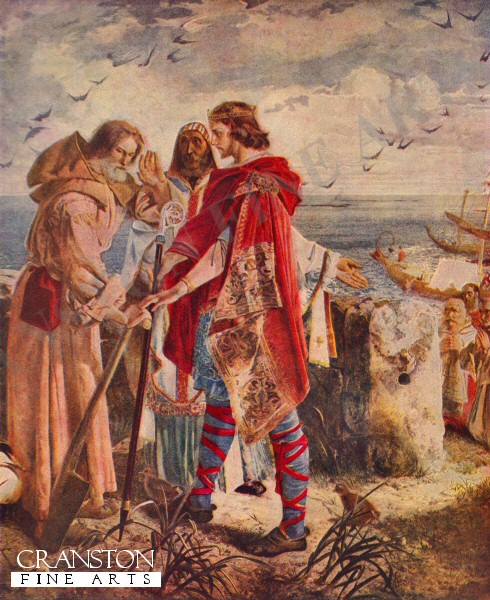
Egfrith Offering The Bishopric of Hexham to Cuthbert, 678 by W. Bell Scott. (B) When Egfrith of Northumbria divided his kingdom into four bishopries. York, Lindisfarne, Hexham and Lindsey and deprived Bishop Wilfred of his power. The see of Hexham was offered to Cuthbert, the hermit of Farne Island. He may have refused the offer, for in 685 he was consecrated Bishop of Lindisfarne but soon after he resigned and returned to his hermitage where he died in 687. |
Sons of Odin by Chris Collingwood. A Viking raiding party comes ashore from their Viking longboat on the western coast of England, 890 A.D. |
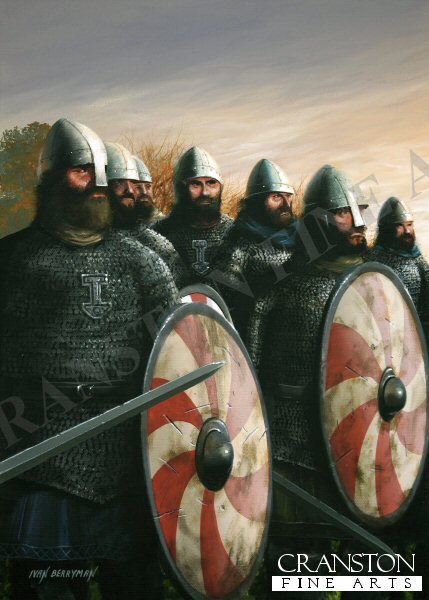
The 14th Dawn by Ivan Berryman. Depicted here at dawn of the battle of Hastings on the 14th of October 1066, the core of King Harold Godwinson's army was made up of housecarls, full-time professional soldiers. Their armour consisted of a conical helmet, a mail hauberk, and a shield. |
Battle of Stamford Bridge by Brian Palmer. King Harold defeats the Viking invaders at Stamford Bridge before his long march south to face William the Conqueror at the Battle of Hastings. |
| Navigation | |
| Page 2 of 8 | Previous .. Page 2 .. Next |
|
Contact Details |
|
Sign Up To Our Newsletter!
This website is owned by Cranston Fine Arts. Torwood House, Torwoodhill Road, Rhu, Helensburgh, Scotland, G848LE Contact: Tel: (+44) (0) 1436 820269. Email: cranstonorders -at- outlook.com |
 |