|
|
|
|
|
|
|
|
 |
 |
 |
 |
 |
 |
 |
 |
 |
 |
 |
 |
 |
 |
|
MEDIEVAL ERA MILITARY PRINTS SECTION
YOU ARE VIEWING: MILITARY PRINTS --> MEDIEVAL ERA MILITARY PRINTS
| Navigation | |
| Page 3 of 8 | Previous .. Page 3 .. Next |
| Military Art Collecton - Medieval |
|
|
|
|
|
|
|
|
|
|
|
|
|
|
|
|
|
|
|
|
|
| Navigation | |
| Page 3 of 8 | Previous .. Page 3 .. Next |
| Text for the above items : |
Sir Walter Raleigh by Chris Collingwood. No text for this item |
Battle of Crecy by Brian Palmer. Battle of Crecy 26th August 1346. On 12th July Edward III landed in Normandy with his army and marching north plundered the countryside. King Philip VI assembled an army to stop Edward and tracked them across the Somme River. When Edward reached Crecy he stopped and ordered his army to take up defensive positions. King Philip surveyed the English positions and decided to postpone his attack until August 27th. However, the French vanguard pressed forward too far and so committed the entire army to the battle. The hired Genoese crossbowmen began the assault but came under severe attack from the English longbows and so fled to the rear. King Philip then ordered his cavalry to charge resulting in a huge loss of horse and man under the barrage of arrows which rained down on them. By the end of the night after several unsuccessful assaults the French army was reduced by a third and King John of Luxemburg was dead. Edward then turned towards Calais. |
Alfred The Great by Chris Collingwood. Alfred was born in 849 at Wantage, Oxfordshire He was the youngest son of King Ethelwulf of Wessex, he became King of the Anglo Saxon Kingdom of Wessex from 871 to 899. Alfred is known for his great defence of the Kingdoms of southern England against the Vikings. Eventually in 871 he made peace with the Vikings who agreed to a withdrawal out of his kingdom. It is likely a large payment of gold was made. Alfred was awarded the epithet The Great, and was the only king to be awarded this title. Alfred the Great was a learned man and improved the education and legal and military systems and structure. Alfred died on the 26th October 899 |
The Standard Bearer by Sir John Gilbert. Historical art print of a standard bearer from Henry VIII reign or Queen Elizabeth I reign. |
Challenge in the Mist by Graham Turner. At dawn on Easter Sunday, 14th April 1471, the armies of Edward IV and his one time ally, Richard Neville, Earl of Warwick, confronted each other near Barnet, 10 miles outside London. A thick fog enveloped the battlefield, causing the opposing forces to misalign - Edwards right wing overlapping Warwicks left and visa versa. In the struggle that followed, the Yorkist left was outflanked and crumbled, its remnants being persued off the field by the Earl of Oxfords men. However, when Oxford managed to regroup some of his force and return to the fray, the misalignment of the armies had caused the whole battle line to rotate and in the confusion, they found themselves engaged against their allies. |
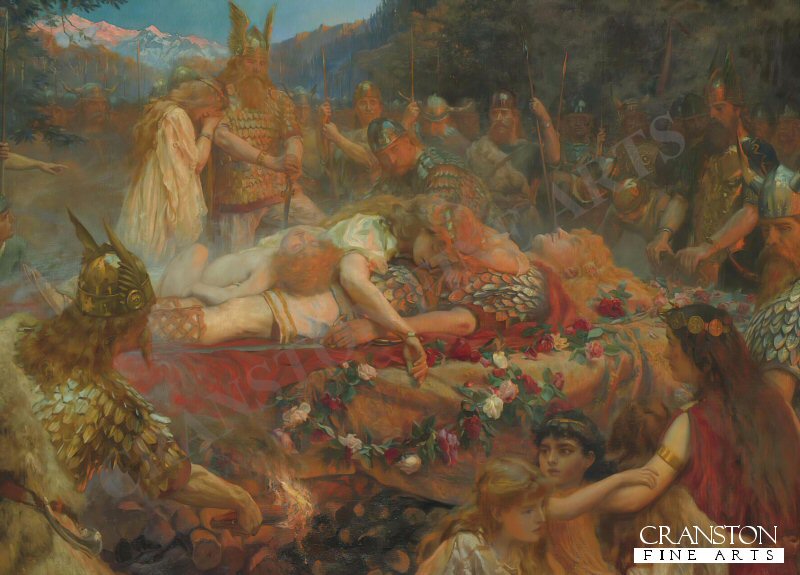
Death of a Viking Warrior by Charles Ernest Butler (PC) Part of the classic collection. |
Battle of Barnet by Chris Collingwood. The Battle of Barnet was fought in a heavy mist, on Easter Sunday 14th April 1471. Due to a misalignment of the opposing armies, all became confusion. The centre of the battle (as depicted here) was fought at close quarters, a mass of struggling knights and men at arms with comrade fighting comrade, their vision of the battle obscured by mist. The Yorkists under the leadership of King Edward IV triumphed, leaving the Lancastrians with hopes dashed. Their champion and leader, the great Richard Neville, Earl of Warwick The King Maker lay dead, cut down while struggling to regain his charger. In the painting Edward IV charges toward the banner of Henry Holland, Duke of Exeter, while in the foreground soldiers of the Houses of York and Lancaster hack and slash at each other in terrified butchery. |
The Siege of Harfleur, 1415 by Brian Palmer. (GL) King Henry V of England leads his army at the siege of Harfleur in 1415. |
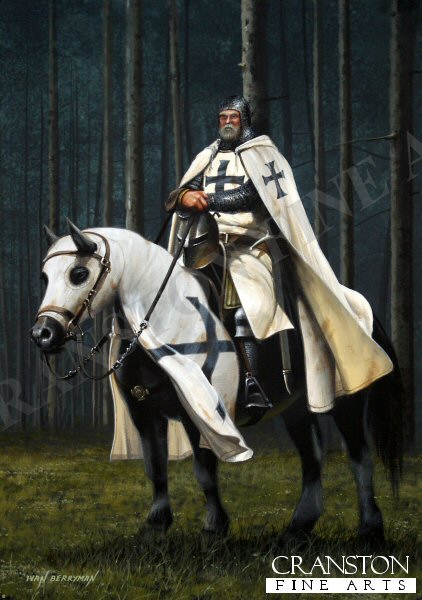
The Old Soldier by Ivan Berryman An Old Knight of the Teutonic Order after many years of service, having fought the crusades in the Holy Land and returned to Europe to continue the battle against pagans in the Baltic states, he is shown wearing the distinctive black cross on his white cloak. |
Battle of Nagashino by Brian Palmer. When Portuguese traders took advantage of the constant violence in Japan to sell the Japanese their first firearms, one of the quickest to take advantage of this new technology was the powerful daimyo Oda Nobunaga. In 1575 the impetuous Takeda Katsuyori lay siege to Nagashino castle, a possession of an ally of Nobunagas, Tokugawa Ieyasu. An army was despatched to relieve the siege by Nobunaga and Ieyasu, two of the most influential figures in Japanese history, and the two sides faced each other across the plain of Shidarahara. The Takeda samurai were brave, loyal and renowned for their cavalry charges, but Nobunaga, counting on Katsuyoris impetuosity, had 3,000 musketeers waiting behind prepared defences for their assault. The outcome of this clash of tactics and technologies was to change the face of Japanese warfare forever. |
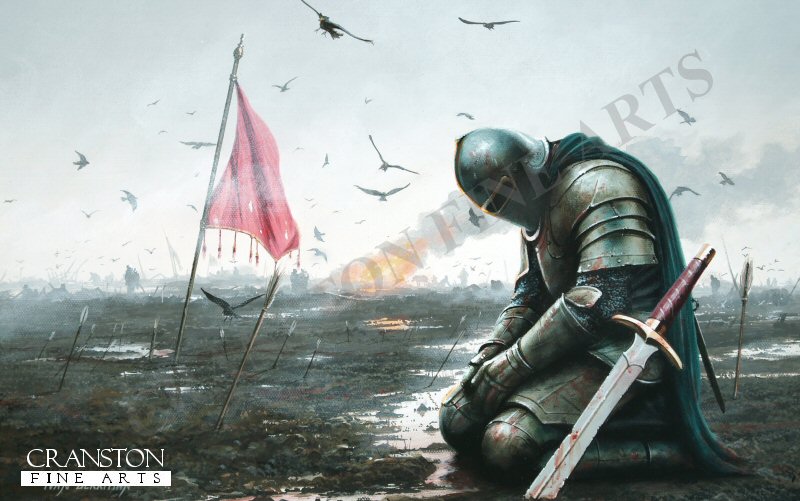
The Day is Done by Ivan Berryman A knight is shown exhausted after a hard fought battle. All around him, a scene of death and destruction, the bodies of the fallen, friend and foe alike. |
1461, Gunpowder by Chris Collingwood (P) No text for this item |
After the Battle of Naseby by Sir John Gilbert. Royalist cavalry at the Battle of Naseby. Cavalier trumpeters are shown advancing with King Charles 1sts cavalry during the Battle of Naseby. |
The Taking of Stirling Bridge by Mike Shaw. The taking of Stirling Bridge over the Forth by the Scots marks the point where the first great battle of the Scottish wars of independence was won. The heavily equipped English army, now divided into two, struggle to fight in the heavy ground of the river plain. In the centre the Scots Captain Wallace can be seen slaying treasurer Cressingham, while to the right lies a fatally wounded Sir Andrew de Moray. |
Robert the Bruce by Jason Askew. Far ahead of Edward II's main army, marching from Falkirk to relieve Stirling Castle, rides the English vanguard. Late on that day, 23rd June 1314, these horsemen advance along the Roman road and cross Bannockburn. Robert the Bruce, King of Scots, rides out ahead of his formations to observe the enemy's advance. One of the English Knights, Sir Henry De Bohun, seeing the King's vulnerable position, gallops ahead of his fellows to engage Bruce in single combat. Undaunted, the King holds his ground. Skillfully turning his mount away from the thrust of the Knights deadly lance in one movement he swings his battle axe down upon his enemy's head with such force that the handle is shattered and the unfortunate attackers skull is split in two. |
Yermacks Conquest of Siberia, 1582 by Vasily Surikov. Yermack Timofeyevich with a force of free Cossacks were enlisted by the Russian Tsar to defeat Kucham the self-proclaimed Khan of Siberia. Yermacks force prepared for the campaign during the winter and embarked on their campaign crossing into Siberia in the early summer of 1582, culminating in the routing of Kuchams large army on the banks of the River Irtysh and entering the Siberian capital of Khanate on the 26th October 1582. Yermack is shown standing under the Vernicle standard which is now housed in the armoury of the Kremlin in Moscow. |
1461 by Chris Collingwood. No text for this item |
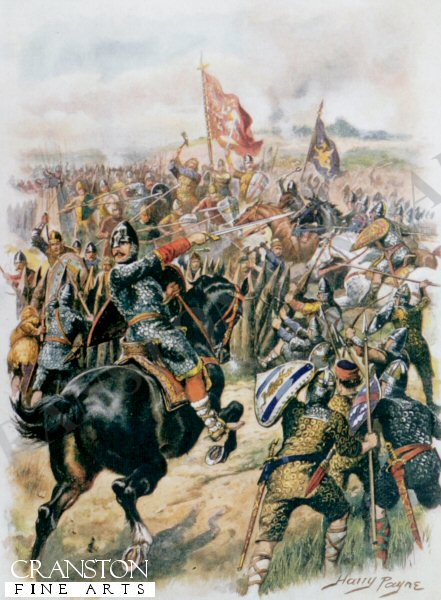
Harold's Last Stand, Battle of Hastings by Harry Payne. William the Conqueror feigned a withdrawal of his cavalry, the Saxon infantry again could not resist to break ranks and pursue the cavalry. Halfway down the hill Williams knights turned and charged the Saxon infantry. King Harold at this time was mortally wounded from an arrow in the eye and the victory was won by the Normans. Each side lost a quarter of their men and during the fighting William the Conqueror had three horses killed under him. Later he ordered the building of Battle Abbey on the battlefield. The way was clear to London and William the Conqueror was crowned King of England on Christmas day at Westminster Abbey. |
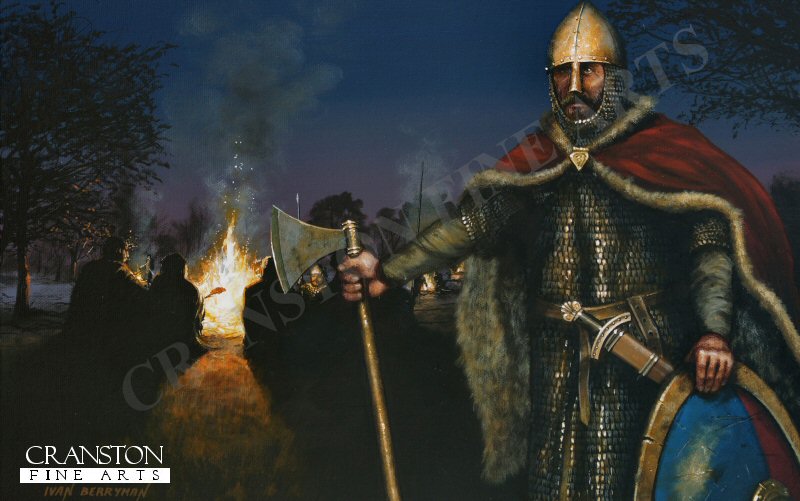
The Morning Watch, Hastings, 1066 by Ivan Berryman. A Saxon guard, keeping watch on the morning of the battle of Hastings. The fighting would begin at 9am and conclude at dusk with a Norman victory against the overwhelmed Saxons, the death of King Harold being the final nail in the coffin that led to retreat. |
Towton - The Rout by Graham Turner. The defeated Lancastrian army flees from the battlefield, down Towton Dale towards the River Cock, pursued and cut down by the victorious Yorkists. |
The Battle of Stirling Bridge by Brian Palmer. After Edward 1st proclaimed himself King of Scotland Sir William Wallace rallied Scots in the South West and began attacking English occupying forces around Scotland. Edward I ordered the Earl of Surrey to put down the rebellion, after taking the surrender of rebel forces at Irvine the Earl of Surrey marched against William Wallaces forces at Stirling. He ordered his army to cross the narrow bridge over the Forth River near the Abbey of Cambuskenneth on September 11th. From a vantage point overlooking the bridge William Wallace watched and waited until the English army of 5,000 had crossed Stirling bridge and with the bridge being crowded with troops he launched his attack with his entire force wiping out the entire bridgehead. The rest of the English army fell back but William Wallace pursued. After this defeat English forces were evacuated south as far as the River Tweed. |
| Navigation | |
| Page 3 of 8 | Previous .. Page 3 .. Next |
|
Contact Details |
|
Sign Up To Our Newsletter!
This website is owned by Cranston Fine Arts. Torwood House, Torwoodhill Road, Rhu, Helensburgh, Scotland, G848LE Contact: Tel: (+44) (0) 1436 820269. Email: cranstonorders -at- outlook.com |
 |