|
|
|
|
|
|
|
|
 |
 |
 |
 |
 |
 |
 |
 |
 |
 |
 |
 |
 |
 |
|
MEDIEVAL ERA MILITARY PRINTS SECTION
YOU ARE VIEWING: MILITARY PRINTS --> MEDIEVAL ERA MILITARY PRINTS
| Navigation | |
| Page 4 of 8 | Previous .. Page 4 .. Next |
| Military Art Collecton - Medieval |
|
|
|
|
|
|
|
|
|
|
|
|
|
|
|
|
|
|
|
|
|
| Navigation | |
| Page 4 of 8 | Previous .. Page 4 .. Next |
| Text for the above items : |
Heroism and Humanity (Robert the Bruce) by Sir William Allen. Depicting Robert The Bruce with Soldiers and Priest with Women and Children, probably after Bannockburn. |
Sir Roger de Trumpington. No text for this item |
Wouldst Though Challenge Me? by Ivan Berryman. A knight fought with measured precision, the shield always close, turning aside blows and driving the enemy off balance. The sword worked in tight, efficient motions-quick cuts and thrusts aimed at the gaps in armour. Every move was a rhythm of defence and attack, shield creating the opening, sword striking in the moment that followed. |
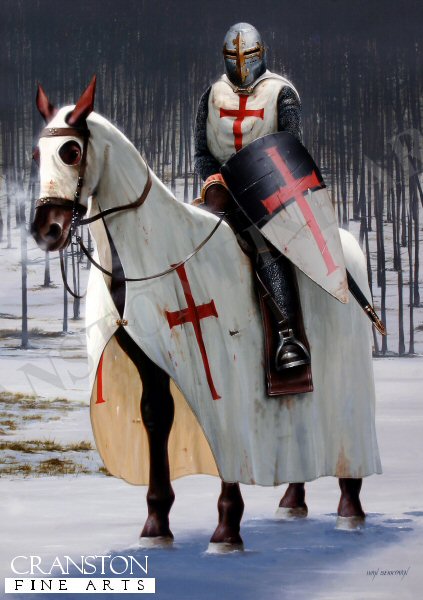
Non Nobis Domine by Ivan Berryman A Knight Templar on horseback, his horse draped in the iconic heraldry of the order. Perhaps one of the most recognisable heraldic symbols of the time, the cross represented martyrdom and courage and was displayed proudly by all members of the Knights Templar. |
Investiture in York by Graham Turner King Richard III, Queen Anne and their son Edward, emerge from the gothic grandeur of York Minster on the occasion of Edwards Investiture as Prince of Wales on the 8th September 1483. |
Death of Brian Boru - Clontarf by David Pentland. At the moment of the crowning triumph of his career, Brian Boru, the high king of Ireland is struck down after a final desperate attack by one of his enemies. |
Charge of the French Cavalry, Battle of Crecy by Harry Payne. Battle of Crecy. One of the battles fought during the Hundred Years War, on 26th August 1346. On 12th July Edward III landed in Normandy with his army and marching north plundered the countryside. King Philip VI assembled an army to stop Edward and tracked them across the Somme River. When Edward reached Crecy he stopped and ordered his army to take up defensive positions. King Philip surveyed the English positions and decided to postpone his attack until August 27th. However, the French vanguard pressed forward too far and so committed the entire army to the battle. The hired Genoese crossbowmen began the assault but came under severe attack from the English longbows and so fled to the rear. King Philip then ordered his cavalry to charge resulting in a huge loss of horse and man under the barrage of arrows which rained down on them. By the end of the night after several unsuccessful assaults the French army was reduced by a third and King John of Luxemburg was dead. Edward then turned towards Calais. |
The Black Prince Before the Battle of Crecy by Mark Churms. Battle of Crecy. One of the battles fought during the Hundred Years War, on 26th August 1346. On 12th July Edward III landed in Normandy with his army and marching north plundered the countryside. King Philip VI assembled an army to stop Edward and tracked them across the Somme River. When Edward reached Crecy he stopped and ordered his army to take up defensive positions. King Philip surveyed the English positions and decided to postpone his attack until August 27th. However, the French vanguard pressed forward too far and so committed the entire army to the battle. The hired Genoese crossbowmen began the assault but came under severe attack from the English longbows and so fled to the rear. King Philip then ordered his cavalry to charge resulting in a huge loss of horse and man under the barrage of arrows which rained down on them. By the end of the night after several unsuccessful assaults the French army was reduced by a third and King John of Luxemburg was dead. Edward then turned towards Calais. |
Alfreds Galleys Attacking the Viking Dragon Ships, 897 by Harry Payne. (B) In 895, Alfred captured the Viking fleet on the Lea, and drove the Danes to Quatbridge, where he besieged their camp. By the Spring they had lost all heart and the great army scattered and disappeared. Alfred then built improved war-vessels to guard against marauding Danish galleys in the Channel and during the year 897 destroyed more than twenty pirate vessels. One fight is recorded between nine of Alfreds ships and six Danish off the Isle of Wight. . |
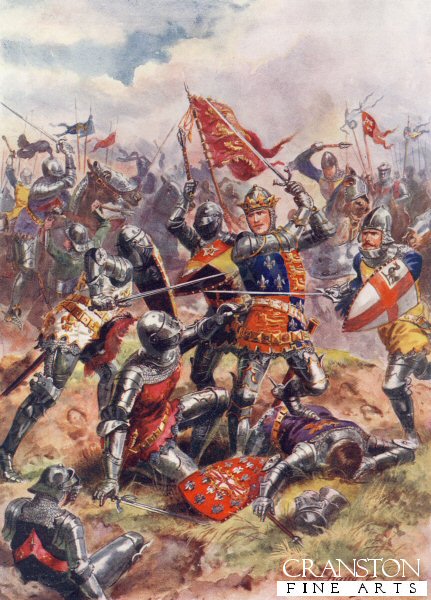
King Henry V Fights With Heroic Valour, Battle of Agincourt by Harry Payne. No text for this item |
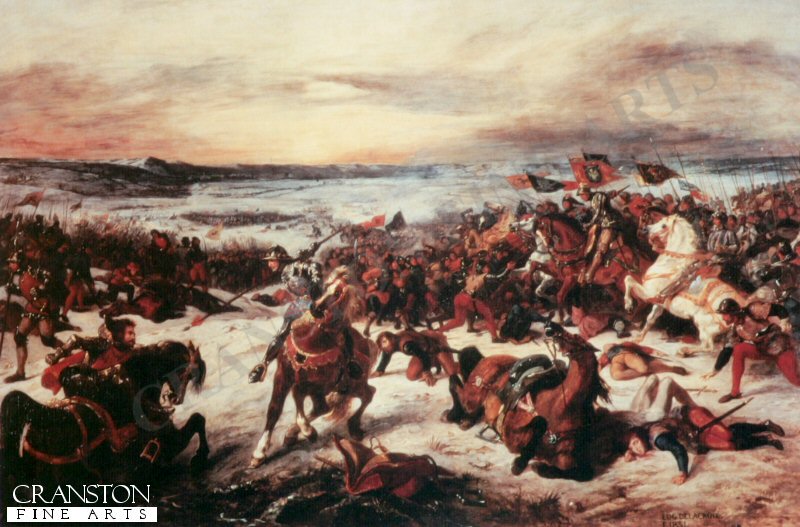
Death of Charles the Brave by Eugene Delecroix. At the battle of Nancy, 1477. Charles the Bold 1433-77. |
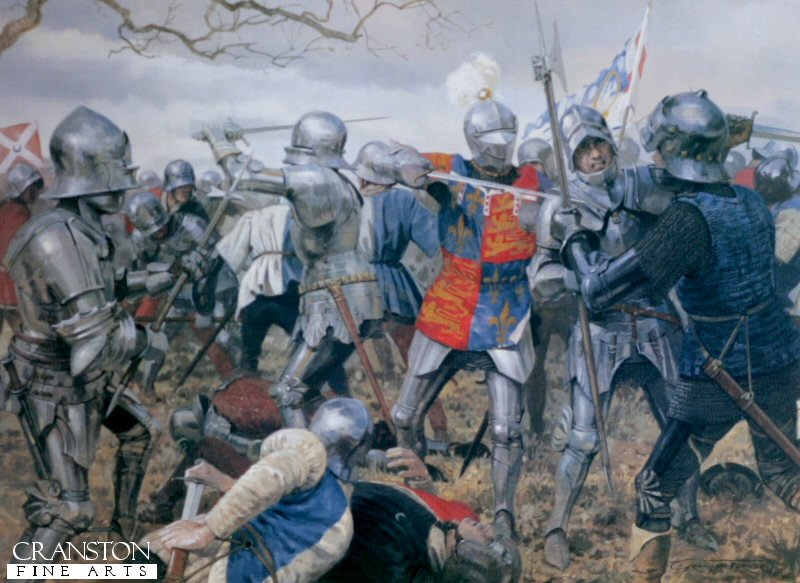
The Battle of Wakefield by Graham Turner On December 30th, 1460, the heirs of the Lancastrian Nobles killed at St. Albans found themselves able to avenge their fathers deaths when their army trapped the Duke of York and Earl of Salisbury in Sandal Castle, near Wakefield. Lured out from the safety of the castle walls and into open battle, Yorks heavily outnumbered force found themselves surrounded and in the fierce melee that followed, York and many of his followers lost their lives, his son, Edmund, amongst them. |
Loyal Subjects - The Battle of Northampton by Graham Turner. Edward, Earl of March, kneels before Henry VI and proclaims his loyalty, having defeated the Royal army at Northampton on 10th July 1460. The Earl of Warwick and Yorkist troops look on, while one of the guns that failed to fire in the rain stands impotently in the foreground. |
The Revolt of Owain Glyndwr. The Battle of Pilleth 22 June 1402 by Brian Palmer. In 1401 Owain Glyndwr began a campaign for Welsh independence. He was crowned Prince of Wales at Carrog on the banks of the Dee and set up a parliament at Machynlleth. In 1402 Edmund Mortimer, Lord of Wigmore, who had been sent by Henry IV to put down the revolt, met the Welsh at Pilleth on Bryn Glas Hill. Owains army totally destroyed the English forces and captured Mortimer, who threw in his lot with Owain, eventually marrying his daughter. The Welsh revolt continued for several years under Owain and although it was finally suppressed, Owain evaded capture, disappearing into the mists of history and welsh legend. |
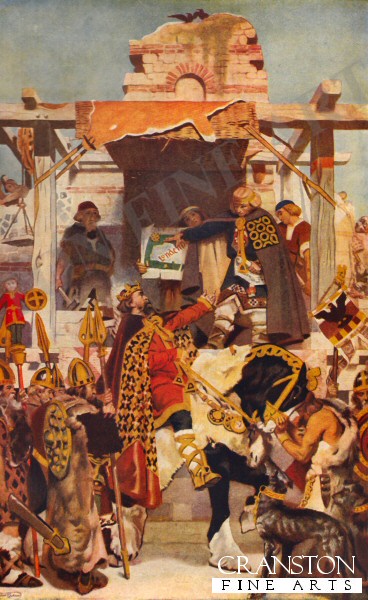
Alfred Rebuilding the Walls of London by F.O Salisbury. (B) In 866 Alfred besieged London and afer considerable fighting gained possession of the city, which had hitherto been in the hands of the Danes. He then rebuilt and fortified it, planted it with military settlers and appointed Ethelred Ealdorman of Mercia as its governor. |
The Homecoming by Ivan Berryman. Professionally produced using a high quality inkjet digital press and printed on 300gsm art stock. |
Norse Marauders Wreak Mayhem by Tom Lovell. At Clonmacnoise, most celebrated of Irish monasteries. Scorning the cross, Pagans hack holy men to death, defile sanctuaries, rob golden objects that made churches the treasures of medieval Europe. Swift assault lets few reach haven in the round tower, its entry accessible only by ladder. |
King Edward II's Retreat from Bannockburn by Jason Askew. Knowing that the battle of Bannockburn was lost, the Earl of Pembroke and Sir Giles d'Argentan led King Edward the 2nd from the field in much haste. King Edward and his bodyguard had to fight their way through the Scots, who barred their escape. King Edward had one horse killed under him, and only the heroic resistance of the earl of Pembroke's bodyguard prevented the Scots from capturing the English King. |
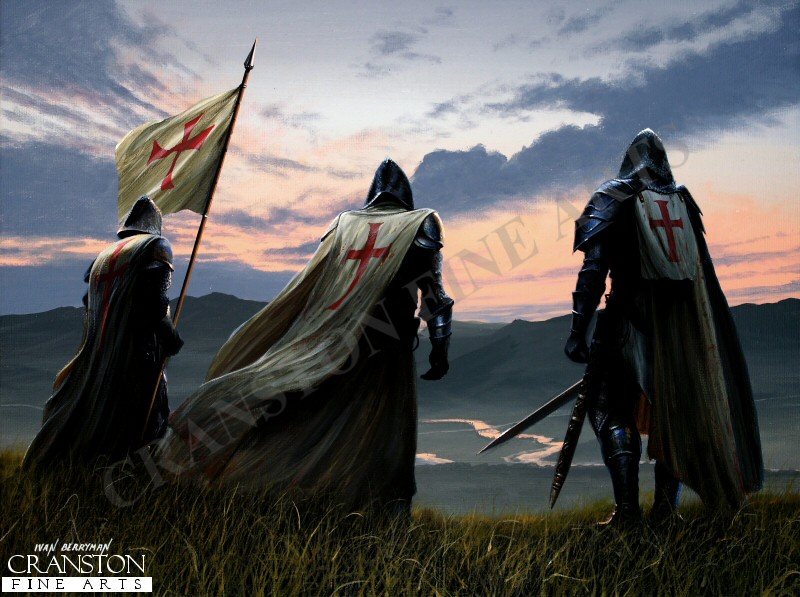
Unholy Land by Ivan Berryman. The Knights Templar, clad in distinctive white mantles adorned with red crosses. These skilled warriors protected Christian pilgrims across the Holy Land and were one of the most powerful military assets during the crusades. |
Battle of Hastings by Brian Palmer. The Battle of Hastings: While King Harold II was defeating the Norse invasion at the battle of Stamford Bridge in the north, the Norman invasion led by the Norman Duke William landed in the south. A Norman force of 7,000 warriors sailed across the English Channel in 450 flat boats and landed at Pevensey in Sussex on September 28th. The following two weeks saw the Norman army organising and raiding the local area for supplies. On hearing of the invasion, King Harold marched south from York to London, a distance of 200 miles, in seven days. And on October 13th with his army of 7,000 men took up position on Senlac Hill, 8 miles north of Hastings. Harold took this position as this was the direct route for London. The following day, the Normans attacked the village (which is now the town of Battle). The Battle of Hastings was a battle between King Harolds infantry and the Norman cavalry and archers. The Saxon line threw back the first charge of Norman knights and as the knights began retiring, the Saxons began to pursue the cavalry but a counter attack by Williams disciplined knights cut down the Saxon infantry. King Harold reformed his line before the second Norman cavalry attack was launched. For many hours King Harolds Saxon infantry held their ground against the repeated cavalry charges, both sides suffered heavy losses. As the evening progressed the battle turned the Normans way, William feigned a withdrawal of his cavalry, the Saxon infantry again could not resist to break ranks and pursue the cavalry. Halfway down the hill Williams knights turned and charged the Saxon infantry. King Harold at this time was mortally wounded from an arrow in the eye and the victory was won by the Normans. Each side lost a quarter of their men and during the fighting William the Conqueror had three horses killed under him. Later he ordered the building of Battle Abbey on the battlefield. The way was clear to London and William the Conqueror was crowned King of England on Christmas day at Westminster Abbey. |
The Battle of Bannockburn by Brian Palmer. Robert the Bruces Scots army stand fast as the English knights attack. Robert the Bruce succeeds in defeating the English army at Stirling. With the full might of Englands army gathered before the besieged Stirling Castle, Edward II Plantagenate is confident of victory. To the west of Bannockburn, Robert Bruce, King of Scots, kneels to pray with his men and commends his soul to God. Patiently awaiting the coming onslaught in tightly packed schiltroms, his spearmen and archers are well prepared for battle. Unknown to the English, the open marsh of no mans land conceals hidden pits and calthrops, major obstacles for any mounted charge. Despite Cliffords and Beaumonts premature and unsuccessful attempt to relieve Stirling the day before, years of victory have caused the brave English knights to regard their Scottish foes with contempt. So, without waiting for the flower of the forest (archers) to weaken the enemy formations, the order is hurriedly given to attack! With one rush, hundreds of mounted knights led by the impetuous Earl of Gloucester, thunder headlong through the boggy ground straight for the impenetrable mass of spears, hurling themselves into defeat and death. With dash and courage the knights try to force a way through but the infantry stand firm. There is no room to manoeuvre. Everywhere horses and men crash to the ground. Casualties amongst the English nobility are horrific. Bruce seizes the moment and orders the exultant army to advance. The English recoil and are pushed back into the waters of the Bannockburn where many perish in the crush to escape the deadly melee. Edward II, his army destroyed, flees with his bodyguard for the safety of the castle but is refused refuge and has to fight his way south to England. For Robert Bruce and Scotland, victory is complete. |
| Navigation | |
| Page 4 of 8 | Previous .. Page 4 .. Next |
|
Contact Details |
|
Sign Up To Our Newsletter!
This website is owned by Cranston Fine Arts. Torwood House, Torwoodhill Road, Rhu, Helensburgh, Scotland, G848LE Contact: Tel: (+44) (0) 1436 820269. Email: cranstonorders -at- outlook.com |
 |