|
|
|
|
|
|
|
|
 |
 |
 |
 |
 |
 |
 |
 |
 |
 |
 |
 |
 |
 |
|
MEDIEVAL ERA MILITARY PRINTS SECTION
YOU ARE VIEWING: MILITARY PRINTS --> MEDIEVAL ERA MILITARY PRINTS
| Navigation | |
| Page 5 of 8 | Previous .. Page 5 .. Next |
| Military Art Collecton - Medieval |
|
|
|
|
|
|
|
|
|
|
|
|
|
|
|
|
|
|
|
|
|
| Navigation | |
| Page 5 of 8 | Previous .. Page 5 .. Next |
| Text for the above items : |
With Banners Bravely Spread by Sir John Gilbert. No text for this item |
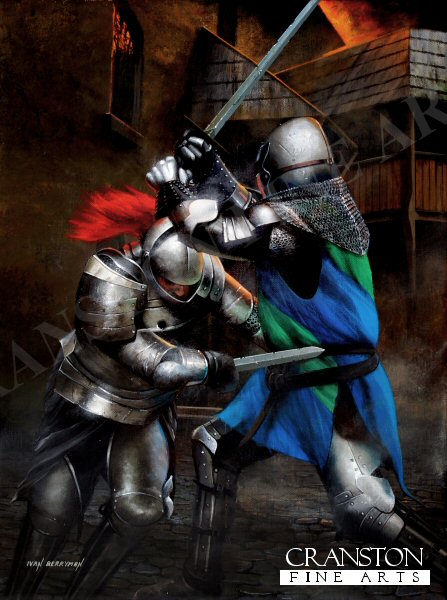
To the Death by Ivan Berryman. No text for this item |
Charles the First at Edgehill by Sir Edwin Landseer. The king and his staff finalise their battle plan before the first major engagement of the English Civil War. |
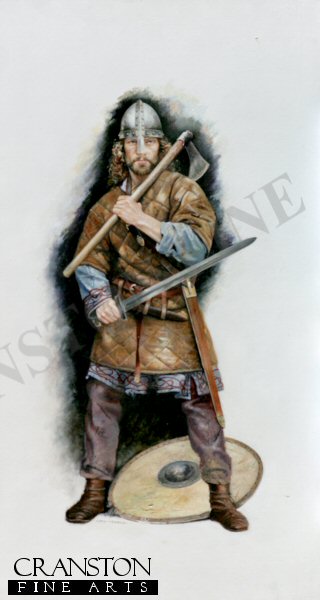
The Viking Hersir by Chris Collingwood. No text for this item |
England Welcomes Henry V by Robert Hillingford. No text for this item |
The Battle of Loudon Hill 1296 by Mike Shaw. In 1296 an English convoy escorting a shipment of looted gold was passing through the Irvine valley to the port of Ayr. It was led by an English Knight by the name of Fenwick, who in 1291 had killed the father of William Wallace, Sir Malcolm. Wallace, who was fighting a guerilla war on the English invaders, planned an attack at Loudon Hill where the road on which Fenwicks convoy was travelling had to pass through a steep gorge. Wallace had about fifty men and Fenwick close to one hundred and eighty. The Scots blocked the road with debris and attacked on foot. The English charged, but the Scots held firm. Fenwick armed with a spear, turned his horse in the direction of Wallace, who in turn felled Fenwicks horse with his claymore. The unhorsed Englishman was no match on the ground where he, along with one hundred of his convoy, met their deaths. |
Battle of Bosworth by Brian Palmer. In 1485, the Lancastrian contender for the throne of England, Henry Tudor, sailed from France with a small force of mainly continental mercenaries determined to wrestle the crown from Richard III. Gathering many supporters along the way he eventually arrived at Bosworth with an army numbering 5000 against Richards 8000. Things began well enough for Richard but it became apparent during the battle that the neutral Stanley Brothers, Sir William Stanley and Lord Thomas Stanley and their men who had remained on the sidelines, had elected to fight for Henry. Richard charged for Henry in person but was overwhelmed and killed. He was the last English King to die in battle. Although not the final battle of the War of the Roses, the victory for Henry at Bosworth secured the crown and began the Tudor dynasty. |
William Wallace Before the Battle of Stirling Bridge by Mark Churms. With Edward I absent from Scotland the land soon slips once more into open insurrection. Though not of noble birth, William Wallace, by brutally slaying the Sheriff of Lanark in vengeance for the murder of Wallaces new bride and her servants, soon comes to embody the Scottish Nationalist cause. Through his popularity and military skill, he is able to rapidly unify the rebellious bands into a single, cohesive fighting force. An English army is sent north to defeat the Scots and capture Wallace and the only noble to come to Wallaces assistance, is his friend Andrew Murray. Other Scottish landowners are too timid and fear the consequences. The armies meet at Stirling and the English begin to deploy across the narrow wooden bridge which spans the River Forth. Whilst the English commanders bicker about their battle plan, Wallace seizes the moment and blows his horn. Upon this signal, the massed ranks of Scottish spearmen charge forward across the open boggy ground towards the bridge! |
Fitz-Stephen Burns His Boats, 1169 by Richard Caton Woodville. (B) In Response to King Dermots solicitations, Strongbow sent Fitz-Stephen to Ireland with an advance guard while he completed his own preparations. The Normans landed near Wexford, were joined by Dermot and marched with him to storm the city. Being at first severely repulsed, Fitz-Stephen determined to leave himself no retreat, led his men to the shore, where they set fire to their transports. Upon their return the garrison displayed a flag of truce and Wexford was surrendered without further bloodshed. |
King Henry V at the Battle of Agincourt by Sir John Gilbert. Battle of Agincourt, October 25th 1415. Fought during the Hundred years war at the end of the English Invasion of 1415. King Henry the V of England, after his conquest of Harfleur marched his army of 1,000 Knights and 5,000 Archers (many of which were Welsh) towards Calais. He marched to Amiens as flooding had affected the river at the Somme which was the direct route. This delay helped the French army of 20,000 strong under the command of the Constable Charles dAlbret and Marshal Jean Bouciquaut II. The French army blocked Henry V route to Calais, giving the English no choice but to fight. Henry V positioned his army at Agincourt, between to wooded areas giving a frontage of 1100 metres. Henry deployed his force into three divisions; each group had archers at each flank. He had chosen his position well, in front of his army was ploughed fields and due to the heavy raid was very muddy. Due to the narrow battlefield area the French army lost their advantage of superior numbers. At 11 oclock the English started to advance their archers within 2509 yards of the French, getting them into range of the French lines. The French line of Cavalry advanced at a slow pass due to the heavy mud, They took heavy losses from the arrows from the English Long Bowman. They were eventually repulsed by the Archers who as the French cavalry approached changed from using longbows for axes and swords. The French second Cavalry line advanced only to be finally repulsed after hand to hand fighting. The commander Duc dAlencon was killed in the attack. The second charge had failed and many of the French knights were taken prisoner. Believing he had been attacked in the rear Henry V ordered that the prisoners were to be put to death. In fact There was no real rear attack it was French Camp followers plundering the English Camp. The French camp followers were quickly dealt with and the English again prepared itself for the next attack. The third attack never materialized as the sight of so much blood shed and piles of corpses turned the charge into a retreat. The English had won the day with losses less than 1600 compared to the French losses of over 7,000, including the capture of Bouciquaut. Henry V, his way now cleared reached Calais on the 16th November 1415. Agincourt is one of the great battles of military history, and this victory enabled Henry V to return to France in 1417 and conquer all of Normandy. |
Richard III by Chris Collingwood. Richard Duke of Gloucester (later Richard III), after the Battle of Tewkesbury, 4th May 1471. Banners are of Richard Duke of Gloucesters White Boar and Sir John Stafford Of Mordaunts (created Earl of Wiltshire by Edward IV) coat of arms. |
King Richard by Henry Cruse Murphy (PC) Renowned for his bravery and chivalric skills, King Richard led his crusades forces to several victories against Muslim armies including the siege and subsequent capturing of the city of Acre and his decisive victory against Saladin at the Battle of Arsuf. His life and legend have been romanticized in literature and popular culture, often depicting him as the epitome of the medieval warrior king. |
Fire from the Fens, c.1071 by Chris Collingwood. In the year 1070, Saxon England lay under Norman oppression. Only one last centre of resistance remained. The Isle of Ely in the Fenlands of East Anglia. Here, Hereward Leofricson, son of Earl Leofric and Lady Godiva, emerged as a warrior leader. Struggling against overwhelming odds in his defiance of the Normans. The legend of Hereward the Wake was born. |
William the Conquerer by Ivan Berryman William the Conqueror, a formidable Norman duke with an iron will, crossed the Channel in 1066, launching his invasion of England. The crown was seized after the Battle of Hastings, with the death of Harold II on the battlefield signalling the dawn of a new age for England, one marked with many troubles as William would wage a constant conquest against English revolts and face a life-long struggle to consolidate his hold over the country. |
The Last Knight by Ivan Berryman. No text for this item |
Richard the Lionheart by Brian Palmer. Richard the Lionhearts tactical skills and military training played a substantial role in the capture of Acre in 1191 by the Crusaders. But Richard the Lionheart was ruthless and after the capture of the city he marched 2,700 Muslim soldiers onto the road of Nazareth and in front of the Muslim army positions, had them executed one by one. But Richard the Lionheart was up against a great leader in Saladin and the crusades did not always go his way. After he negotiated the Treaty of Jaffa with Saladin and secured the granting of special rights of travel around Palestine and in Jerusalem for Christian pilgrims, Richard the Lionheart started his journey back to England in 1192. He was shipwrecked, and captured by the German Emperor Henry VI, only being released after a 150,000 mark ransom was paid. This money was raised by taxes in England. |
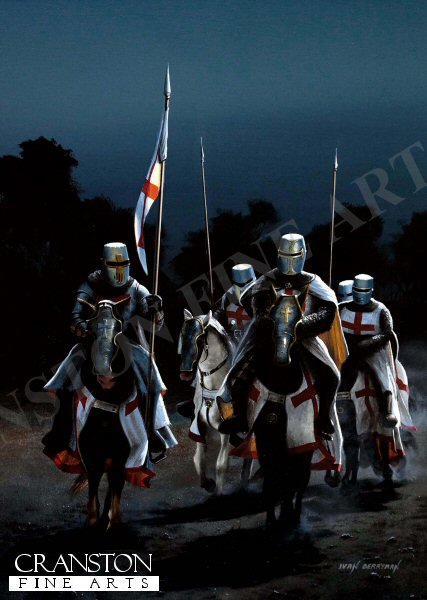
God's Work by Ivan Berryman. A key stratagem of the Knights Templar was the Squadron Charge in which a group of knights and their armoured warhorses would charge towards enemy lines at full speed. This displayed their ferocity and sheer determination and would often break a hole in enemy lines, allowing the tides of battle to change in favour of the Knights Templar forces. |
Silentium by Ivan Berryman. No text for this item |
Battle of Flodden 9th september 1513 by Brian Palmer. While King Henry VIII was invading France, King James IV of Scotland crossed the Tweed into Northern England with a Scots Army of 50,000. With the majority of the English army away in France, the defense of England was left to Thomas Howard Earl of Surrey with an army of 25,000 men. The murderous storm of arrows from the English longbow men cut though he Scottish Schiltrons (dense circles of Spearman). The English cavalry exploited this, cutting through the Scots infantry. this was followed by hand to hand fighting, with the English infantry slaughtering the surviving Scots. At the end of the battle King James IV was dead, along with most of the Scottish nobles. The battle was the last battle to be won by the longbow. |
A Viking Raid by Brian Palmer. No text for this item |
The Five by Ivan Berryman. No text for this item |
| Navigation | |
| Page 5 of 8 | Previous .. Page 5 .. Next |
|
Contact Details |
|
Sign Up To Our Newsletter!
This website is owned by Cranston Fine Arts. Torwood House, Torwoodhill Road, Rhu, Helensburgh, Scotland, G848LE Contact: Tel: (+44) (0) 1436 820269. Email: cranstonorders -at- outlook.com |
 |